CLICK IMAGE: Tanzil Website


OUR MISSION:
UNCOVERING the original message of the Arabic Qur'an by using Lexicons compiled more than 1,000 years ago.

ISOLATING Fact from Fiction.


RECOVERING Hope and regaining the perspective where Humanity is one, God's Message is one, and our Future CAN become one we all look forward to!


© 2010 IQRATHECHALLENGE: INTELLECTUAL PROPERTY PROTECTED BY D.M.C.A. ALL RIGHTS RESERVED.

© 2010 IQRATHECHALLENGE: INTELLECTUAL PROPERTY PROTECTED BY D.M.C.A. ALL RIGHTS RESERVED.
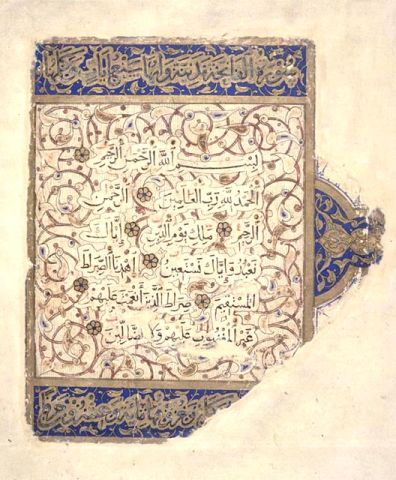
Image: 14th C. Qur'an, Mamluk origin, Library of Congress; Rights obtained.

A BREAKTHROUGH project which helps understand the Qur'an AS REVEALED -not just 'as explained.'

---------------------------------------------------------------------------

Thursday, January 7, 2010

Welcome Friends! Day 7; HQ 2: 84-93; pages 13+14.


Welcome Friends: Ahlan wa sahlan!


Your comments show that the central issue of yesterday’s posting is a real concern. We must look upon the Qur’anic verses as living lessons for us all, and benefit from them, especially when we see around us the very actions that the Qur’an denounces, leading us to the exact consequences it warns of.

As Muslims, we cannot say that God did not warn us of the real life consequences. As Arabs, we cannot say we did not understand.

And now, back to our text:

COMMENTS:


1. “….Do you then believe in some parts of the Divine writ and deny the truth of others..?

Humiliation and contempt IN LIFE are the consequences to such action and inaction, while on the Day of Resurrection comes the suffering most grievous. In applying this to ourselves we might understand that our present state is simply a consequence.

2. “And yet it is you who slay one another and drive some of your own people from their homeland…” History tells us that there were 2 opposing idol-worshipping Arab tribes and 3 Jewish tribes living in Yathrib (Medina) prior to Prophet Muhammad’s emigration there, peace upon him. These verses are addressed to the 3 Jewish tribes who had taken opposite sides in battle (allying themselves to opposing Arab tribes), and were therefore flagrantly inconsistent in upholding their religious Laws, unlawfully killing each other at one point, then paying each other the blood-money due according to their Law.
To see several side by side translations (Asad’s included, as well as Arabic text; Commentary is by Yusuf Ali) go to: http://www.islamitexts.org/?noar=&t=9&k=2%3A84

3. Verse 86 gives us a perspective many of us may have never thought of:
Isn’t it a sorry exchange indeed, to buy the ‘life in proximity’ (literal translation of ‘al hayat aldunya - الحياة الدنيا’* the life closest to you at this point) at the price of The Ultimate? The Ultimate Life is our final, everlasting existence, while this life is paltry in comparison (also see HQ: 6:32, 9:38).

4. Jesus, son of Mary, is mentioned in verse 87, peace upon him. He was strengthened with ‘Roohul Quds’ translated as ‘Holy Inspiration (M. Asad), or ‘the Holy Spirit’ (Y. Ali). Most scholars believe this refers to Angel Gabriel.

5. We find these verses discussing transgressions such as worshipping the calf, arrogance, not following God’s Messengers due to pride in their own learning on one hand, while killing these Messengers- which is what their Holy Book forbids- on the other. Asad explains how they do that, “all their beliefs are centered on themselves and their alleged ‘exceptional status’ in the sight of God” (footnote 74).

6. Verse 93 is similar to verse 63, in that it is about the solemn pledge (‘meethaaq,’ which Yusuf Ali translates as Covenant), given to God as they were threatened with the mountain above their heads. The mountain is not specified here, but is mentioned simply as ‘the mountain.’ Ali keeps the word (Sinai) between brackets, while Asad puts it in the body of his translation. The word Sinai appears only once in HQ: 23:20, while a similar word (Seeneen) appearing in HQ: 95:2. To keep the translation as close to the original as possible, I would prefer not to mention ‘Sinai’ in this instance.


Enough said!

Our reading for tomorrow is from verse 94-105.

Peace unto all!

----------------------------------------------

دني: المقارَبَة. ومن ذلك الدّنِيُّ، وهو القَريب، مِن دنا يدنُو. وسُمِّيت الدُّنيا لدنوّها.*

Wednesday, January 6, 2010

Welcome Friends! Day 6; HQ 2: 70-83; pages 11+12.


Welcome Friends: Ahlan wa sahlan!

How do you feel, now that you've tried to fit this in with your daily activities?

Frankly, the responsibility of posting -on a daily basis- IS an intimidating challenge of its own, but I'm enjoying it so far, hoping and praying for the best.

I say, if Julie did it, then there's no reason why we can't. So, let's get cooking!


COMMENTS:

  1. We continue to look upon these verses as a living lesson for us all, not simply an admonition to a bygone people. Yusuf Ali says in his footnote no.75, that the moral of these verses goes wider than the Children of Israel, applying to all nations, especially if they are stiff-necked.
    In the past 2 days' readings, the Qur'an gave us an account of Moses' trial with his people, a trial which continues in today's reading. His people kept asking for more details regarding the cow they were supposed to sacrifice, while any cow would have done- HAD they not asked.


  2. In Verse 73 there is great disparity between traditional explanations and Asad's, who thinks it unlikely that the murdered person rose from the dead to name his killer. Yusuf Ali, on the other hand, translates without commenting, but seems inclined toward the traditional explanation.

    I have no problems with either interpretation, especially since other verses DO mention people being brought back to life. Furthermore, this is 'gheyb,' part of the unseen past, and will not have any bearing on my faith or knowledge… however:

    What I'd like to mention here, is Asad's analysis on the usage and application of the verb 'da ra ba' in the Arabic language, a verb we will be discussing when it appears in important verses in our future readings:

    "..the verb daraba (lit.,"he struck") is very often used in a figurative or metonymic sense, as, for instance, in the expression daraba fi 'l-ard ("he journeyed on earth"), or daraba 'sh-shay' bi'sh-shay' ("he mixed one thing with another thing"), or daraba mathal ("he coined a similitude" or "propounded a parable" or "gave an illustration"), or `ala darb wahid ("similarly applied" or "in the same manner"), or duribat `alayhim adh-dhillah ("humiliation was imposed on them" or "applied to them"), and so forth."


  3. Verse 74 tells us that hearts/minds can become harder than rocks, for even rocks do crack and allow water to flow through. But what is it that caused THESE people's hearts/minds to harden? Another verse (HQ:5:13) tells us it's their breaking of solemn pledges made to God, and his subsequent rejection of them:

    "Then, for having broken their solemn pledge, We rejected them and caused their hearts to harden-[so that now] they distort the meaning of the [re-vealed] words, taking them out of their context; and they have forgotten much of what they had been told to bear in mind; and from all but a few of them thou wilt always experience treachery. But pardon them, and forbear: verily, God loves the doers of good. (13)


  4. It is interesting to read what Asad says in his commentary on Verse 80 about Jewish belief, especially that which relates to their perception of themselves being the 'Chosen People' (footnote no. 64).


  5. Verses 83+84 mention the Covenant God took from the Children of Israel, one similar to what we ALL are responsible for, as we shall see in HQ: 4:36.


  6. Finally, there is a valid question we must ask ourselves upon reading this segment and applying it as a living lesson to ourselves:

    In what ways do WE complicate our own lives while blaming it on our faith?

    If a law is given in general terms, one could either follow that law, or ask for (and generate) further details, making it incumbent upon oneself to comply with them all.

    The Qur'an does tell the companions of Prophet Muhammad, peace upon him, NOT to ask about issues until revelation is completed, for by then all will be made apparent to them (HQ:5:101).

    Muhammad Asad believes that the importance of this issue is illustrated by the choice of "The Cow" as title for this chapter. Here is an excerpt from what he sees as the moral of the story (footnote no.55):

    "It would appear that the moral of this story points to an important problem of all (and, therefore, also of Islamic) religious jurisprudence: namely, the inadvisability of trying to elicit additional details in respect of any religious law that had originally been given in general terms-for, the more numerous and multiform such details become, the more complicated and rigid becomes the law."


Enough said!


Our reading for tomorrow is from verse 84-93.


Peace unto all!

Let's TWEET this!

Tweet me!