CLICK IMAGE: Tanzil Website


OUR MISSION:
UNCOVERING the original message of the Arabic Qur'an by using Lexicons compiled more than 1,000 years ago.

ISOLATING Fact from Fiction.


RECOVERING Hope and regaining the perspective where Humanity is one, God's Message is one, and our Future CAN become one we all look forward to!


© 2010 IQRATHECHALLENGE: INTELLECTUAL PROPERTY PROTECTED BY D.M.C.A. ALL RIGHTS RESERVED.

© 2010 IQRATHECHALLENGE: INTELLECTUAL PROPERTY PROTECTED BY D.M.C.A. ALL RIGHTS RESERVED.
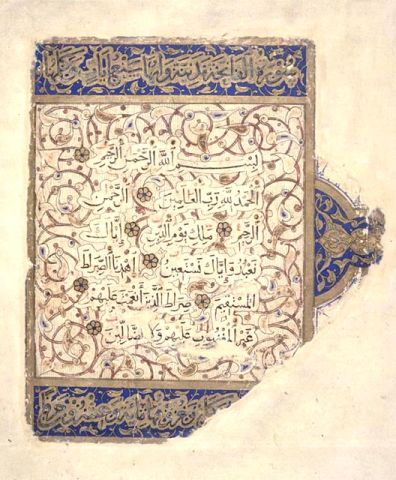
Image: 14th C. Qur'an, Mamluk origin, Library of Congress; Rights obtained.

A BREAKTHROUGH project which helps understand the Qur'an AS REVEALED -not just 'as explained.'

---------------------------------------------------------------------------

Tuesday, February 9, 2010

Day 35; HQ 3:149-157; pages 69+70


Welcome Friends:  Ahlan wa sahlan!
It’s a good idea to read up on the history (see right side-bar addition about the Battle of Uhud).

COMMENTS:

1.     In verses 149-151, just as Those who attained Faith were previously warned against obeying the People of the (earlier) Compilation (HQ3:100), here they are warned against obeying the Deniers, and the verses are clear in that, if they did, they would in fact be transformed into Losers.  HOWEVER (‘bal’ meaning: but rather) God is your Protector and He is The Best of Supporters/Patrons.  The Qur’an clearly warns the Deniers that their denial of God and their associating of other deities with Him will bring much fear and alarm into their hearts/minds.

2.     In Verses 152-154 the Qur’an recounts how God fulfilled His promise to those who attained Faith (that they would gain the upper hand), right up to the point when 40 out of 50 archers changed the course of battle by failing their comrades, disputing about the matter, and violating their command.  Then the verses quite picturesquely describe the battle-ground as well as the deepest sentiments of those soldiers who had made an error in judgment; an error with monumental repercussions.
The regret they felt was but an outcome they had brought on themselves; their brothers who were killed defending their posts were yearning for the Hereafter whereas they (now shamefully defeated) had yearned after the spoils of war … but not anymore.  Having fully appraised what they had done, they had begun to seriously suffer the psychological and physical results. But then, Verse 152 ends on a note of Forgiveness!

 
3.     We have often heard of the dangers of stress, but perhaps we do not realize its seriousness.  In his book ‘Ageless Body, Timeless Mind,’ Dr. Deepak Chopra explains that, although humans can withstand extraordinary stress …

…” if we are pushed too far, our stress response turns on our own bodies and begins to create breakdowns both mentally and physically. In war, which is a state of extremely heightened, continual stress, every frontline soldier will eventually go into shell shock or battle fatigue if kept under fire too long; both syndromes are signs from the body that it is exceeding its own coping mechanisms. 
Whenever you experience a stress, there are three phases to your response: (I) the stressful event; (2) your inner appraisal of it; (3) your body's reaction.

What makes the stress response so difficult to handle is that once it begins, the mind has no control over it.

Most of the time, your cells are occupied with renewal- roughly 90 percent of a cell's energy normally goes to building new proteins and manufacturing new DNA and RNA.  When the brain perceives threat, however, the process of building is set aside.  Whatever you decide to do in fight-or-flight situations, your body needs a massive burst of energy to propel your muscles.
 
To allow this, the normal style of metabolism that builds the body, called anabolic metabolism, converts to its opposite, catabolic metabolism, which breaks down tissues.

…As a temporary expedient, the stress response is vital, but if it is not terminated in time, the effects of catabolic metabolism are disastrous.*”

4.     Perhaps we now understand why God, in His Mercy, let descend upon the best of them the soothing mantle of slumber (أمَنة نعاساً), to be their refuge from insurmountable guilt and sorrow.  Their well-being depended on it*- so he brought it down upon them.  Sleep is indeed a wonderful refuge for the weary and the worried!
As for those who had doubted God, they had no slumber induced upon them.  They naturally remained alert, wondering why they had put themselves in the path of danger to start with.

This should also help us understand better the Verse of Dominion/Knowledge 'Ayatul Kursi' with its statement: God, there is no deity save Him, The Ever-Living, Self-Subsistent Fount of All Being, neither slumber overtakes Him nor sleep..."
He IS as He Is, The Fount of all Being- and that is all we need to know!

5.     The beauty of these verses (as many others in the Qur’an) is that they publicize the inner feelings and thoughts of someone who would much rather have had them remain private.  Just think of finding the Qur’an expose our thoughts like that!  People sometimes say, “I wish I’d lived during the Prophet’s time …” without realizing what responsibility that entails, or whether or not they would have been among his best supporters, peace upon him.

We are extremely blessed to be where we are right now, healthy enough, comfortable enough, educated enough, technologically advanced enough, to be reading this explanation of God’s words at our leisure!  How many people can say that?

6.     Verse 155 tells the Faithful that indeed, it was the Deviant (Shaytan) who caused them to stumble because of something they had earned before that on their own, and assures them that God has erased their misdeed.  M. Asad’s note 117 summarizes the Qur’anic doctrine of ‘Satan’s influence,’ that it is NOT the cause of a misdeed but the first consequence of a person’s attitude of mind in a moral crisis; ie one is first guilty by commission or omission, and then trips into the wrongdoing.  They freely chose their course of action.

God-willing, we’ll try to discuss the many Arabic words(إثم -سيئة -ذنب -خطأ-خطيئة -معصية) which are usually translated as‘sin’ in English, as well as the different words (عفو-مغفرة -تكفير -تجاوز) which are usually translated as ‘forgiveness.’  Arabic is a RICH language, and it is amazing how different these words actually are!

7.     In Verses 156-157, the Faithful are told not to say the words ‘If only...’ as related to brethren who had died.  It is God Who gives Life and Death.  Yusuf Ali’s note 469 lays out his reading of the verse.

Enough said!


Our next Reading is from HQ 3:158-173.

Peace unto all!
* Excerpted from pages 150-153: Chapter: ‘The Invisible Threat.’
*Sleep renewal, or anabolism, is at its maximum during sleep when protein synthesis helps form new cells (such as skin cells) and replaces the constituents of others (such as brain cells).

Monday, February 8, 2010

Day 34; HQ 3:133-148; pages 67+68

Welcome Friends:  Ahlan wa sahlan!
We must bear in mind that many of these verses continue to relate to the Battle of Uhud, which we spoke of in our last reading.  For readers who desire to read about this period of history, an excellent book, perhaps the best written in English is:

Muhammad: his life based on the earliest sources’ by Martin Lings.

COMMENTS:

1.     Our Reading begins with highly motivational words, similar to what we might feel today if someone urges us on saying: “Go-GO-GO!”
Continuing to address those who attained to Faith (having begun in HQ3:130), the Qur’an says:

“AND HASTEN/advance towards forgiveness from your Lord and a garden, the vastness thereof is (as) the Heavens and the Earth, prepared for the Aware!”

This calls upon us to ‘hurry,’ to ‘rush forward,’ advancing together, towards all good deeds, as if there is no tomorrow!  (We read something similar a few days earlier, in HQ3:115, describing some amongst People of the (earlier) Compilation who were doing just that.)

The Arabic word ‘saari’oo (سارعوا) calls upon those who have attained Faith in the third command given them here.  This concept of advancing quickly as a group, also appears as a race in the words ‘saabiqoo’ (سابقوا), to ‘race each other’ forward (HQ57:21).  The result of such a race is ‘outrunning’ everyone else, making headway till we arrive at our prized destination, explained in the beautiful verses of HQ23:61 (which, God-willing, we’ll be doing together later).
Some commentators have explained this verse as, “and a garden the display thereof is (as) the Heavens and the Earth, taking (‘ard)- (عرض) to mean ‘display,’ as in (2:31).  Yusuf Ali says ‘…a garden whose width…’ Muhammad Asad says “…and to a paradise as vast..”

2.     After telling us that Paradise is readied for ‘the Aware’ (Y. Ali: the Righteous/M. Asad: the God-Conscious) the next three verses 3:134-136 provide their characteristics and confirm their ‘status’:

·        In their unfailing generosity.
·        In their restraint of anger.
·        In their forgiveness others.
·        In their promptness to self-reproach, self-correct, and seek forgiveness.

The bounteous reward they are granted is for having been ‘those who work (and strive)’ (Yusuf Ali); ‘those who labor’ (Muhammad Asad).
When we read their characteristics we realize that it is indeed laborious to keep up that level of self-control and awareness.  They were indeed ‘Strivers’ in life, but after arriving at their destination (once they are done striving) perhaps we should call them: ‘Achievers.’
Beautiful verses!

3.      Verse 137: “Many were the ways of life that have passed away before you: travel the earth and see what was the end of those who rejected Truth” (Y. Ali).  We are often told to travel the earth in observation, and especially to see the consequence of rejecting Truth; ‘kath-thaba’ means to belie, or contradict a truth (HQ6:11; 16:36).  Read M. Asad’s note 98 explaining ‘sunna’- way of life.
Verse 138 states emphatically that THIS IS…(meaning the Qur’an) a clear lesson unto Mankind, and an admonition to the Aware. 
I prefer Asad’s translation.  It is closer to the original to call the Aware ‘God-conscious’ than those ‘who fear God.’  For the sake of accuracy however, we should note that both have added the word ‘God’ where the word in Arabic does not exist.  There are other verses which DO say ‘conscious of God’ as in (تقوى الله) so we should differentiate to show the distinction.

4.     I prefer Yusuf Ali’s translation of Verse 139.  M. Asad simply says ‘you are bound to rise high,’ while the Qur’an say ‘the Highest.’
What a promise given by God, what a goal to live up to: Being uppermost, prevailing over all obstacles and whatever might seek to put one down... but there is a catch: IF:

“So lose not heart nor fall into despair:
For you must gain mastery if you are true in Faith.”

5.     Verses 140-143 are a balm, a solace to Believers in distress.  All humans taste pain and affliction, and it is in the nature of earthly existence that fortune changes hands. 
Life is but a test so that God may mark out, or set apart, those who have faith.  
M. Asad’s interpretation of the verb ‘allama’ as ‘mark out’ is accurate (see علم  below.*) 
Many people have fretted over interpreting ‘liya’lama’ as ‘so that God would know,’ which of course is not correct since God’s Knowledge encompasses all.  Many do not realize that it is also linguistically inaccurate because the meaning of the word (’allama) is originally related to making a ‘mark.’  (Teachers in Arabic-speaking schools give the students their marks (grades) called ‘alaamah (s), ‘alaamaat (pl)علامة-علامات .)  The word “ya’lam”   يعلم has come to mean ‘to know’ because when we know something it becomes ‘marked’ or distinctive to us.  Realizing this is very important in our understanding of many verses in the Qur’an, prominent among them is chapter 96.  
For historical background of this verse, read Asad’s note 103.

6.     Verse 144 relates to the rumor that spread over the Uhud battle-ground that Prophet Muhammad, peace upon him, had been killed.  The Believers are told that, even if that had been true, Muhammad is no  more than a Messenger preceded by the Messengers before him ( (خلت من قبله الرسل, and that they should not retreat.
Verse 145 is a statement regarding Death and Recompense.  In accurate linguistic translation it begins as follows:
 
“It is not for any ‘Self’ (nafs) to die except by God’s leave, a compilation (kitaab) in due course……..”

The word ‘Kitaab,’ as we know, means a ‘compilation.’  The word ‘ajal’ means ‘term,’ and its derivation ‘mu’ajjal’ means ‘in due course, eventually.*’
  
In this instance, the fact that Death is called a ‘kitaab mu’ajjal’ indicates a compiled set of circumstances that have to come together in due course for Death to occur.
 
Yusuf Ali’s ‘term as if fixed by writing’ and Asa’d ‘term pre-ordained’ may be common interpretations, but understanding the Qur’an in its original Arabic is so much more scientific!

The rest of the verse discusses recompense; we get the return for our deeds wherever we desire it, and God rewards the ‘shaakireen.’  
M. Asad translates it as ‘grateful,’ Y. Ali says ‘those that serve us with gratitude..’  Linguistically however, it is: those who are PRODUCTIVE… from Posting Jan 13th: “..those who make full use of His favors by working with, and multiplying, them. ‘Shukr’ means accepting what is little and making the most of it until it achieves abundance” (see full definition).


7.     Verses 146-148 report to the Prophet and his companions the trials and tribulations of previous Prophets and Devotees of God, peace upon them all, to strengthen their resolve, and then relays to them their beautiful prayer in the time of utmost danger and need. 
So God gave them all they had asked for, with a reward in the Present Life and the best of rewards in the Hereafter, for God loves those who do Good.
These are lessons for us today, and prayers for us to learn (in Arabic).  No prayer is more beautiful than a Qur’anic prayer in God’s own words!

Enough said!

Our next Reading is from HQ 3:149-157.

Peace unto all!

*أجل: فالأَجَل غاية الوقت في مَحَلِّ الدَّين وغيره. وقد صرّفه الخليلُ فقال أَجِل هذا الشّيءُ وهو يَأْجَلُ، والاسم الآجِل نقيض العاجل والأجيل المُرْجأ، أي المؤخَّر إلى وقتٍ.

*علم: يدلُّ على أثَرٍ بالشيء يتميَّزُ به عن غيره. من ذلك العَلامة، والعَلَم: الراية، والجمع أعلام. والعلم: الجَبَل،
وكلُّ شيءٍ يكون مَعْلَماً: خلاف المَجْهَل. والعِلْم: نقيض الجهل، وقياسه قياس العَلَم والعلامة، وتعلّمت الشَّيءَ، إذا أخذت علمَه.
ومن الباب العالَمُون، وذلك أنّ كلَّ جنسٍ من الخَلْق فهو في نفسه مَعْلَم وعَلَم. وقال قوم: العالَم سمِّي لاجتماعه.
 قال الله تعالى: {وَالْحَمْدُ للهِ رَبِّ الْعَالَمِينَ، قالوا: الخلائق أجمعون… وذلك أنّهم يسمون العَيْلم، فيقال إنّه البحر.

Let's TWEET this!

Tweet me!