CLICK IMAGE: Tanzil Website


OUR MISSION:
UNCOVERING the original message of the Arabic Qur'an by using Lexicons compiled more than 1,000 years ago.

ISOLATING Fact from Fiction.


RECOVERING Hope and regaining the perspective where Humanity is one, God's Message is one, and our Future CAN become one we all look forward to!


© 2010 IQRATHECHALLENGE: INTELLECTUAL PROPERTY PROTECTED BY D.M.C.A. ALL RIGHTS RESERVED.

© 2010 IQRATHECHALLENGE: INTELLECTUAL PROPERTY PROTECTED BY D.M.C.A. ALL RIGHTS RESERVED.
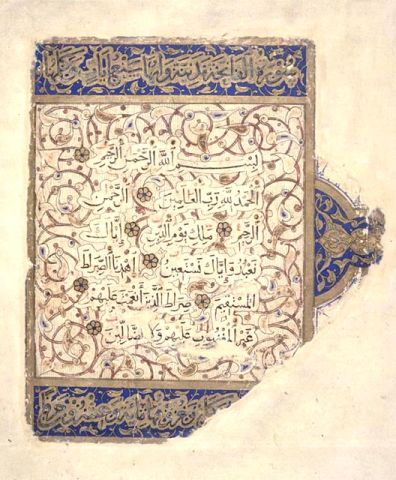
Image: 14th C. Qur'an, Mamluk origin, Library of Congress; Rights obtained.

A BREAKTHROUGH project which helps understand the Qur'an AS REVEALED -not just 'as explained.'

---------------------------------------------------------------------------

Tuesday, February 2, 2010

Day 29; HQ 3:53-70; pages 57+58

Welcome Friends:  Ahlan wa sahlan!
COMMENTS:

1.     The last verse in yesterday’s reading (HQ3:52) was a question posited by Jesus, peace upon him, after he sensed Denial in those whom he had hoped would benefit from his guidance:  “Who would be my Helpers in God’s cause?”  The Disciples/the white-garbed ones (Y. Ali, Muhammad Asad respectively) responded, saying that they, indeed, will be Helpers in God’s cause for they have indeed believed in God, and that he (Jesus) should bear witness to their being ‘Muslimoon’ (those who are devoted purely to God/those who surrender unto God).
In Verse 53 they continue bearing witness to having faith in God and following His Messenger, Jesus, peace upon him.  Read their ‘shahada’.

2.     But not all of them were sincere, so while some were planning kill Jesus, God had His plan, and He imparted it to His Messenger (verse 55).  He told Jesus that He will cleanse Him of the Unbelievers and their Denial, by taking him/causing him to die (Y. Ali/M. Asad respectively), and raising him, exalting him, unto Himself.  The Deniers would suffer the consequences of their actions in this life and in the Hereafter (verse 56), while those who have faith and do good deeds will be recompensed.

It is important to read HQ4:157 to better understand how the Qur’an reports Jesus’ departure from this earth:

“And so, [We punished them] for the break­ing of their pledge, and their refusal to acknowledge God's messages, and their slaying of prophets against all right, and their boast, "Our hearts are already full of knowledge"- nay, but God has sealed their hearts in result of their denial of the truth, and [now] they believe in but few things -; (155) and for their refusal to acknowledge the truth, and the awesome calumny which they utter against Mary, (156) and their boast, "Behold, we have slain the Christ Jesus, son of Mary, Messenger of God!" However, they did not slay him, and neither did they crucify him, but it only seemed so to them; and, verily, those who hold conflict­ing views thereon are indeed confused, having no [real] knowledge thereof, and following mere con­jecture. For, of a certainty, they did not slay him: (157) nay, God exalted him unto Himself - and God is indeed almighty, wise.


3.     Conjecture is certainly all we can do right now, and trying to understand the issue of crucifixion wouldn’t change our faith in God or His Messengers one way or the other.  Nevertheless, for the sake of general knowledge (not for argument, as this is all 'unseen' (gheyb) and can never be proven beyond doubt) it might be worthwhile to offer the most prominent explanations of this verse. 
Some have put forward the argument that Jesus was ‘almost’ crucified but not really, because although he was put on the cross, he did not die on it, but was brought down before that.  Others have posited that the person who was crucified was not Jesus at all, but the traitor Judas who was mistaken for Jesus.  And then there are others, such as Kamal Salibi* who, although a committed Christian, resorts to Qur’anic evidence saying:

“A Christian might balk at the idea of resorting to the Koran for evidence concerning the origins of Christianity.  But the holy book of Islam speaks profusely of Jesus and it would be unreasonable to reject its evidence before examining it” (p.46, Conspiracy in Jerusalem, I.B. Tauris, 1988).

He contends that, what certain parts of the Bible hold are in reality three stories, fused into one (two from history and one from legends of a deity); the crucifixion narrative being a fusion of two historical figures who lived centuries apart, with somewhat similar names, and with a mother called ‘Mary.’  We understand that, while the first was Jesus, Messenger of God, the other was someone who sought to revive the Kingdom of David, and was crucified by the very persons whose seats he sought to overthrow.  Salibi recounts the joy of the Nazarene Christians when Muhammad appeared, bringing back to them the pureness of faith in God and the true history of the rightful Jesus who had been lost because of Paul’s ‘conspiracy’ (hence the title of the book).  Many people from different faiths disagree with him.
Again, Conjecture is ALL we can do right now, so we leave it at that.
 
4.     Verses 58-63 speak to Prophet Muhammad, peace upon him, telling him (telling us, actually!) that is what God conveys to him.  Then comes the explanation that Jesus and Adam are similar in that they were both of this earth, created by a word from God, ‘Be!’ which IS a Reality no one should doubt. 
It seems that some did doubt, and history indicates that these were Christians from Najran who continued to believe in Jesus’ divinity, to the result of which the Prophet Muhammad, peace upon him, was told to invite them to a session of prayer in which both would bring their entire families and ask God to curse whomever among them were liars.  He did invite them… they declined, and the debate ended peacefully, with a signed treaty (read notes 400-401 Y. Ali /47-48 M. Asad.)

5.     Verses 64-68 are very important in showing us the common terms we could have with those who follow earlier Compilations- according to a BASIS we begin from; a common Word:

·        We worship none but God.
·        We associate none with God.
·        We appoint none amongst ourselves as Lord or patron instead of God.

These are the three basic (Terms/Tenets) that WE can never compromise on, in ourselves, as Believers. 
However, if OTHERS do not agree to these three tenets, we should simply let them be- to each his own- (as we saw with the delegation from Najran) it is ultimately God’s knowledge which indeed encompasses any who corrupt their own faith.

6.     Abraham was neither a Jew nor a Christian (verse 67).  Rather, he was Consistently Inclined towards Righteousness (Haneefan), Pure in Faith and Deference to God (Musliman).  Readers who are ‘consistent’ will remember those definitions! (See Posts of January 12th and Jan 29th )
Closest to Abraham (verse 68) are those who follow him, as well as THIS Prophet (Muhammad).  We notice here that God did not say as well as this ‘Messenger’ Muhammad.  What’s the significance? 
As we read on, we will notice the great significance, for indeed, these two words are not interchangeable (although we might use one or the other without any distinction). 
His title ‘Prophet’ is general, and always relates to his role amongst people, while his title ‘Messenger’ is specific, and ALWAYS relates purely to the Message, the Qur’an.  That is why God would not refer to him as Messenger here, for the Message he bears is distinct from all previous Messages.  In his capacity as Messenger -bearing God’s Final Message- he is distinctive.  We’ll have more on that next time.
7.     Verse 69 addresses the Believers, while verse 70 addresses Followers of earlier Revelation, warning, questioning:

“Why do you deny the truth of God’s Message, to which you, yourselves, do bear witness?”


Enough said!

Tomorrow’s reading is from HQ 3:71-83.

Peace unto all!

*Kamal Salibi is a Lebanese historian and a committed Christian.  The driving force behind this book was his belief in the historical Jesus as well as his desire to reconcile certain Biblical contradictions.
 

Monday, February 1, 2010

Day 28; HQ 3:38-52; pages 55+56

Welcome Friends:  Ahlan wa sahlan!
We’ve been following the Qur’anic account leading up to the story of Prophet Jesus, peace upon him:
HQ3:35-39
﴾Behold! a woman of 'Imran said: “My Lord, I have dedicated unto You what is in my belly, committed to Your Service, so accept of me: For You Alone Are The All-hearing, The All-Knowing.” (35)
Then, when she delivered her, she said: “My Lord!  I have delivered her, female,” - and God knows best what she delivered- and no wise is the male like the female- “and I have named her Mary, and I do commend her and her offspring to Your protection, from the Rejected Deviant.” (36)
So her Lord accepted her right graciously, and He well-nurtured her as she grew up, and assigned her to the care of Zachariah.  Whenever Zachariah entered the sanctuary upon her, He found that she had provision.  He said: “O Mary! Whence do you get this?”  She said: “It is from God: Indeed God Provides whom He wills without measure.” (37)
Right then, Zachariah prayed to his Lord, saying: “My Lord! Bestow upon me -from Your Grace- a goodly offspring: You are indeed The Listener to all prayer!” (38)
Thereupon the angels called unto him while he stood praying in the sanctuary: “God sends you glad tidings of (the birth of) John, confirming the truth of a Word from God, and outstanding among men, and utterly chaste, and a prophet from among the righteous.”(39)﴿

No matter who translates these verses… they are absolutely beautiful!

COMMENTS:

1.     Verses 38-41 tell us Prophet Zachariah’s story, peace upon him.  He wanted someone to carry on his mission after him, but his wife had borne him no children.  The fact that he was in charge of providing for young Mary -yet would enter the sanctuary and find her provided for - may have amazed him, but what truly opened his eyes was her simple, eloquent response:

“It is from God: Indeed God Provides whom He wills without measure.”

Mary could have just said that it was from God, without elaborating, but that would not have shown how generous she knew He was, or how secure she felt in that He would always provide for her. 
(Ali and Muhammad Asad have different views on the subject, the former reads the verses literally, while the latter does not, but concludes that all provision is indeed, from God.) 
Readers will notice that her faith is directly related to her future as the Virgin Mother of Jesus, with all the trial and tribulation her role entails.  But little did she know about that, at this point.  Also, little did Prophet Zachariah know about what he and his son, John, peace upon them, would have to endure!
We also notice, that when Zachariah asked, ‘How shall I have a son..’ the Answer was:  “Thus does God DO what He wills.”  We will be comparing this to the answer Mary gets to a similar question after a few verses.
When Zachariah says, ‘Make me a sign..’ most commentators take that to mean a sign from God to verify conception, and that he is told the sign would be his sudden inability to speak (seeing that there would be no immediate physical sign in a non-menstruating woman).  M. Asad does not agree with that interpretation which he feels matches what is reported in Luke 1:20-22 (see his note 29).  M. Asad thinks the Sign is spiritual in that Zachariah should dedicate himself to prayer. 

2.     Verses 42-43 are about Mary, who is purified, and twice chosen for the role ahead… indeed chosen above all womankind.  She is told to maintain her reverence and devotion, in prostration and bowing to God.

3.     Verse 44 addresses Prophet Muhammad directly, peace upon him, and everyone else indirectly.  All these narrations of past occurrences are but ‘gheyb’ to him (unseen; un-witnessed by him), and no other than God could have informed him of them.  How else would he know about the competition which arose when Mary was a child, as to who would be her guardian?

4.     In Verse 45-46 the angels tell Mary of her future son, a Word of God, the Anointed Jesus son of Mary, of great honor in this world and in the Hereafter, and among those who are drawn nearest to God. They also tell her that he will speak to people while yet in the cradle.
(Asad says the word ‘Christ’ is derived from Greek ‘chreien’ which means ‘to anoint’ – see note 32.)

5.     In verse 47 Mary asks a question somewhat similar to what Zachariah asked, ‘How shall I have a son..’ But, in her case, she wonders how, when no human being has ever touched her.  The Answer which Mary -the unmarried virgin- gets is NOT:  “Thus does God DO what He wills,” which was the short response given to the married Zachariah.  The response she gets is:

“Thus does God CREATE what He wills, when He wills  something to be, He only says unto it : Be! And it is.” 
 

In other words, as mentioned in the center of the beautiful verse HQ 6:73: “…قوله الحق… His word is Reality (manifested)….” which certainly is a concept difficult to grasp unless one has already acknowledged God’s Magnificence and Omnipotence.  But the angels were addressing Mary and her unmatched Faith.  Through her, God’s ‘qawl قوله-’ -what He said or intended- became ‘The Manifest Reality الحق-’!

6.     Although Verse 48-51 seem to continue along the same vein (speaking to Mary), we gradually realize that we, the listeners, are the ones spoken to here.  When we remember that both Judaism and Christianity were present in Arabia when the Qur’an was revealed, we realize the scope of this Message: 
We are told about Prophet Jesus, peace upon him, bearing a Message from God with Signs to prove his authority, among which were his ability –by God’s leave- to cure lepers, raise the dead, and know what people have in their own homes.  These were signs for them, if they indeed had faith.  We are told how he was appointed to bring the Children of Israel back to their Divine Revelation (or its remnants, see M. Asad’s note 40 and 3)*, and make lawful for them what had been considered, till then, unlawful, and ask them to worship God Alone, his Lord and theirs.  We are told that he was to lead them to a Straight Path.
It is important to note that a ‘Straight Path/Way’ is often mentioned in the Qur’an as a direction taken (and guided to) by Messengers prior to Muhammad, peace upon them all.  If we were to do some research we’d also see much mention of that in the Old and New Testaments.  Two examples would be in Samuel 12:20-23 and John 1:23 (King James Version):

Samuel: “Moreover as for me, God forbid that I should sin against the LORD in ceasing to pray for you: but I will teach you the good and the right way.” (Read Arabic version below, ‘tareeq saleh mustaqeem’.*)
John: “He said, I am the voice of one crying in the wilderness, Make straight the way of the Lord, as said the prophet Esaias.”

If we think of the Straight Path as explained in our study of the Opener and defined in HQ6:151-153, and remember its similarity to the Ten Commandments…we recognize the single Divine Source of all God’s Messages.
And the final verse in today’s reading takes us from the description of Prophet Jesus’ mission … to the outcome:  He sensed their Denial. What an awful realization that must have been…may God’s peace and blessings be upon him!

Enough said!

Tomorrow’s reading is from HQ 3:53-70.

Peace unto all!

*We must remember that M. Asad is an authority on the Talmud and received Rabbinical knowledge, besides his proficiency in Hebrew and knowledge of Aramaic).

*1 Samuel:12:23 (in Arabic):
 ( وَأَمَّا أَنَا فَحَاشَا لِي أَنْ أُخْطِىءَ إِلَى الرَّبِّ، فَأَكُفَّ عَنِ الصَّلاَةِ مِنْ أَجْلِكُمْ، بَلْ أُوَاظِبُ عَلَى تَعْلِيمِكُمُ الطَّرِيقَ الصَّالِحَ الْمُسْتَقِيمَ. )


Let's TWEET this!

Tweet me!