CLICK IMAGE: Tanzil Website


OUR MISSION:
UNCOVERING the original message of the Arabic Qur'an by using Lexicons compiled more than 1,000 years ago.

ISOLATING Fact from Fiction.


RECOVERING Hope and regaining the perspective where Humanity is one, God's Message is one, and our Future CAN become one we all look forward to!


© 2010 IQRATHECHALLENGE: INTELLECTUAL PROPERTY PROTECTED BY D.M.C.A. ALL RIGHTS RESERVED.

© 2010 IQRATHECHALLENGE: INTELLECTUAL PROPERTY PROTECTED BY D.M.C.A. ALL RIGHTS RESERVED.
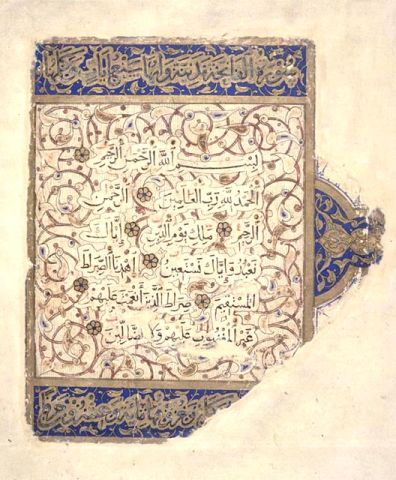
Image: 14th C. Qur'an, Mamluk origin, Library of Congress; Rights obtained.

A BREAKTHROUGH project which helps understand the Qur'an AS REVEALED -not just 'as explained.'

---------------------------------------------------------------------------

Thursday, June 10, 2010

Day 131; Qur’an 14: 1-10, page 255 + 256

Welcome Friends:  Ahlan wa sahlan!
I’d like to applaud our Friends who have been learning the important Qur’anic definitions we’re presenting here, at The Iqra Challenge! 
My hope is to supply you with a ‘Table of Definitions,’ but in the meantime, keep up the great work, and thank you for telling us what you’ve been doing!  Your comments mean a lot to Author AND Readers of this Blog, so do write.

Yusuf Ali’s Translation of our new Chapter.
Muhammad Asad’s Translation of our new Chapter.
Their commentaries can only be read in verse by verse view.

سورة إبراهيم

COMMENTS:
Yusuf Ali says in his introduction:
“The subject-matter of this Sura is a continuation of the concluding portion of the last Sura, which explained how God’s revelation gains ground in spite of selfish man’s opposition.  Here illustrations are given from the story of Moses and Abraham, and Abraham’s Prayer for Mecca forms the core of the Sura.”
Muhammad Asad says in his introduction:
“ALL AUTHORITIES agree that this surah belongs to the last group of Meccan revelations; in the Itqan it is placed immediately after surah 71 (Nuh), and we have no reason to question this chronology. The title is based on Abraham's prayer in verses 35-41; its relevance to the rest of the surah has been explained in note 48.”
PAGE 255 Arabic Qur’an.
 
1.  The first verse of this Chapter also begins with the ‘sounds’ (written as disjointed letters) which refer to the alphabet (discussed April 6th):

“Alif Lam Ra. A Compilation We have sent down to you, to deliver Cognizant Humans from the Darknesses to the Light by leave of their Lord, to the Path of The All-Mighty, The Worthy of all Praise.”

We notice that, as usual, these sounds inevitably introduce the Compilation!  Their value should not be underestimated- perhaps we’ll have time one day to study them specifically.  Meanwhile, Readers can refer to ‘Classical Arabic: Unique Human Communication” and check out the table at the end, which gives us the meanings of sounds.
We also notice that Darkness is always plural ظلمات – ‘Darknesses,’ whereas Light is always One.  Why is that so?  Perhaps because there is One Truth, and many, many Falsehoods; One Correct Direction to follow, and many, many Mis-directions?

2.  Actually, Verses 1  2- 3 should be read together, as each leads up to the next with important statements. 

In Verse 3 we notice THREE characteristics to Those who Denied Godالذين كفروا- :

·  They prefer this immediate, lowly Life to the Hereafter.
·  They impede others from following the path to God.
·  They seek to distort and bend the path.   

How true!

Verse 4 is tied to the first verse.  After we read the important preceding statements, we learn how, as Cognizant Humans, each Messenger’s People were given ample chance to deliver themselves from the Darknesses to the Light, seeing that THE MESSAGE WAS DELIVERED IN THEIR OWN TONGUE.

3.  After this important introduction, Verse 5 mentions the story of Prophet Moses, peace upon him.  His story offers very important lessons, and is a recurrent theme in the Qur’an (if we copy + paste "موسى" in Tanzil we’ll find his name mentioned 129 times.).  Here it is mentioned as an example of Guidance from Darknesses to Light

PAGE 256 Arabic Qur’an.

4.  In Verse 6 we hear Moses reminding his people of God’s Blessing in delivering them from Pharaoh’s people, and of what they had suffered at their hands.

5. Verse 7 is an oft-quoted verse:
 وَإِذْ تَأَذَّنَ رَبُّكُمْ لَئِن شَكَرْتُمْ لأَزِيدَنَّكُمْ وَلَئِن كَفَرْتُمْ إِنَّ عَذَابِي لَشَدِيدٌ

“And your Lord declared: "If you work in Appreciation, I shall indeed augment you, but if you Deny, My chastisement is surely severe."’

We already know (Jan 13th) thatشكر-  ‘Shukr’ means accepting what is little and making the most of it until it achieves abundance.
 
This is a statement of FACT.
 
When we work, we enhance the value of what we are working with, and it increases further in value.  Appreciate’ here is not simply about thankfulness, but is the opposite of ‘depreciate,’ or ‘to lose value’.
Unfortunately, many Muslims of recent generations have taken ‘shukr’ to mean ‘thankfulness by word of mouth,’ as in saying ‘al Hamdulil-Lah.’  This misinterpreted word – on its own- has set us back 1,000 years.  Another statement of fact!

6.  Verse 8 takes us back to Prophet Moses, who tells his people that God is in NO NEED of anyone’s faith.  Here we encounter the word ‘ghaniغني- as one of God’s attributes. Readers might remember that this word in Arabic means Self-Sufficient (but when attributed to us, is misunderstood as ‘wealthy’).  See Posting of April 26th.

7.  Verses 9- 10 illustrate the familiar arguments between God’s Messengers (NOT ‘apostles’) and those who disbelieve them. 

Notice, in Yusuf Ali’s footnotes, his correct translation of ‘nabaنبأ- ’ as ‘news’ and his valuable indication as to the difference between doubt /‘shakشك- and suspicion /‘reybريب- .

Enough said!
 
Our next Reading is from HQ 14: 11- 24.

Peace unto all!

Wednesday, June 9, 2010

Welcome Friends:  Ahlan wa sahlan!
As you noticed, we had to keep Page 254 for today. 
This is due to the all-important final concepts that bring the Chapter of Thunder to a close.

COMMENTS:
1.   We notice four things in Verse 37:

“Indeed We have bestowed this an ‘Arabic’- Self-Expressive Ordinance, and if you were to follow their desires after the knowledge that has come to you, you will have none to protect you from God, or to shield you!”

·       This is revealed: an Arabiعربي- Self-expressive Ordinance.
·        Quite clearly here, God is addressing His Messenger. 
Indeed, the entire conclusion to this Chapter is taken up by this address, but in Verse 37 the ‘Voice of God’ is easily identifiable as it is dutifully received by His Messenger and then transmitted to the world:
‘…and if thou dost follow their caprices, after the knowledge that has come to thee, thou shalt have no protector against God, and no defender”  (Arberry).
·       Being a Revelation of clearly expressed Ordinances, the Messenger can, and indeed MUST, apply it to himself on one hand, and guide others to it as well, regardless of people’s desires.
·       As for the people: Since it is ‘Arabi’ and clearly expressed, they have absolutely no excuse in not understanding its wisdom; in other words, when they refuse to follow the Messenger or his Message, the reason will NOT be that the Revelation was incomprehensible, but that they themselves were lacking.

Dear Readers: 
This is serious business!  You might ask:  How about us, today, when WE do not truly comprehend God’s Message, yet do NOT want to be in a position where we have none to protect or defend us from God..?
The answer is that, as long as we are truly TRYING to comprehend it, we cannot be blamed.
We must use EVERYTHING in our power to try and understand what God is telling us; we must seek original Qur’anic intent, with the help of the references at hand. 
It frightens me to think, dear Reader that our responsibility in this Information Age surpasses the responsibility of all the past generations combined.  But then I think:  What an opportunity to be alive today, opening with our fingertips entire libraries, any book of which our predecessors would have spent years searching for!

2.     Verse 38 continues to address the Messenger, giving him responses to Qureish’s unreasonable demands, related to his being ‘just one of them’ rather than an angel, and to ‘miracles.’ 
Then, at the end of verse 38, and beginning of verse 39 we find two VERY important statements (in my translation):

‘… to each Term a Compilation.’ (38)
 God dissolves what He wills, and affirms, and in His tenure is the Source of the Compilation.” (39)

Wow.  All in a nutshell. 
At first, we find mention of A ‘Compilation,’ any compilation sent by God according to the ‘Term’ to which it belonged.  Then we find that the dissolution of certain parts, and the affirmation of others, is all according to His Will; the Source itself being in His Tenure!  Indeed, what an eloquent, self-expressive (Arabi) Ordinance!
  
For ‘Compilation,’ Ali said ‘Book’ and Asad’ said ‘Revelation.’  Zamakhshari explained that to each generation is an Ordinance which best fits the life requirements.  See Verses 38- 39 in Arberry’s explanation, and notice, dear Reader, that LESS IS MORE.  This is why I advise Readers to always read at least two or three explanations of the Qur’an to get to the correct meaning, one of which should be a concise, literal explanation.

3.     AGAIN, in Verse 40  we distinctly hear ‘God’s Voice’ discussing the Prophet’s death, and his responsibility as Messenger, which is solely to convey the Message, NOT TO HOLD PEOPLE ACCOUNTABLE!  Isn’t that something WE should learn from?

4.    Both Yusuf Ali and Muhammad Asad’s explanations of Verse 41 are interesting, although I prefer Arberry’s, because it remained literal.  Some persons have explained the verse differently, relating it to a ‘Scientific Marvel’ rather than to people and life.  (A ‘Scientific Marvel’ is related to the Qur’an mentioning a scientific fact unknown at the time of Revelation).  
Dr. Zaghloul Al Najjar has deduced such a ‘marvel’ from this verse; check it out at YouTube.

But we must always bear in mind that, not only do the linguistic marvels of the Qur’an surpass the scientific, but ‘Arabi’ IS, in fact,the Qur’an’s DEFINING characteristic.  This means that, even when we do end up finding ‘scientific’ marvels, we can only do so based on the correct linguistic definitions.  Without the original language we cannot obtain correct references to anything! 

The last part of the verse, returns all judgment to God, and tells us that no one can follow-up on (or amend) His judgment, and that He is swift in holding Account.
  
5.     Verse 42 tells us of the devising of those who Deny, and announces that, ‘….. to God
Belongs all Devise, and that Those who Denied will come to know to whom shall be ‘the final outcome, or end  عقبى الدار. ‘The final outcome/ end’ is explained as ‘who gets home in the end/ to whom the future belongs’ (Yusuf Ali/ Muhammad Asad).

6.   The Chapter of Thunder concludes by responding to Qureish, who alleged that Muhammad is not a Messenger.  He is told to respond by saying that God suffices as witness between him and his people, as also suffices the witness of ‘he who has knowledge of the Compilation.’

A most eloquent conclusion to this Chapter! 

Enough said!
 
Our next Reading is from HQ 14: 1-10.

Peace unto all!

P.S.  Did you notice, in the right side-bar:  “What is Taught in Schools Today, versus What Should be Taught”? 
When there is Truth in our narration of the Past, we will come closer to Agreement in our Present, and to Fellowship in our Future!  

Let's TWEET this!

Tweet me!