CLICK IMAGE: Tanzil Website


OUR MISSION:
UNCOVERING the original message of the Arabic Qur'an by using Lexicons compiled more than 1,000 years ago.

ISOLATING Fact from Fiction.


RECOVERING Hope and regaining the perspective where Humanity is one, God's Message is one, and our Future CAN become one we all look forward to!


© 2010 IQRATHECHALLENGE: INTELLECTUAL PROPERTY PROTECTED BY D.M.C.A. ALL RIGHTS RESERVED.

© 2010 IQRATHECHALLENGE: INTELLECTUAL PROPERTY PROTECTED BY D.M.C.A. ALL RIGHTS RESERVED.
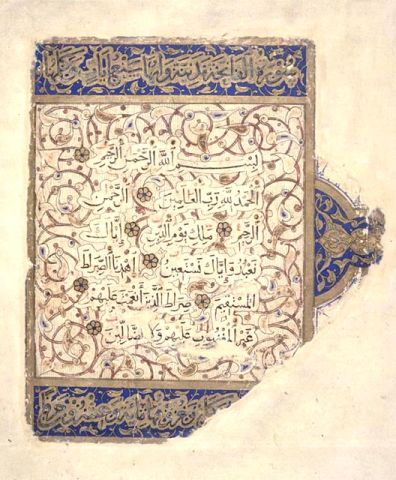
Image: 14th C. Qur'an, Mamluk origin, Library of Congress; Rights obtained.

A BREAKTHROUGH project which helps understand the Qur'an AS REVEALED -not just 'as explained.'

---------------------------------------------------------------------------

Tuesday, January 5, 2010

Welcome Friends! Day 5; HQ 2: 58-69; pages 9+10.


Welcome Friends: Ahlan wa sahlan!

You may have noticed the new tools added to our project today. It's so much easier with tools at our fingertips. Muhammad Asad's complete translation with commentary is right here for reference or download.

And now we can simply open the virtual Arabic Qur'an to read any page we need, or just flip through, enjoying its audio-visual elements and appreciating the technology behind it!

At the lower right-hand corner we can find 'Your Question, My Answer,' which is actually the beginning of our Q&A project. I could not include the Arabic material for the sake of brevity, but I'll try to do so in the Q&A page so that the non-traditional definition of Al Rahmaan (which I made sure was endorsed by linguists) becomes quite clear.

And finally, who can resist 3 Cups of Tea? 

I hope the pace is ok for you; I am trying not to put in too many comments, and probably should write less so you can read Qur'an more.  Please let  me know how you are doing.


COMMENTS:


  1. In yesterday's reading, the Qur'an gave us an account of Moses' trial with his people; how, although he had freed them, they did NOT seem capable of freeing themselves from their concept of servitude, which had spanned generations. Their story is not unique in that sense, but serves as an example of the power perception holds over reason. During Moses' 40 days of absence, they turned to worshipping a calf instead of God, but God forgave them. As we understand, He was giving them a chance to grow and mature, to rise in faith, knowledge, and self-respect above their past. In verse 52, 'Yashkurun' is from the root verb 'sha-ka-ra' which means to increase, enhance, be productive which is THE TRUE PROOF OF GRATITUDE, because just feeling thankful, without producing anything, is not worth much.


  2. In studying the effects of slavery one must note that persons who have never been free, will not only be lacking qualities of leadership, but they usually find difficulty in accepting any kind of change -even when for the better. This seems to be one of the main reasons behind the lack of positivity which Moses' followers were notorious for, and the Old Testament describes that in some detail. Perhaps we can now understand one reason why God made Moses' mother give him up. She had to do so in order for him to be adopted into a family with ultimate power, setting free his inborn strengths and gaining the qualities of leadership necessary to take his people out of servitude. Freedom is indeed worth cherishing.


  3. In today's pages we have 5 instances of the Children of Israel's disobedience mentioned, and one mention of their 'killing Prophets with no right.' We also find them substituting the rightful words to say with other words, or preferring a larger variety of lower-grade foods than the few excellent staples God had provided for them, and even profaning the Sabbath. The Qur'an says that in their story and in their punishment is a lesson to all who are Aware. Sadly, throughout history, very few of us remained Aware, as proven by the state we are in today.


  4. The word 'Misr' in Arabic means 'within limits,' as in land within boundaries, or shortage of provision. That was to be their portion (verse 61) after having asked for inferior sustenance and argued with Moses, so they were told to descend 'Misr,' the plural of which is 'amsaar' or lands. This was a descent in status, as evident from the rest of the line… "and ignominy and humiliation overshadowed them…" Most scholars however just say that the Children of Israel were told to descend to Egypt. The Arabic name for Egypt has been 'Misr' since Amr Ibnil Aas named it so, circa 641 AD. Its Greek name, relative to the Copts, was Aigýptios.


  5. Asad explains eloquently, how Verse 62 lays down a fundamental doctrine of Islam, that salvation is ultimately conditional upon belief in God, in Judgment Day, and righteous action in life.  This is quite clear in HQ:4: 48, 116, which indicates that other wrongful beliefs and misdeeds do stand a chance for forgiveness, depending on each person's reality known by God Alone.


  6. This chapter's title (The Cow/The Heifer) is taken from verses 67-73, which describe a specific incident. Both Ali's and Asad's commentaries tell us that if a murder is committed and the murderer is unknown, the Mosaic law states that community-elders in surrounding areas should seek absolution or else be considered collectively responsible. This law is mentioned in the Old Testament, Deuteronomy 21:1-9. "All the elders of that city which is nearest to the slain man shall wash their hands over the heifer … and they shall declare: "Our hands did not shed this blood, nor did our eyes see it done." It seems that they were reluctant to do so, and complicated the issue so that, instead of getting 'any cow' to do the job, they needed a 'specific' cow.


Enough said!


Our reading for tomorrow is from verse 70-83.


Peace unto all!

----------------------
 المِصْر، وهو الحدُّ؛ "اشترى فلانٌ الدَّارَ بمُصورها"، أي حدودها
والتَّمَصُّر: القليل من كل شيء؛
والمِصْر: واحد الأَمْصار.


Monday, January 4, 2010

Welcome Friends! Day 4; HQ 2: 38-57; pages 7+8.


Welcome Friends: Ahlan wa sahlan!


Perhaps some of you might have noticed that, with regard to the Prophets and their messages, Qur'anic and Old Testament narratives seem similar at times and dissimilar at others. However, the most significant difference between both narratives is that, in the Qur'an, each of these Prophets plays much more of a POSITIVE role and does NOT seem flawed in character.

In future we will notice many differences between the Qur'anic and Biblical narratives, starting with the story of Adam and his spouse (her name not mentioned in Qur'an), and onward.


 COMMENTS:


1. When God commanded Adam to descend, He was addressing 3 persons or more, as the Arabic plural shows. In Arabic, plural (jama') consists of three and above. Two is not considered plural, but has a form of its own called 'muthanna.' It is therefore interesting that although Adam and his spouse were addressed initially in the 'muthanna' (when they ate of the tree etc..) they were addressed in a plural of three or more when told to descend
Also, 'descend' does not necessarily mean that they were in a higher place in the physical sense. It could very well mean descend from a superior status to a lower one, where they would have to seek their sustenance and well-being. The Qur'an says that they were in a garden. 'Jannah' is garden in Arabic ('juneinah,' a common word, means small garden). The Qur'an does NOT specify the garden's location, as opposed to the probability of it being on earth. We also have to bear in mind that it is from earthly matter that Adam was created, and it is about what was happening on earth that the angels asked. These indications have led present-day scholars to readdress the concept of them having been in a 'Heavenly Paradise from which they were banished.'

According to Arabic linguistics*, the term 'Adam' is related to the nouns 'adamah' which means an earth-toned complexion, and 'Adeem-ul-Ard' which is the soil below the top layers of earth. Since the root verb 'a-da'ma' literally means 'compatibility, accord and love,' and being the compassionate social beings we are (children of Adam), we now better realize the wondrous beginnings of our existence!


2. In the Qur'an, both were reproached, and Adam's spouse was NOT considered responsible for his fall. We also know that they were forgiven, which makes the whole incident with the forbidden-fruit seem to have been no less than a lesson for them; one tree in the entire garden made off-limits to teach them the value of self-restraint and the consequence of transgression.  And they were also promised that Guidance would be delivered to them, and all they had to do is follow God's Guidance.  


3. The statement: "O Children of Israel! Remember those blessings of Mine with which I graced you…" is repeated 3 times in the Qur'an (HQ 2:40,47,122). The Children of Israel are the children of Prophet Jacob, his 12 sons, and their descendants. Both the Qur'an and the Bible agree that 'Israel' is another name for Prophet Jacob, peace upon him. Although certain Qur'anic verses may address the Children of Israel, and others at times, the lessons presented are of great value to all. This is a Timeless Message.

4. From today's verses come the following admonitions. WE should take heed of them too:


Remember. Believe. Do not barter away My Message. Stand in awe of Me.
Be constant in prayer. Spend in charity. Bow down in prayer.
Seek aid in steadfast patience and prayer.
Do you demand piousness of others while forgetting your own selves?

5. Many of us know that Muhammad Asad was born Leopold Weiss, a grandson of an Orthodox Jewish Rabbi who made sure that by age 13 his grandson was set to follow in his footsteps. But instead of that, he became a Mulsim in his twenties and went on to fulfill key roles and complete beautiful works, one of which is the explanation of Qur'an we are now using. Asad's commentary provides excellent explanation of a most serious admonition addressed to the Children of Israel. We have ample reason to trust his input, seeing that he knew about the subject first-hand. This is Asad's commentary on verse 42:


"By 'overlaying the truth with falsehood' is meant the corrupting of the biblical text, of which the Quran frequently accuses the Jews (and which has since been established by objective textual criticism), while the 'suppression of the truth' refers to their disregard or deliberately false interpretation of the words of Moses in the biblical passage, 'The Lord thy God will raise up unto thee a prophet from the midst of thee, of thy brethren, like unto me; unto him ye shall hearken' (Deuteronomy 18:15), and the words attributed to God himself, 'I will raise them up a prophet from among thy brethren, like unto thee, and will put my words in his mouth' (Deuteronomy 18:18). The 'brethren' of the children of Israel are obviously the Arabs, and particularly the musta'ribah ('Arabianized') group among them, which traces its descent to Ishmael and Abraham: and since it is this group that the Arabian Prophet's own tribe, the Quraish, belonged, the above biblical passages must be taken as referring to his advent."


As noted, the text which Asad says was corrupted by the Children of Israel, was the announcement of the advent of God's Messenger, Muhammad, peace upon him.

Enough said!

Our reading for tomorrow is from verse 58-69.

Peace unto all!


".الكشّاف للزمخشري: "ءادَمَ من الأدمة، ومن أديم الأرض*

معجم المقاييس في اللغة لابن فارس:أدم: "الموافقة والملاءمة. قال الكسائيّ: يُؤدَم يعني أن يكون بينهما المحبّة والاتفاق، يقال أَدَمَ يَأدِمُ أَدْماً.... الأدَمة أحسن ملاءمة للَّحْم من البشرة، ولذلك سُمّي آدم عليه السلام؛ لأنّه أخذ من أدَمة الأرض... وناس تقول: أديم الأرض وأَدَمَتُها وجهها


Let's TWEET this!

Tweet me!