CLICK IMAGE: Tanzil Website


OUR MISSION:
UNCOVERING the original message of the Arabic Qur'an by using Lexicons compiled more than 1,000 years ago.

ISOLATING Fact from Fiction.


RECOVERING Hope and regaining the perspective where Humanity is one, God's Message is one, and our Future CAN become one we all look forward to!


© 2010 IQRATHECHALLENGE: INTELLECTUAL PROPERTY PROTECTED BY D.M.C.A. ALL RIGHTS RESERVED.

© 2010 IQRATHECHALLENGE: INTELLECTUAL PROPERTY PROTECTED BY D.M.C.A. ALL RIGHTS RESERVED.
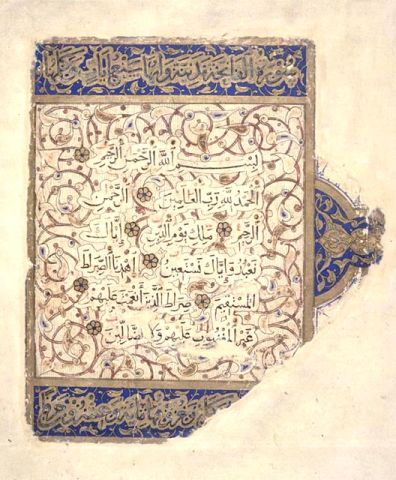
Image: 14th C. Qur'an, Mamluk origin, Library of Congress; Rights obtained.

A BREAKTHROUGH project which helps understand the Qur'an AS REVEALED -not just 'as explained.'

---------------------------------------------------------------------------

Monday, January 18, 2010

Day 16; HQ 2: 197-210; pages 31+32

Welcome Friends:  Ahlan wa sahlan!

We had so much to discuss in yesterday’s Reading.  Was it too much?  The idea is, that we read the Qur’an, find clarifications in reputable explanations such as Muhammad Asad & Yusuf Ali’s, and then use this forum to pace ourselves and discuss certain points, as discerning readers.

Please CLICK the ‘Reaction’ when you finish reading, and put your opinion in the Poll below; YOUR viewpoint is crucial. 

COMMENTS:


1.      Our general topic is about the Pilgrimage to Mecca, ‘Hajj.’  The journey could be embarked upon months earlier, but one must make sure to spend a part of the 9th day of the 12th Lunar month, Thul Hijjah, at Mount Arafaat (see Yusuf Ali’s note 217).  Muhammad Asad calls this day at Arafaat ‘the climax of the Pilgrimage’ (see his note 184).

2.      In these verses are guidelines related to one’s Physical presence in Hajj; there should be no obscenity or lewdness of speech, no harmful or immoral conduct, and no arguments or quarrelling.  The last one is not easy!

In these verses are recommendations related to one’s Spiritual presence in Hajj; one should be aware of God, remember Him, ask His forgiveness, recognize the value of His Guidance and the gifts it brings, rising in Awareness so that by the end of Hajj, no matter how attached we are to our roots, God would be The One to Whom we relate.

3.      See Yusuf Ali, note 223, about the idolaters of Qureish relating to their forefathers. Again, Ali’s translation of Taqwa as ‘fear’ ( -واتقوا اللهlast line, Verse 196) is not accurate, especially since we know that the only word which could be translated as fear is ‘khawf’خو ف  (see Post January 14).

4.      The Faithful are presented with a beautiful prayer to ask of God (Verse 200), to grant them a ‘hasanah’; a good return for their deeds, in this world and also in the next.

5.      We should not fall under the influence of destructive people whose speech is attractive (Verse 204: I like Ali’s translation: dazzling).  Such persons could be the “most contentious of adversaries in a dispute” (Asad: note 188).  God does not like destructiveness/corruption (‘Fasaad’; Verse 205).

Such a person’s demeanor is characterized by a refusal to admit wrongdoing- and especially when asked to be aware of God, you will find him even the more arrogant in adherence to (and in defense of!) his crime (Verse 206). 

Then there are others whose only aim is to gain God’s pleasure- and God is Most Compassionate to His worshippers.  (I like Ali’s explanation of Ibaad here as Devotees.  Asad’s ‘servants’ is inaccurate.  See Jan. 15th Post regarding 'Abeed' (عبيد) and 'Ibaad' (عباد).

6.      Another call to the Faithful in 208, to enter thoroughly into Peace, and to make sure they do not follow The Deviant’s ‘footsteps’ for he is to them an avowed enemy.  The Deviant’s footsteps are mentioned 4 times in the Qur’an (2:168; 2:208; 6:142; 24:21), and explained as follows:

O You who have attained to faith! Follow not Satan’s footsteps: for he who follows Satan’s foot­steps [will find that], behold, he enjoins but deeds of abomination and all that runs counter to reason. And were it not for God’s favor upon you and His grace, not one of you would ever have remained pure. For [thus it is:] God who causes whomever He wills to grow in purity: for God is all-hearing, all-­knowing. (21)

Interestingly however, the Deviant (that which prods us to trespass against others or against what our mind/heart tells us is best for us) has no power over Humans except the power of suggestion.  It is we who fall into trespass on our very own (HQ: 14:22; 15:42; 17:65; 50:27).

7.      The final verse in today’s reading seems to tell people to stop setting up excuses for themselves.  If they are waiting to see the Divine before they believe, they should know that when something of that magnitude DOES indeed take place, it would be the End, when all matters Return to God.


Enough said!


Tomorrow’s reading is from verse 211-219.


Peace unto all!

Sunday, January 17, 2010

Day 15; HQ 2: 187-196; pages 29+30

Welcome Friends:  Ahlan wa sahlan!
Our previous Reading had an important statement at the center of Verse 185.  A statement indeed central to God’s Message and our interaction with it:
“….God intends every facility/ease for you and does not intend any hardship...”

Besides being a source of comfort to Believers, this statement helps us realize our great responsibility.  As Cognizant Humans, we can choose to fulfill His best purpose for us, or we can choose to let ourselves down.  This verse tells us that what He mentions in the Qur’an is intended to provide us ease, not hardship.  Indeed, if we were to pin-point the ‘hardships’ we encounter as Muslims, we would notice that they are mostly of our own doing!  Also in HQ: 4:28:
“God intends to make light your burden, and the Human is created weak.”

This beautiful concept assures us that the easing of difficulties and the lightening of burdens IS indeed part of God’s purpose in sending us His Final Message!
COMMENTS:

1.   This is the first time the spousal relationship is mentioned. From a Qur’anic viewpoint, husbands and wives are ‘garments’ for one another, as explained by Yusuf Ali, note 195.
FURTHERMORE: 
In HQ 7:26 the Qur'an shows us the THREE types of garments bestowed upon us: A. Essential garments that protect us from hurt or harm by covering weaknesses/flaws.  B. Non-essential garments that embellish or adorn us. C. The garment that radiates from our Awareness; Heedfulness; Consciousness; 'Taqwa,' which is referred to as "that is best, that is of the signs of God".
"O children of Adam We have bestowed upon you garments to cover your flaws/ weaknesses لباساً يواري سوءاتكم and as adornment "ريشا" but the garment of Awareness (Taqwa) that is best, that is of the signs of God that they may remember."

There is great significance in the Qur'anic description of mates ideally being 'garments' each to the other.  As always, there is interdependence between our Physical and our Spiritual well-being, a balance well-maintained throughout the Qur’an.  The parallel is therefore quite literal, seeing that the togetherness of compatible mates is a garment that: A. Protects each other physically and emotionally; B. Embellishes each other's lives on this earth; C. Creates an atmosphere of calmness (sakeena) which generates Awareness –Consciousness-Mindfulness… all leading to a fulfillment of their physical, psychological and spiritual potential!


2.   But Verse 187 is about Fasting (spousal relationship was mentioned in passing) and so it continues, setting the time for abstention from food, drink and sexual relations, from before dawn till nightfall.
The purpose for Fasting is again mentioned: Awareness; Heedfulness; Taqwa.
The rewards of Awareness are manifold, as mentioned in other verses:

O ye who believe!
If you heed God,
He will grant you a criterion (to judge between right and wrong)
Erase (all record of) your misdeeds and forgive you,
For God is the Lord of grace unbounded
.
HQ: 8:29
“O ye who believe!
Heed God,
and believe in His Messenger: He will give you two portions of His mercy, and provide for you a light by which you will walk, and forgive you, and God is Forgiving, Merciful.”

HQ: 57:28

Since we are both body and soul, Fasting is designed as an exercise to help raise our spiritual awareness.  As we focus on our spiritual well-being, we temporarily put our physical needs aside.  This gives us greater strength to face decision-making, besides providing a boost to self-esteem.  It therefore comes as no surprise that Ramadan is the time when many Muslims make the grand self-improvement decisions, whether by attempting to lose their bad habits, or by gaining good ones.  Children practice ‘Fasting’ too when they really want to, in a ‘make-believe’ exercise we call ‘Steps up the Minaret.’  They usually have a full meal during the day, then ‘fast’ till Sunset.  This teaches them the value of delayed gratification.  It also brings people together at ‘Iftar’ tables all over the Muslim world; hardly anyone is allowed by friends, family, or caretakers to break their fast completely alone.
A note to the novice:  Adults who have not fasted growing up may find it quite difficult at first!
  
3.   Verse 188 gives Believers the responsibility of safe-guarding each other’s wealth and property, telling them to uphold what they know is just and deny themselves what they know rightfully belongs to someone else -even when they can obtain it by legal judgment.

4.   And there is mention in this verse of the word ‘Ithm,*’ which literally means ‘hindrance; delay,’ and is of great significance in today’s legal process.  People should not unjustly drown one another in matters that could take years to be resolved. Moral responsibility guiding the legalities… how wonderful is that? (See Y. Ali’s note 201.) 
Verse 189 is well-explained by both M. Asad and Y. Ali.


5.   Verses 190-194 discuss self-defense as justification for war, prohibiting aggression, for indeed God does not love aggressors. Read M. Asad’s notes 167-172. 
We find in these verses a partial statement that is often taken out of context and misquoted thus:
“And slay them wherever you may come upon them..”
It is often misquoted (as seen above) by people whose intention it is to prove that aggression is ordained in the Qur’an.  Check out the amazing TEDxRainier talk given by Lesley Hazleton on this very topic.
Such misquoting goes on, despite the fact that the preceding verse has 3 anti-aggression indicators which are overlooked, while the rest of the same verse makes it absolutely clear that, in response to driving people out of their land, oppressors deserve to be slain or driven out from where they do not belong, to return the land to its rightful owners:

“And slay them wherever you may come upon them and drive them out of where they drove you out, for oppression is even worse than killing… but if they fight against you slay them, such shall be the recompense of the Deniers.”


6.   Verse 195 is about spending in God’s cause, but most Muslims will recognize this verse when it is partially quoted as follows:
“… let not your own hands throw you into destruction..”
If you ask anyone what it means, they’d say that God is telling you not to put yourself in harm’s way.  Many do not realize that what they know well, is no more than a partial verse, and that indeed, right before these words is a call to spend freely in God’s cause and right after these words is a call to persevere in bountiful conduct. 
Unfortunately, with partial quoting, a verse loses much of its meaning. 
Misquoting, or partial quoting, has serious ramifications.  We shall notice a lot of that throughout our study.

7.   With Verse 196 we begin a section that discusses the Hajj and Omra to Mecca (Pilgrimage and Visit), well-explained by both Yusuf Ali (notes 212-216) and Muhammad Asad (notes 174-179).  There will be more on that tomorrow.

Enough said!

Tomorrow’s reading is from verse 197-210.

Peace unto all!
---------------------------------------

(أثم) البطء والتأخُّر. يقال ناقة آثِمةٌ أي متأخِّرة... والإثم مشتقٌّ من ذلك، لأنَّ ذا الإثمِ بطيءٌ عن الخير متأخّر عنه. قال الخليل: أثِمَ فلانٌ وقع في الإثم، فإذا تَحَرَّج وكَفّ قيل تأثّم كما يقال، حَرِجَ  وقع في الحَرج، وتحرّج تباعد عن الحَرَج. وقال أبو زيد: رجل أثيمٌ أثُومٌ.

Let's TWEET this!

Tweet me!