CLICK IMAGE: Tanzil Website


OUR MISSION:
UNCOVERING the original message of the Arabic Qur'an by using Lexicons compiled more than 1,000 years ago.

ISOLATING Fact from Fiction.


RECOVERING Hope and regaining the perspective where Humanity is one, God's Message is one, and our Future CAN become one we all look forward to!


© 2010 IQRATHECHALLENGE: INTELLECTUAL PROPERTY PROTECTED BY D.M.C.A. ALL RIGHTS RESERVED.

© 2010 IQRATHECHALLENGE: INTELLECTUAL PROPERTY PROTECTED BY D.M.C.A. ALL RIGHTS RESERVED.
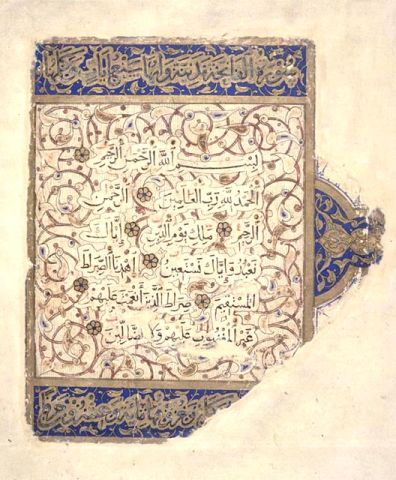
Image: 14th C. Qur'an, Mamluk origin, Library of Congress; Rights obtained.

A BREAKTHROUGH project which helps understand the Qur'an AS REVEALED -not just 'as explained.'

---------------------------------------------------------------------------

Friday, February 5, 2010

Day 32; HQ 3:101-115; pages 63+64

Welcome Friends:  Ahlan wa sahlan!

Yesterday’s Reading was highly detailed, but it is a CRUCIAL topic to some readers, and I know many who were asking for clarification of the ‘Messenger versus Prophet’ issue.  I hope that yesterday’s discussion helped.

Our Reading was also supposed to cover Verse 100, but we missed that due to ‘overload.’ 
We will include it in today’s discussion- where it fits even better into the topic.

COMMENTS:
1.     We begin today’s Reading with Verse 100, a warning to The Faithful who were already told in HQ3:32 (to obey) to follow the guidance of God and His Messenger, that if they (obeyed) followed the guidance of a certain faction of the People of (previous) Compilation, they would render them, after their faith, into Deniers/Apostates. 

Yusuf Ali’s explanation of (يطيعوا) seems more accurate here, because ‘paying heed’ (Asad’s rendering) is a weaker word. 
‘Obey,’ does mean ‘to comply with, to follow the commands and guidance of,’ but M. Asad probably steers clear of that word because of the negative connotations of ‘obedience’ being blind.
Anyway, in comparing what the Arabic Lexicon says about ( طوع) with the original meanings of the English* -I find them quite similar, so ‘to obey’ is correct, but one should not take it to mean ‘blind obedience,’ but rather a willing compliance based on one’s enlightened judgment of what is best. 

2.     The responsibility borne by the Companions of Prophet Muhammad, peace upon him, was great (Verse 101).  How could they Deny (Faith/Truth) even as the Signs of God are being conveyed to them, and among them, indeed in their very midst, is His Messenger?!
Verse 102 is better explained by Muhammad Asad, since the explanation for ‘Taqwa’ is Awareness, not ‘fear,’ so Ali’s ‘fear God’ (اتقوا الله) is definitely inaccurate.  A rendering more accurate would be:

“O you who have attained to Faith, be aware of God, as is indeed His due of (your) Awareness (towards Him), and do not die except while being Purely Reverent to Him.” (2:132)

As we read this verse, we remember our past reading (Jan. 11th) and both Abraham and Jacob’s dying legacy to their children (HQ2:132):

“And this did Abraham entrust unto his children, as well as Jacob: "O my children! God has chosen for you the Standard of Accountability, therefore do not die except while being Purely Reverent to Him.” (2:132)

If we believe in God, we’d make sure this is what we entrust our children with; whether we live it, say it, write it… we have to relay this to them in any way we can.  If it had not been crucial we would not have found this as the final act of previous Messengers of God, and now in a direct command from God Himself to all who are Faithful!

3.     Verses 103-104 continue to address those who have attained Faith, beginning by telling them to secure themselves (اعتصموا) onto what God has extended for them*(بحبل الله) , collectively, and not to drift apart.  Then they are reminded of how God brought their minds/hearts together and they became brethren by His Grace, after being enemies.  And that there should grow out of them a community which invites unto Goodness, enjoins (upon its citizens) that which is mutually acceptable, and forbids that which is mutually objectionable (see Posting Jan. 22nd. for the characteristics of this vibrant community)… and the verses conclude with an important statement:  And such indeed are the Successful!

‘Falaha’ (فلح) literally means to prevail, AND win or succeed- see below*. (Yusuf Ali’s ‘felicity’ and M. Asad’s ‘happy state’ are both incorrect explanations, although Ali adds ‘success’ in his note 431, and says that it is also pertains to life).   
And perhaps we should also remember that in our Call to Prayer (athaan) right after the Muezzin calls everyone to ‘Salaah,’ he also calls them to ‘Falaah,’ to success.  So success is indeed ingrained into our daily lives as a CONSTANT goal, sought after as often as we seek the direction of Mecca.  So let us bring back that most important goal: Success.
  
We should be aware of this:  In the above verse Qur’an is talking here about SUCCESS which is primarily realized in Life.  Succeeding in Life and in the Afterlife.  Succeeding as a community and as individuals.  This cannot be attained without Security in holding onto the means and tools God has extended for us (whilst knowing that He will help us achieve our noble goals when we work well for them), and Togetherness (each one of us supporting and filling in for the other when required).  If we understood these verses we would refrain from putting one another down; it is OUR OWN security which is endangered when we hit at one another.  The Aware are the guardians of their communities, and of Humanity at large.
Verses 105-106 are well-explained by both Y.Ali and M. Asad.

4.     Verse 107-109 is better explained by Muhammad Asad.  I prefer his rendering of the words ‘aswad’ and ‘abyad.’  In the Arabic lexicon, these are not always related to color, but also denote the commonness of one thing and the rarity of the other.  Two OPPOSITE States of Being.

5.     The first half of Verse 110 is commonly quoted, and considered a description of the ideal Muslim Community.  Although it is directed to the First Community of Believers and says: ‘You were..’ in the past tense, many continue to explain or translate the first words as: ‘You are..’  (including both Yusuf Ali and Muhammad Asad).
They were the best community ‘ever evolved/brought forth’ for mankind (Y. Ali/M. Asad), a beautiful verse explained by both.  Please read both their notes:  Y. Ali’s note 434 about “a non-sectarian, non-racial, non-doctrinal, universal religion which Islam claims to be.”  And M. Asad’s note 82 in which he says that “this promise to the followers of the Qur’an is conditional” and ends by saying: “this promise is bound to lapse whenever the Muslims fail to live up to their faith.”

6.     Verses 111-112 describe one group among the People of earlier Compilation, those who have been degraded in life by their own deeds.  M. Asad explains in note 83 that, in considering themselves ‘God’s chosen people,’ they have in fact created a barrier between them and all other believers in One God. 
This should be a lesson for us, since many of us tend to put ourselves in our own, self-made, holier-than-thou, halos.

7.     After the unpleasant description above of the negative-minded community, Verses 113-115 are absolutely beautiful in their description of those who are their exact opposites.  Both are People of the (earlier) Compilation, but what a difference Faith makes!  This community is upright, and observes its bonds with God and with mankind (see Asad’s note 85), recites God’s messages throughout the night…

“They believe in God and the Last Day, and enjoin what is mutually acceptable and forbid what is mutually unacceptable and they advance* in all that is Good: and these are among the righteous (114) And whatever good they do, they shall never be denied it, for God has full knowledge of the Aware” (115)

Enough said!

Have a Blessed Weekend, and catch up with us!
Our next Reading is from HQ 3:116-132.

Peace unto all!

*طوع: الإصحابِ والانقيادِ. يقال طاعَه يَطُوعه،  إذا انقاد معه ومضى لأمره. وأطاعه بمعنى طاعَ له. ويقال لمن وافَقَ غيرَه: قد طاوعه. والاستطاعة مشتّقةٌ من الطَّوع... والعرب تقول: تطاوَعْ لهذا الأمر حتى تستطيعَه. ثم يقولون: تطوَّعَ، أي تكلَّف استطاعتَه، وأمَّا قولهم في التبرُّع بالشيء: قد تطوَّعَ بهِ، فهو من الباب لكنَّه لم يلزمه، لكنَّه انقاد مع خيرٍ أحبَّ أن يفعله. ولا يقال هذا إلاَّ في باب الخير والبِرّ.
1 : to follow the commands or guidance of..
2 : to conform to or comply with..

*(حبل) يدلُّ على امتداد الشيء. ثمّ يحمل عليه، ومَرْجِع الفروع مرجعٌ واحد.
  ومن الباب الحَبَل، وهو الحَمْل، وذلك أن الأيّام تَمْتَدُّ به.

*(عصم) يدلُّ على إمساكٍ ومنْع وملازمة. والمعنى في ذلك كلِّه معنىً واحد. من ذلك العِصْمة: أن يعصم اللهُ تعالى عَبْدَه من سوءٍ يقع فيه. واعتصم العبدُ بالله تعالى، إذا امتنع. واستَعْصَم: التجأ. وتقول العربُ: أعْصَمتُ فلاناً، أي هيّأتُ له شيئاً يعتصم بما نالته يدُه أي يلتجئ ويتمسَّك به. 
ومن الباب مِعْصم المَرْأة، وهو موضعُ السِّوارَين مِن ساعدَيها. وإنما سمِّي مِعْصماً لإمساكه السِّوار، ثم يكون معصماً ولا سِوار. وعِصامٌ: رجل والعرب تقول عند الاستخبار: "ما وراءَكَ يا عصام؟"، ويقولون للسَّائِدِ بنفسه لا بآبائه: نفسُ عِصامٍ سوَّدَتْ عِصَاما.

*(فلح) يدلُّ على شَقٍّ، أوعلى فَوْزٍ وبَقاء.
فالأوَّل: فَلَحتُ الأرضَ: شَقَقتُها.
والفَلاَح: البقاء والفَوْز.
advance means 'steady progress' and stresses effective assisting in hastening a process or bringing about a desired end, while advancement suggests progression that is bigger, more, or beyond normal

For ‘Ma’ruf’ & ‘Munkar’ Muhammad Asad says
(“…enjoin the doing of what is right and forbid the doing of what is wrong…”)

Thursday, February 4, 2010

Day 31; HQ 3:84-100; pages 61+62

Welcome Friends:  Ahlan wa sahlan!
If you have just joined IQRATHECHALLENGE, you will understand today’s Post better by going back a few Readings to get the correct terminology. 
A good strategy would be to put the search-word you need in ‘SEARCH THIS SITE’ (top right).

Yesterday’s Reading ended with a QUESTION:
أَفَغَيْرَ دِينِ اللَّهِ يَبْغُونَ وَلَهُ أَسْلَمَ مَن فِي السَّمَاوَاتِ وَالْأَرْضِ طَوْعًا وَكَرْهًا وَإِلَيْهِ يُرْجَعُونَ ﴿٨٣﴾
“Do they then seek a Standard of Accountability other than God’s, even as all who are in heaven and on earth do surrender in pure deference to Him – (whether) in willingness or reluctance- and unto Him shall they be returned? (83)*
Today’s Reading continues along the subject, addressing People of the (previous) Compilation.

COMMENTS:

1.     Prophet Muhammad, peace upon him, is commanded here to state unequivocally the beliefs he and his followers hold, namely Faith in what is being revealed to them, as well as what was revealed previously (to Abraham, Ishmael, Isaac and Jacob) and what was delivered to Moses and Jesus and Prophets from their Lord, making no distinction between any of them.  The verse ends with, ‘and unto Him are we pure in our reverence’ (ونحن له مسلمون).
The next verse states:
وَمَن يَبْتَغِ غَيْرَ الْإِسْلَامِ دِينًا فَلَن يُقْبَلَ مِنْهُ وَهُوَ فِي الْآخِرَةِ مِنَ الْخَاسِرِينَ ﴿٨٥﴾

“For whoever seeks a Standard of Accountability other than Pure Reverence to God, it will never be accepted from him, and in the Hereafter he will be among the Losers.”

2.     Verses 86-89 ask questions and provide incentives to a self-assessment and a return (to God).  ‘Tawba’ literally means ‘to return,*’ but it is well-translated as ‘repent’ because when we repent, we regret something, turn away from it, and make amends.

3.     Verses 90-91 are self-explanatory, and end on the note that no amount of wealth will do a Denier any good on Judgment Day.

4.     Verse 92 is a directive on how Faithful persons should spend if they wish to attain the degree of ‘Bir,’ or Sincerity.  ‘Bir’ from the root-verb ‘barra’ means being genuine, forthcoming, true to oneself and others (see Posting of Jan. 15th).  If we wish to attain that degree, we have to give others what we actually cherish for ourselves! (Y. Ali, note 419, calls it the ‘test of charity’.)

5.     Verses 93-95 continue discussing People of (earlier) Compilation, specifically the Children of Israel (Israel=Jacob), regarding the foods Jacob had made unlawful unto himself  (M. Asad’s note 73-74), and encourage them to follow Abraham’s creed, peace upon him.  Verses 98-99 are self-explanatory (see M. Asad’s note 78).

6.     Verse 96 begins by saying: “Indeed, the first House placed (positioned) for Mankind is that which is in Becca …

·        Most commentators say it refers to Mecca (pronounced and written ‘Becca’ here), and that Becca is another name for Mecca.  Yusuf Ali and Muhammad Asad agree, Asad explains in note 75-76 that B &M are phonetically close and have sometimes interchanged as they evolved from older to more recent languages. 

·        Others (such as historian Dr. Ahmad Daoud ) explain that this is related to the First House of Worship which was ‘positioned, or placed’ ( وُضِع means placed from above NOT ‘raised from below’) upon a very important site.  This location or site was where God first united the Spirit and the Human Self, bringing into existence the Cognizant Human who thus united for earthly existence, worshipped The Creator.  He tells us this interpretation goes back to the ancient language from which Arabic evolved, where ‘Ba’ means ‘Spirit,’ and ‘Ka’ means ‘Self!’

·        Others say that each sound in the Qur’an is there for a purpose, and that its purpose is to fulfill its role in the general DIVINELY inspired DESIGN that is the Qur’an.  This Revelation, being the final one, is preserved by its Divine Design, which is a Unit of Precision.  People have approached this Message and studied its numeric design, its scientifically-sound descriptions, its linguistic and phonetic distinction, and have always been awed by its precision.  Where ‘sounds/letters’ are concerned, numerically or phonetically, ‘M’ is not equivalent to ‘B.’ The exchange (Mecca appearing here as Becca) has to do both with preserving Qur’anic precision of Design (as to the exact number of times each appears in it), as well as phonetic distinction.  In this computer age there are many important findings related to this, and we’ll get to them in time.

Numeric and phonetic design is also considered one reason why, for example, we see the Arabic word ‘siraat’ (سراط) pronounced (and indeed written in the Qur’an) with the letter ‘sad’(ص=صراط)  instead of the letter ‘seen .(س)  We will be discussing phonetics, as this subject is VERY interesting and helps us understand why Arabic was chosen as the Qur’anic medium!

Indeed, God’s word is Truth- May He guide us to its correct understanding!


7.     We finally get to the topic of Messenger of God versus Prophet, which we’ve been hoping to discuss for the past few days: 
In our Reading of February 2nd (in verse 68) we read:

“Closest to Abraham are those who follow him, as well as this Prophet ….”  

We noticed then, that the Qur'an did not say “…as well as this ‘Messenger.” We began to discuss the significance of using one title over the other.  We said that these two words should not be interchangeable, as is common amongst us. 
His title ‘Prophet’ is general, and relates to his role amongst people, while his title ‘Messenger’ is specific, and ALWAYS relates purely to the Message, the Qur’an.  That is why the Qur'an would not refer to him as Messenger in the verse mentioned above, for it is in his capacity as Prophet that he is discussed.  In his capacity as Messenger -bearing God’s Final Message- Muhammad is distinctive, peace upon him.
We shall continue this discussion, showing the distinction between the two words ‘Prophet’ and ‘Messenger’ of (from) God’ الله/ رسول من الله)  .*(نبي؛ رسول 

Scholars of various disciplines have already written in length on the subject, so it might be a good idea to look at these two titles from a new angle:

·        We find the title(رسول الله)  ‘Messenger of God or God’s Messenger’ mentioned in the Qur'an 17 times, referring to Moses, Jesus, Muhammad and others, peace upon them all, while the Qur'an does NOT ONCE mention the title Prophet of God ‘نبي الله.’ Why?  Because the title of each Messenger is relative to the Message FROM God, so he is God’s Messenger.  As for the title of Prophet, it is his status among his people; it is relative to them. 
    
    And the Qur'an NEVER tells us to believe in God+Prophet/s, but OFTEN tells us to believe in God+Messenger/s*.
     Why is that significant?

It is very significant for, when we search the Qur’an, we find that, we are told to obey Muhammad, peace upon him, (رسول الله) Rasoolul-Lah; to obey him in his capacity as Messenger.  Not once are we told to obey (النبي) al-Nabi, the Prophet.
On the other hand, when God reproaches him for something he did that he could have done differently, or says he forgives him, and speaks to him of his marriage or divorce, He always addresses him as ‘O Prophet!’ (يا أيها النبي)  or of his family, it is (يا نساء النبي)…O women of the Prophet, or when his companions are given the etiquettes of entering his home, or how should speak to him...it is all about the 'Nabi'- Prophet.  In other words, every-day happenings NEVER relate in any way to the ‘Messenger.’

Indeed, everything in daily life, and in what goes around him, is relevant to a Prophet, but what is relevant to a Messenger of God has to be related to the Message itself and its Source.

In his existence there is an awareness that is achieved in his capacity as Messenger.  It is that awareness which receives Divine Revelation.  In that capacity he is God’s, he will not make mistakes, he need never be reproached, he can bear no blame.
 
God will correct what that chosen person might say or do in his capacity as a Prophet, but what he delivers from God in his capacity as Messenger is by definition flawless, because the Message is God’s and He delivers it, safeguarded throughout.
Therefore, the main difference between the two terms is that ‘Prophet’ describes the relationship of a chosen person to other people from amongst whom he was chosen, while ‘Messenger of God’ describes the relationship of this chosen person to God.

As for the (human) Messenger of God himself, well, he IS ALSO a Prophet, as is very clear in HQ4:69 (and there are many other verses to prove that), for without that understanding, we'd find the heavenly company of the Hereafter, listed below, excluding Messengers!

"And whoever obeys God and the Messenger, such people shall be with those upon whom God has bestowed His Blessings: of the Prophets, the Truthful, the Witnesses, and the Righteous, and how goodly are such for company!"

 
Where are the 'Messengers' in this Blessed company?  They are either missing completely, or are among the 'Prophets.'  Of course the latter is more likely, which proves that Messengers of God indeed, ARE Prophets to their people.
Therefore, let us at least arrive together at the following conclusion:
In verse (HQ33:40), when God said that Muhammad His Messenger was the Seal, the Conclusion, the Final of Prophets, He was speaking to humanity so, as is indeed relative to us, there will NOT be any other person bearing Divine inspiration.
And if this verse does not say, in so many words, that he is the final 'messenger,' isn't that possibly due to the Qur'an's precision, seeing that Angels ARE indeed 'messengers' too? (HQ22:75; 35:1)
                                                    

Enough said!

Tomorrow’s reading is from HQ 3:101-115.

Peace unto all!
*This translation is tweaked slightly from yesterday’s; a more accurate rendering.
 (يُرْجَعُونَ) is in a grammatical form called ‘mabni lil Majhoool,’ where diacritical marks indicate a verb’s subject.  In this case, the subject is ‘unknown’ (majhool) so they are NOT returning themselves, but indeed shall be ‘returned!’

توب: كلمةٌ تدلُّ على الرُّجوع. يقال تابَ مِنْ ذنبه، أي رَجَعَ عنه يتوب إلى الله تَوبةً ومَتَاباً، فهو تائب. والتَّوْبُ التَّوبة. قال الله تعالى: (وَقَابِلِ التَّوْبِ( [غافر 3].
‏
*People have been grappling to define these terms for quite a while, often in argument and controversy.  Their argument became even more heated after it was posited that, although the Qur’an indicated clearly (HQ33:40) that Muhammad, peace upon him, was the final Prophet, it did not indicate that he was indeed the final Messenger of God!  Some people believe that this leaves that title open for others whom God might choose after him which, according to their argument, allows for present-day messengers of God.   
We do not aim to, nor indeed can we, settle any controversy here.  We can only research the definitions of these terms and try to minimize the problems which have stemmed from our lack of precision after centuries of interchanging Qur’anic terms. 

*(أنبياء) Mentioned here 'Anbiyaa', and NOT (نبيين) 'Nabiyeen' (as in HQ33:40 'Khaatam il Nabiyeen), which -being a Researcher- makes me realize that there is still more to uncover linguistically.  I'll get back to THIS specific distinction when I get an answer to it, God-willing.

* In plural, it is also about God’s Messengers. (رسول من الله- من عند الله) … Once however, when it blames people for killing their Prophets the Qur’an say ‘Anbiyaa'ul-Lah'

*Copy paste and research on Tanzil: آمنوا بالله + رسول+ رسل+ نبي
See for yourself the difference between the two, how the title Messenger is related to the Source of the Message- God- while and the title 'Prophet' is related to the people. You will find many verses which ask us to believe in God AND the Messenger/s, while only two which ask us to believe in God, and then list EIGHT other nouns BEFORE mentioning the Prophets INDIRECTLY, saying that we should believe in 'what was given unto the Nabiyoon-Prophets..' 


Let's TWEET this!

Tweet me!