CLICK IMAGE: Tanzil Website


OUR MISSION:
UNCOVERING the original message of the Arabic Qur'an by using Lexicons compiled more than 1,000 years ago.

ISOLATING Fact from Fiction.


RECOVERING Hope and regaining the perspective where Humanity is one, God's Message is one, and our Future CAN become one we all look forward to!


© 2010 IQRATHECHALLENGE: INTELLECTUAL PROPERTY PROTECTED BY D.M.C.A. ALL RIGHTS RESERVED.

© 2010 IQRATHECHALLENGE: INTELLECTUAL PROPERTY PROTECTED BY D.M.C.A. ALL RIGHTS RESERVED.
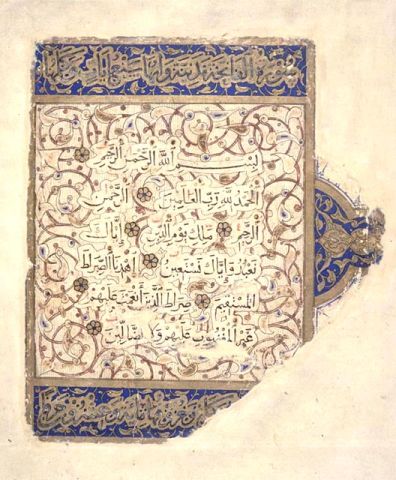
Image: 14th C. Qur'an, Mamluk origin, Library of Congress; Rights obtained.

A BREAKTHROUGH project which helps understand the Qur'an AS REVEALED -not just 'as explained.'

---------------------------------------------------------------------------

Wednesday, March 17, 2010

Day 62; HQ5: 90-102, pages 123+124

Welcome Friends:  Ahlan wa sahlan!

How are you doing with your Readings? 
Some of you may have noticed the words ‘A Dynamic activated..’ added to the top of our page, and if you are newcomers, you might be wondering about this. 
Well, our endeavor is designed to activate the Dynamic of Iqra’ in Regular Readers.  Check the Posting of December 27th for what ‘IQRA’ means.  Some Readers already sense great positivity in themselves, while others have yet to make a Priority of their daily Qur’anic reading, with the rest of us.  All it takes is time set aside for this -even if only 15 minutes or so every day. 
In the IQRA Dynamic, Time is an integral component.  So, as we set our course on this Challenge, our daily gains measured in imperceptible increments, Time becomes our Friend rather than our Opponent!   
COMMENTS:
1.  Our Reading today begins with the verse we referred to when the topic of intoxicants first came up in our Reading of HQ2:219.  Readers will note that this, below, is my translation:
“O you who have attained Faith! Indeed the intoxicants, and easy-gains, and idols, and divination-tools, are but Turmoil of the work of the Deviant/Sheytaan, therefore steer clear of it, so that you might succeed (90)

It is but the the Deviant/ Sheytaan’s objective to strike between you hostility and hatred through the intoxicants and easy-gains, and to prevent you from the remembrance of God and from the prayer.  So, will you then not abstain/desist?' (91)
Some aspects of this translation might be new, such as the word ‘Turmoil’ for (Rijs- رجس).  ‘Rijs,’ in the Lexicon, is a kind of confusion (physical and mental) which is also expressed by the sound of thunder  (see footnote*).  Since we have already discussed intoxicants in our Postings of January 19th and 20th, Readers can refer them for clarity. 
As we saw, Verse 91 asked the Faithful to put an end (abstain/desistينتهوا-) to both their pastimes of gambling and drinking intoxicants –and history tells us that they did –pouring out all such beverages onto their streets saying, ‘We’ve abstained, our Lord!  We’ve abstained!- انتهينا! انتهينا يا ربّنا! ).
But this is a Timeless call for abstention, to be similarly received by each generation of the Faithful, at each public gathering where intoxicants might be served, a person Faithful to God would ABSTAIN.
Furthermore, when God asks you, whether you will or will NOT do something, this is no less than a direct question, a ‘One on one’ INTERACTION between The Creator AND yourself,  deserving an immediate RESPONSE on your part, and that response is: …………………………..!
(Note that whatever you do, you will in fact, be responding. 
Silence IS a most eloquent response!)

Then we read the next verse (92); coming right after the question it underlines the fact, that whoever does NOT abstain has in fact turned away from obedience to God and to His Messenger:

Furthermore, obey God, and obey the Messenger, and beware.  But if you were to turn away, then you must know that upon our Messenger is only (the obligation of) an explicit delivery.” (92)

(For persons believing wholeheartedly in God, but STILL unconvinced of the seriousness of His verses regarding abstention from intoxicants, please consider the similarity of this call (verses 90-92), to Posting of March 15th –namely, the word ‘desist’ –‘yantahu’ ينتهوا)) in verse 73:

“Indeed, they have denied, those who said that God is the third of a Trinity, while there is no God except One God, and if they do not desist…”

and the interrogation at the end of verse 74:
“Will they not turn to God in repentance and ask his forgiveness…?” 

Please note the similarity in both commands, the same word was used and the same INTERACTIVE sentence form, a question after which persons (who ‘placed’ God in a Trinity) will respond, either by silence, or by saying: “You Are One, Unlike any other: I turn to You O God, in repentance, and seek Your Forgiveness!”) 

2.  Verse 93 mentions three times the need for the Faithful to maintain Awareness while eating and drinking! Knowing now of the harm hidden in foodstuffs, we realize how amazing it is that these verses were revealed more than 1,400 years ago.    
Traditionally, this verse is thought to relate to those who died before the verses on the prohibition of certain meats and the abstention from intoxicants were revealed, but there are commentators who say that it is for all time (Yusuf Ali is of the first opinion while Muhammad Asad is of the second). 
The Faithful should enjoy of what God has put at their disposal (except the unwholesome substances mentioned in HQ5:3; HQ6:145), as long as they are THREEFOLD aware and doers of good deeds. 
Researching Readers will notice that HQ6:145 describes the forbidden Meats as ‘Rijs,’ just like today’s description of gambling and intoxicants (I translated ‘rijs’ as Turmoil, but let me know if there is a better word to illustrate its Arabic meanings).

3.  Verses 94-95 discuss the ban on hunting when Believers are ‘hurum,’ related to what Yusuf Ali calls ‘in the Sacred Precincts or in pilgrim garb,’ and Muhammad Asad considers the ‘state of Pilgrimage (see Posting March 4th).  Verse 95 offers a means for atonement, but severe suffering awaits the transgressors who hunt during those times or in that place (while in a Pilgrim’s garb, a Believer cannot hunt anywhere, and in the Sacred Precinct of Mecca, hunting is always prohibited).  Verse 96 allows the hunting of water-game.
 
On a different note: Just to get an idea of how modern usage of Arabic terms has changed, look at the word meaning ‘travelers,’ from the verb ‘saara’سار - ‘walk,’ go.  The meaning of this word, سيّارة ‘sayyaara,’ has evolved for many Arabs, from a traveling caravan to a car!’

4.  Verse 97 mentions the status of the Sacred House, the Ka’ba or Cube, described by Yusuf Ali as ‘an asylum of security,’ and by Muhammad Asad as the ‘Inviolable Temple, a symbol for Mankind.’  Read Asad’s note 117 in which he speaks of its simple form.
Verse 98 is a statement describing God, that BOTH stirs the heart, and stills it!

5.  Verse 99 is related to verse 92 in its description of the Messenger’s sole obligation, telling us here that, despite the Messenger's limitations, GOD KNOWS WHAT WE REVEAL AND WHAT WE HIDE.  

6.  Verse 100 is related to perception; when we see something widespread, or see it often, we get conditioned to its acceptance, even if it is bad.  ‘Ulul albaab’ (أولوا الأباب), or the 'Insightful and Dedicated' should be aware of that, and will reject such harmful matters as they continue on their path to success (see definition of Ulul-albaab Posting Feb 12th)

7.   Verses 101-102 call the Faithful, telling them NOT to rush (God’s Messenger) with questions, but rather, to wait for the Qur’an to be revealed and the answers to gradually appear.  Yusuf Ali, in note 807, speaks of ‘secrets wisely hidden from us,’ while Muhammad Asad, in note 120, connects it directly to verse 99 and says that we should not ‘deduce additional laws from the injunctions’ revealed, adding burdens to ourselves as earlier peoples had done.

Interestingly, ‘O you who have attained Faith!’ is a call we heard today 4 times, and is one which appears 16 times in this Chapter alone!

Enough said!
Our next Reading is from HQ5: 103-112
Peace unto all!

  (رجس)  الراء والجيم والسين أصلٌ يدلُّ* على اختلاطٍ. يقال هُمْ في مَرْجُوسَةٍ مِن أمرِهم، أي اختِلاط. والرَّجْس: صوت الرَّعد، وذلك أنه يتردَّد. وكذلك هَدِيرُ البعيرِ رَجْسٌ. وسَحابٌ رَجّاسٌ، وبعيرٌ رَجّاس. وحكى ابنُ الأعرابيِّ: هذا رَاجِسٌ حَسَنٌ، أي راعِدٌ حَسن. ومن الباب الرِّجْس: القَذَر؛ لأنّه لَطْخٌ وخَلْط.

Tuesday, March 16, 2010

Day 61; HQ5: 77-89, pages 121+122

Welcome Friends:  Ahlan wa sahlan!
Congratulations dear Friends: Today we begin the 7th Section of the Qur’an!

As we noticed so far, this Chapter ‘the Repast,’ addresses in most part the Followers of (earlier) Compilation, calling them to Faith in their own Compilation, and showing them the rewards of upholding such Faith. 
From our last Posting:
‘Say: O People of the Compilation!  You are (standing) on nothing, until you uphold the Torah and the Evangel and what was revealed to you from your Lord..” and also: “Had the People of (earlier) Compilation been Faithful and Aware, We would have erased their misdeeds and brought them into Gardens of Bliss.”

We also noticed that the Qur’an does NOT label any of them (it does not call them ‘Deniers,’ كفّار an adjective some Muslims are quick to use), but rather it criticizes actions of certain people among them, mentioning their denial as a verb (and we already know the significance of verbs versus nouns): “Indeed, they have denied, those who said that God is Jesus son of Mary …” and: “Indeed, they have denied, those who said that God is the third of a Trinity, while there is no God except One God….” 
COMMENTS:
1.   Our last Posting ended with a question addressed to such persons in Verse 76: “Say, ‘Do you worship other than God, what neither has power to harm or to benefit you, while God is the Hearer, The Knower?”

And today’s Verse 77 continues with another general address to them:

“Say: O People of the (earlier) Compilation!  Do not commit unjustified excesses in your Standard of Accountability, and do not follow the desires of a people who had strayed earlier, and led many astray, and strayed from/lost the even way.

Verse 78 tells us that those amongst Bani Isra-eel who had Denied, were then condemned (to be banished from God’s Favor) by the tongue of David, as well as Jesus, Son of Mary, because they were non-complying بما عصوا and persisted in transgressing كانوا يعتدون. 

I do not like most translators’ use of the word ‘cursed.’  ‘La’ana’ لعن in Arabic is not a simple swear-word, or a ‘curse,’ but has the physical connotation of being deprived of all that is good; condemned to banishment from God’s Favor.  The power of these words uttered by the tongues of both Prophets David and Jesus, peace upon them, goes to show their suffering at the hands of those who denied!

2.  The following verse gives us the reason for such Banishment, and should be especially important to all Cognizant Humans who say they seek God, yet have nothing to show for it:

“They were not bidding one another to desist لا يتناهون from committing unacceptable deeds منكر, evil indeed is what they were committing (specifically) يفعلون .” 

3.  Note the levels of ‘Deeds’ we have so far read about:
There is a huge difference between ‘committing,’ which is related to specific acts, and what we mentioned in our last posting, comment no. 6: “what they were doing … يعملون” which is related to general acts (and also “what they were manufacturing/constructing…يصنعون’, which is related to the scheme). 

We shall discuss this in more depth as we proceed, but for now it is important to note that عمل (‘amala) and فعل (fa’ala) are NOT synonymous. 
If I ask a painter ‘What do you ‘ta’mal?’ ماذا تعمل؟- he would respond that he is a painter, which is his general occupation.  If I ask, ‘What do you ‘taf’al?’ ماذا تفعل؟ - he would never say that he is a painter, but would probably say that he mixes paint, uses brushes, and applies different layers on various surfaces etc.. 
Now let’s say I ask him the same two questions, adding the words ‘right now.’ His response to my first question might relate to a project he is currently working on, BUT his response to my second question would HAVE to reflect the EXACT act he is doing when responding; in fact he’d have to say, “I am talking to you!”
This is why verses such as HQ39:70 are SO eloquent!

“And every Self will be repaid for its work عمل, and He Knows best what they were doing/committing (in minute detail)” !

And now a question to our dear Readers:  How does the Qur’an refer to God’s ‘acts?’ Does it use the general verb ya‘mal يعمل- or the specific verb yaf’al يفعل- or perhaps both? I’ll leave the answer till later to give you time to think (or search Tanzil)!

4.  Verses 80-81 discuss the alliance of Protection made between certain persons from among the People of earlier Compilation, namely here, the Jewish Tribes of Yethrib, and  Those who have Denied, namely, the Idolatrous Tribe of Qureish, which is considered a reprehensible act.  Had they any Faith at all in God, and the Prophet (Moses) and what was revealed to him, they would never have taken them as Protectors, but many of them are corrupt.

5.  Verse 82-85 gave the Faithful, at the time of Revelation, a general assessment of the two contrasting positions held TOWARDS them by ‘Those who have Associated Partners with God,’ as well as the People of Earlier Compilation. 
We notice that Those who have Associated, AND the three Jewish Tribes, are considered one Hostile group, dubbed ‘the most severe among people in enmity towards Those who have attained Faith.’  Their negative position is given in a short statement of a few words, making up the first half of verse 82.
This is in stark contrast to those who identified themselves as Nasaaraa, meaning the Christians.  Their positive position and beautiful description takes up the second half of verse 82 as well as all of verses 83-85:
·  They are closest in feelings of accord and affection مودة to those who have Faith.
·  Among them are dedicated priests and monks.
· They are not arrogant.
· They are overcome with emotion when they hear what was revealed to the Messenger (Muhammad), and weep in their knowledge of its Truth.
· They say, “Our Lord,’ enroll us among the Witnesses!”
· They say, “And why should we not believe in God and in what has been delivered to us of the Truth, and yearn that our Lord admits us to the company of the Righteous?”

The result of all those beautiful qualities is given in verse 85, that God rewards them for their standpoint (which they verbally affirmed), Gardens beneath which rivers flow, to dwell therein eternally, and that is the reward of the Doers of Good.  
Read Posting March 8th for more on such persons.
Verse 86 gives the contrasting image of Those who Denied and belied God’s Signs, as being Companions of the Inferno.

6. Verses 87-88 are addressed to those who have attained Faith, telling us NOT to prohibit unto ourselves what is wholesome (in the first place) and was made lawful to us by God, but also NOT to transgress (committing excesses in our partaking of what is lawful), for God  loves not the transgressors.  And then, that we can partake of what he has provided for us, lawful and wholesome, and that we should be Aware of God whom we have faith in (as we do so).

7.  Verse 89 shows us the importance of awareness in doing the right thing, even if after a mistake, and underlines the value of a Believer’s utterance.  Although oaths in general are not to be uttered lightly, and better yet not uttered at all because a Believer’s word should be the equivalent of an oath, yet that is an idyllic situation.  In this verse we find a way out of the oaths ‘not so idealistic’ persons might have made of their own accord in everyday settings, usually casually or in the heat of argument, as in ‘I swear I will never …’ This is NOT to be confused with the serious oaths of persons bearing witness or in courts of justice; THAT is a false oath called ‘zoor’ –زور- and is among the prohibitions ‘muharramaat,’ mentioned together with the worshipping of idols (HQ22:30)!  
Therefore, as for any casual oaths we may have uttered that are hasty, irresponsible, ignorant, or detrimental in any way to us or others, such oaths must not be allowed to stand, because general benefit is more important than keeping an oath.  However, there is a price to be paid for that; an atonement, and expiation.  Also, although we should break all harmful oaths, deliberate or otherwise, God WILL call us to account for our intention, and we should be aware of that.  There is no point in fulfilling a hurtful or regretful oath as that will land us in an even graver condition: we’d have shown the intent AND committed the injurious deed- such oaths are better broken. 
The best thing of course, is to preserve our oaths; never use them, or use them rarely and with full awareness of the consequences.

Four CHOICES are given as expiation for an oath:

·  Feeding ten poor persons of the most balanced, or best, of what you would feed your own families (see  وسط*)
·  Or clothing ten persons.
·  Or freeing the yoke around one person’s neck (at one point in time this verse was understood to mean purchasing a slave’s freedom.  Today it probably refers to any financial yoke that is an obstruction to freedom).
·  Or, if one does not find the means for the above, a Fasting of three (consecutive) days.
(Readers can check HQ3:48 for a similar in-part, albeit more demanding, atonement for involuntary manslaughter- without forgetting the real definition of ‘Mu’min’ discussed in Posting of Feb 24th).

We are told at the end, that this is the atonement for our oaths, but that we should ‘preserve’ or oaths (the word أيمان- ‘aymaan’ twice repeated), and that this is how God makes clear for us His signs so that we might make the most out of what He has given us.  For definition of ‘Shukr- شكر- Posting Jan. 13th.

Enough said!
Our next Reading is from HQ5: 90-102
Peace unto all!

(وسط) يدلُّ على العَدل والنِّصف. وأعْدلُ الشَّيءِ: أوسَطُه ووَسَطُه. قال الله عزّ وجلَّ: {أُمَّةً وَسَطاً} [البقرة 143]. ويقولون: ضربتُ وَسَط رأسهِ بفتح السين، ووَسْطَ القوم بسكونها. وهو أوسَطُهم حَسَباً، إذا كان في واسطة قومه وأرفعِهِم محلاًّ.

Let's TWEET this!

Tweet me!