CLICK IMAGE: Tanzil Website


OUR MISSION:
UNCOVERING the original message of the Arabic Qur'an by using Lexicons compiled more than 1,000 years ago.

ISOLATING Fact from Fiction.


RECOVERING Hope and regaining the perspective where Humanity is one, God's Message is one, and our Future CAN become one we all look forward to!


© 2010 IQRATHECHALLENGE: INTELLECTUAL PROPERTY PROTECTED BY D.M.C.A. ALL RIGHTS RESERVED.

© 2010 IQRATHECHALLENGE: INTELLECTUAL PROPERTY PROTECTED BY D.M.C.A. ALL RIGHTS RESERVED.
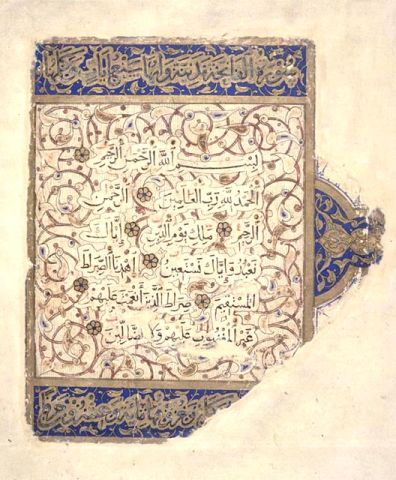
Image: 14th C. Qur'an, Mamluk origin, Library of Congress; Rights obtained.

A BREAKTHROUGH project which helps understand the Qur'an AS REVEALED -not just 'as explained.'

---------------------------------------------------------------------------

Saturday, March 27, 2010

WEEKEND OASIS II


Classical Arabic continued (from March 20th Posting).
Languages transform through time.  Utterly unrecognizable is the following line of Old English poetry:
hû þâ äðelingas ellen fremedon..” (see image).
Written about a thousand years ago, in modern English it would read: ‘How princes displayed then their prowess-in-battle.’[1] 
Old English during that period was similar to other European languages;[2] they were mutually intelligible,[3] and one group could easily understand the other.  In time, each language would evolve, but it wasn’t until the 15th century that each of these languages became standardized with the introduction of printing presses[4] to Europe. 
Classical Arabic is rooted far deeper in ancient history.[5]  Referred to as the only living member of the Old North Arabian group, it evolved from Old Arabic, which coexisted with other mutually intelligible languages in the Arabian Peninsula at the time, and is found today in inscriptions dating back to the 1st century B.C.[6]  Evolving from these beginnings, Classical Arabic reached maturity in the late 6th and early 7th century with the advent of the Arabic Qur’an. 
The standardization of Classical Arabic is quite remarkable.  In the early 7th century, believers began to memorize the Qur’an ad verbatim for prayer recitals, as guidance to daily life and for legal matters.  They first carved its verses into memory, and then onto pieces of wood, leather, palm-fronds, and parchment. 
Meanwhile, Islam was rapidly spreading:  “Only a century after its inception in Mecca i.e., A.D. 622, the new religion dominated an area extending from the Iberian Peninsula in the West to the steppes of Central Asia in the East.”[7] 
When the Chinese craft of paper-making arrived at their frontiers in Samarkand, Muslims began to mass-produce and distribute identical manuscript texts of the Qur’an.  By some accounts, this was around 500 years before printing presses[8] were first used in Germany[9].  What this did however, is simply confirm and broadcast what had already taken place three centuries ago: 
The Arabic language had already been standardized in a unique relationship between believers and the oral compilation of Qur’an.  In fact, no sooner had the Qur’an begun to be memorized in 610 AD, than it began to standardize the language!
For comparison between the usage of the English and the Arabic languages centuries ago, look at this historic manuscript dated 22 A.H/642 A.D. You will notice that it is much like the Arabic script of today -even the letters are dotted!  Also check out the LEXICON we use in our daily Readings, whose author died more than 1000 years ago
The Qur'an and the Arabic language have both preserved each other, and nothing can change that.  What should change is OUR level of understanding Arabic so as to present authentic Qur'anic concepts.


[1] From ‘Beowulf,’ an epic poem describing the adventures of a great Scandinavian warrior of the sixth century.
[2] Especially Old High German and Old Dutch.  The hypothetical common ancestor (proto-language) of all the Germanic languages (modern English, Dutch, German, Danish, Norwegian, Icelandic, and Swedish) is referred to as Proto-Germanic, or Common Germanic.  It is hypothetical because there is no surviving text; information has been reconstructed using the comparative method (http://en.wikipedia.org/wiki/Proto-Germanic).
[3] Mutual intelligibility: a relationship between languages in which speakers of different but related languages can readily understand each other without intentional study or extraordinary effort.
[4] Devised by German craftsman Johannes Gutenberg
[5] From the Afro-Asiatic, or Hamito-Semitic (حامي- سامي) family, of which is Akkadian (or Aramaic) with which Arabic still has much in common. 
[6] Old Arabic was attested in written form in an inscription in Qaryat Al-Faw (Qaryat Dhat Kahil) in the 1st century BC. (http://en.wikipedia.org/wiki/Ancient_North_Arabian). Qaryat Al-Faw, is the capital of Kinda and other Arab tribes (http://www.islamic-awareness.org/History/Islam/Inscriptions/faw.html)
[7] Dictionary of the History of Ideas: http://etext.virginia.edu/cgi-local/DHI/dhi.cgi?id=dv2-72
[8] Discovered in excavations at Fustat (old Cairo), archaeological context made it possible to date these manuscript texts to the 10th century.
[9] Geoffrey Roper http://www.khtt.net/person-578-en.html

Friday, March 26, 2010

Day 70; HQ6:91- 99 pages 139+140


Welcome Friends:  Ahlan wa sahlan!

COMMENTS:
1.  Today’s Reading starts with TWO VERSES that make us stop in our tracks and RECONSIDER EVERYTHING WE HAVE EVER LEARNT (or failed to learn) about God and His Compilation:

The first, Verse 91 begins

“They did not hold God in His rightful Esteem …”

Although this verse is of the early Meccan era, it is Timeless, and applies to anyone who underestimates God, or treats His Message as ‘static sheets’ (قراطيس)! 
Notice how the verse continues, commanding the Messenger Muhammad, peace upon him, to state a few eye-opening facts to such persons:

“They did not hold God in His rightful Esteem when they said, ‘God has not bestowed upon Mankind anything.’ 
Say: ‘Who bestowed the Compilation which Moses came with, a Light and Guidance to the people?  You (pl.) make of it static sheets, (some of) which you display, and you conceal much, while you were given to learn what you did not learn, neither you nor your forefathers.” 
Say: ‘God!’ 
Then leave them to their antics, plunging in their own predicament.”

Notice that Moses’ Compilation was both Guidance and Light, UNTIL it was made into static sheets by later generations of his followers.  When God’s revealed Message was tampered with (parts mis-explained, parts concealed) it lost its Divine Properties.  Much of its Learning and guiding interaction was lost to its followers.

2.  And then we find, in Verse 92, a ‘second chance’ given to Humanity, a Blessed Compilation which, as the Qur’an says, any person of ANY faith who believes in the Hereafter WILL believe in:
Why?  Because that is HOW such believing persons can maintain their relationship with God!

“And THIS is a Compilation we bestowed, of Abiding Benefit (Blessings), Confirming what was before it, so that you may warn the Foremost of all towns, and all around it.  And those who believe in the Hereafter, do believe in it (this Compilation), and THEY, of their Relationship (with God), are maintaining.”

From previous postings and definitions, our Regular Readers understand the full implication of these two verses: 
The fact that the Qur’an is Interactive, has been LOST on Humanity for the past one thousand years or more.  We have been treating the Qur’an as a dry ‘Book’ full of inscribed sheets, and God has told us that it is NOT so- it is of Abiding Benefit, which is the literal meaning of ‘blessed.[i]

Also see, in Posting March 21st:

“Had we sent unto you a Compilation (inscribed) in a static sheet, and had they touched it with their hands, Those who Denied would have said, “This is manifest Sorcery!” (HQ6:7)

3.  In continuation of  that denial, Verse 93 tells us that NO ONE IS WORSE IN WRONGDOING ([ii]أظلم) than someone who invents a lie in God’s name (intending it to be taken as God’s word), or says that he had received Revelation while he hasn’t received any, or that he too can ‘send down’ revelation like God’s (an indication that he does not believe in its Divine origins).  
 
And then the verse TRANSFERS us to these wrong-doers' deathbeds: 

The scene is scary, the wrong-doers are reluctant to depart this earth, and their consciousness/ spirit clings tight to their bodies as they literally sink into the depths of ‘mawt,’ their physical death, which to the 'thaalim' is full of 'thalaam...'  (The root-verb 'thalama ظلم' also indicates 'Darkness!')

At that point they fully realize the impact of all they had done AND what to expect.  

Meanwhile, the Angels are overpowering them.. (the term ‘bast + yad’ is always forceful.  Remember Cain and Abel, in March 10th Reading?  Copy, paste in Tanzil: بسط يدي).

“….Meanwhile, the Angels are overpowering saying:  “Get yourselves out!  Today you shall be rewarded with humiliating suffering due to what you were attributing to God of Untruths, and the arrogance in which you dismissed His Signs!”

Verse 94 goes on, to the second part of death, when each consciousness/ spirit has left its body, and comes to its Creator, bare and alone, with nothing it may have possessed on earth, and with no intercessor:

 “You did indeed come to Us, each alone, as We created you the first time…”  

God speaks directly, TO US ALL, in this verse! 

Dear Reader: You could probably guess what I felt, as I attempted to explain all these verses today.  Not just personal concern at the responsibility to deliver as accurate an explanation of His Word as possible after the warnings we read above- but also the Certainty that THIS IS God’s Message to us all, no matter what label we carry or what ‘faith’ we think we subscribe to:  HE IS OUR GOD, our Awe-inspiring God, and it is an absolute HONOR –for us all- to have received His Message.
As for skeptics who might question the existence of One God: 
Imagine yourself (or someone whom you love most on this earth), in the most hopeless state you can think of.  What would you do then?  On whom would you call... or more importantly, WHO can answer your call?  (Refer to Posting of March 22nd.)

4.   We must mention another fact:
 
Some might wonder why many Muslim Scholars prefer to repeat what others before them have said, rather than do fresh new research.  The verses above have probably given Readers an idea of why that is so: A debilitating fear of responsibility has stopped many true scholars from stepping out of the norm.  Unfortunately however, it has NOT stopped extremists!  They have always been quick to interpret and motivate others to their way of thinking.

This is why it is CRUCIAL to explain the Qur’an contextually and linguistically, in as accurate a rendering as possible, an achievement which would not only replace the extremist readings, but would also make us ‘hunafaa’ (Jan 12th Post) returning today’s recipients of the Qur’an to a status similar to that of the early Recipients; we too can become the most admirable of citizens in our Human Community!

5.   Verses 96-99 re-introduce us to God: 
“God is He Who……………”  
The verses SHOW us Who He is by what He does, in a long list of His Blessings and Bounty which we are familiar with, and require for our existence.
But at the TOP of that list, He shows us Life being brought out of Death, and vice versa.
These verses are well-explained by both Yusuf Ali and Muhammad Asad.
Note the variant endings  “.. to people who know-97/ to people who understand 98/ to people who believe 99”…which are related to the topic of each verse.
Also note in Verse 98 the different interpretations of (مستقر ومستودع) ‘place of sojourn/ time limit’ and the ‘place of departure/ resting-place’ according to Yusuf Ali and Muhammad Asad.

6.  This chapter is titled, al An’aam, and those of us who know Arabic would have noticed the root verb ‘na’ama’ ([iii]نعم) which is related to 132 Qur’anic verses, as well as to the Opener, the Faatiha, when we ask God to guide us to the Path of those upon whom He has bestowed His Grace/ His Blessings (Ali/Asad) أنعمت عليهم. 
Commentators have traditionally understood this title to refer to the livestock mentioned in this Chapter, because these are called ‘an’aam’ in Arabic, and were for Qureish the greatest and finest of ‘blessings.’   
The Lexicon tells us that the root-word’s variations are too plentiful to even mention, but that their connotation relates to only ONE thing: a comfortable, advantageous living in a state of well-being. 
Perhaps we should widen the scope in which we understand the title ‘An’aam’ to include the many other blessings this chapter mentions!

Enough said!
Have a ‘Blessed’ Weekend full of In’aam إنعام’ !!
Our next Reading is from HQ6:100-116
Peace unto all!


 مبارك: ثابت الخير، ثبوت الماء في البركة.. [i]

[ii] (ظلم) أصلان:
-خلافُ الضِّياء والنور.
-ووَضْع الشَّيءِ غيرَ موضعه تعدِّياً.
فالأوَّل الظُّلْمة، والجمع ظلمات. والظَّلام: اسم الظلمة؛ وقد أظْلَمَ المكان إظلاماً.
والأصل الآخَر ظلَمَه يظلِمُه ظُلْماً. والأصل وضعُ الشَّيْءِ [في] غير موضعه؛ ألا تَراهم يقولون: "مَنْ أشْبَهَ [أباه] فما ظَلَمَ"، أي ما وضع الشَّبَه غيرَ موضعه.

[iii] (نعم)  فروعُه كثيرة، وعندنا أنَّها على كثرتها راجعةٌ إلى أصلٍ واحدٍ يدلُّ على ترفُّهٍ وطِيب عيش وصلاح. منه النِّعمة: ما يُنعِم الله تعالى على عبدِه به من مالٍ وعيش. يقال: للهِ تعالى عليه نِعمة. والنِّعمة: المِنَّة، وكذا النَّعْماء. والنَّعْمة: التنعُّمُ وطيبُ العيش. قال الله تعالى:{وَنَعْمَةٍ كَانُوا فِيهَا فَاكِهينَ} [الدخان 27]. والنُّعَامَى: الرِّيح اللَّيِّنة. والنَّعَم: الإبل، لما فيه من الخَيْر والنِّعمة. قال الفرّاء: النَّعم ذَكَرٌ لا يؤنَّثُ فيقولون: هذا نَعَمٌ وارِدٌ؛ وتُجمَع أنعاماً. والأنعام: البهائم.

Let's TWEET this!

Tweet me!