.jpg)
Welcome Friends: Ahlan wa sahlan!
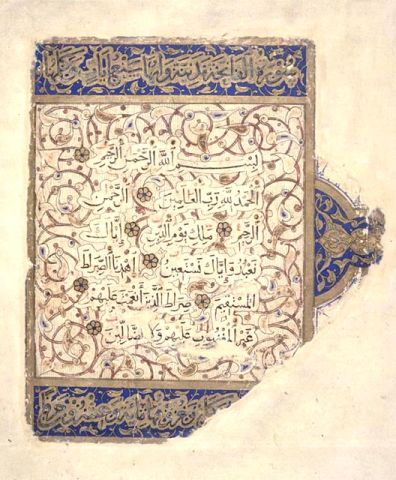
Today we’ll begin by touching upon the BEAUTY of the Arabic Qur’an!
Their commentaries can only be read in verse by verse view.
COMMENTS:
PAGE 205 Arabic Qur’an.
1. I’d like to introduce our dear Readers to another renowned scholar, Arthur J. Arberry, who, in 1955, first published ‘The Koran Interpreted.’ This book is noteworthy for its lyrical English, and considered by some to be the most beautifully translated meanings of the Qur’an in the English Language.
In his Preface to part one, Arberry highlights the beauty of the Arabic Qur’an and explains that it cannot be translated:
“In choosing to call the present work The Koran Interpreted I have conceded the relevancy of the orthodox Muslim view, of which Pickthall, for one, was so conscious, that the Koran is untranslatable. Some of the implications of that doctrine are sketched out in the preface to my The Holy Koran: an Introduction with Selections (Allen & Unwin, 1955), and it is not proposed to repeat the same argument here. Briefly, the rhetoric and rhythm of the Arabic of the Koran are so characteristic, so powerful, so highly emotive, that any version whatsoever is bound in the nature of things to be but a poor copy of the glittering splendour of the original. Never was it more true than in this instance, that “Traduttore, Traditore!”
In Italian, “Traduttore, Traditore!” means ‘Translator, Traitor!’ because by translating, one ends up betraying the original work.
Since we are trying very hard with our IQRA project NOT to betray Qur’anic intent, we should always consider our Qur’anic explanation as an ongoing project, open to revision at all times. May God accept and guide this humble effort.
2. And now we approach Verse 113, which is SO beautiful in Arabic. Nine characteristics to the Faithful, for which glad tidings are due. How heart-warming it must have been for those Early Believers who, having fulfilled all these characteristics, heard this verse in a direct command from God to His Messenger, to give them glad tidings!
Listen to it at Tanzil (‘Recitation’ window Left side-bar. I like Al-Ghamadi). As for the meanings, besides Ali and Asad, let’s also look today at Arberry’s explanation. He tries to emulate Qur’anic rhythm whenever possible:
"Those who repent, those who serve, those who pray, those who journey, those who bow, those who prostrate themselves, those who bid to honour and forbid dishonour, those who keep God’s Bounds -- and give thou good tidings to the believers."
"Those who repent, those who serve, those who pray, those who journey, those who bow, those who prostrate themselves, those who bid to honour and forbid dishonour, those who keep God’s Bounds -- and give thou good tidings to the believers."
3. Verses 113-114 are a notice of Severance from people who are idol-worshippers or associate partners with God.. total severance of ties.. no matter how related they are by blood or how close. This severance of all relationship included praying to God for their forgiveness! The example of Abraham, peace upon him is given in that, once he had evidence that his father was hostile to God, he absolved (released) himself of that relationship. Note the two beautiful characteristics of Abraham.
4. Verse 115 is a statement which I seem to understand differently than most scholars (I think Arberry got it right). As far as I can tell, this verse seems to show us that ‘Guidance,’ by definition, is ‘to know what you should be aware of.’ Therefore those who might stray after guidance, do so knowing exactly what they are doing and what the consequence to their actions will be. (That is why the consequences they will suffer are more severe than those who never knew guidance in the first place. This could refer to Hypocrites who believed then disbelieved.)
Verse 116 banishes from our mind… all… except God.
Verse 117 (Ali and Asad) is related to the ‘hour of Distress’ which took place on the occasion of the Battle of Tabuk, when some of the Faithful were about to lose heart.
PAGE 206 Arabic Qur’an.
5. Notice the state of mind of the three Believers who lagged behind (Verse 118). We are familiar with their story, having discussed it earlier and then posted it in the footnote on April 30th. We ended that footnote by saying:
“… Before dawn the next morning Qur’an was revealed HQ9:118 describing their pain and their repentance and declaring that God had indeed ‘forgiven them so that they might repent.’ The entire town rejoiced, a man on horseback was dispatched to give each of them the good news but someone had already climbed a hill and shouted out the good news, and therefore was able to reach them first. HQ9:43-46; 90; 102-105; 106; 118. We might be the ones asking for forgiveness, but when we do we must know… that God already has forgiven!”
6. Verse 119 calls upon those who have attained Faith, to be Aware of God and to be WITH the ‘saadiq’ صادقين. We uncovered the definition of ‘sadaqa-صدق’ in Posting of May 6th. The Arabic footnote, taken from two Lexicons tells us that being ‘true,’ is a word which denotes something strong and solid, because truth is more powerful than falsehood, which is why a sword or spear are described as ‘true,’ and a gift given in all willingness ‘sadaaq’ and ‘sadaqa.’ A friend in Arabic is a ‘sadeeq,’ because if there is no sincerity there is no friendship!
Therefore, as Believers, we should always be WITH the Truthful. This is something we should all be aware of at a time when hypocrisy seems to be the name of the game.
The next verses bring to an end the narrative on the Battle of Tabuk and its lessons. Verse 120 relates the fact that none should have lagged behind or succumbed to selfishness when the Messenger of God called them to him….the fact that every touch of thirst or weariness or need they felt, and every step they took and every advantage they had over their enemy only served to compile good deeds in their favor; God does not let go without reward any deeds of those who do Good.
7. Verse 121 seems to depart from the battle-ground, telling us that God took account of their spending, whether small or big, and their travels, to give them their reward AS PER THE BEST OF THEIR DEEDS.
This is beautiful.. .. Copy + paste أحسن يعملون in Tanzil to see how WE might qualify for this VIP treatment: If we patiently persevere (HQ 16: 96; 29: 7), if we have faith and do good deeds (HQ 16: 97), and IF WE ARE TRUTHFUL (HQ 39: 33-35). We have come full circle, back to TRUTH.
The final verse in Today’s reading, Verse 122, is very important, and this is an almost literal explanation:
“It is not for the Believers to go forth all together; but rather, if a traveling-team from every group of them went forth so as to become well-versed in Accountability, and to warn their people when they return to them, so that they may take heed.”
The word ‘taa’ifah -طائفة’ is of the same root-verb as ‘tawaaf’ which is to circumambulate, or go around something, which denotes constant motion, hence my explanation as traveling-team, or perhaps ‘action-team.'
If you can read Arabic, check Zamakhshari's commentary (1074-1143 AD) in which he says (punctuation and words within brackets are mine):
"The letter 'laam' (l) is to emphasize the negative, in that it is neither proper nor possible for everyone to leave their homeland altogether and go forth in pursuit of knowledge. This implies that, had it been proper, possible, and undamaging, then it would have been obligatory upon everyone to travel in pursuit of knowledge because (according to the Prophet's Saying): 'The pursuit of knowledge is obligatory upon every Muslim male and Muslim female.' Since it is neither possible nor beneficial for everyone to (leave home and) go forth altogether, then it is recommended that, out of every large group, a smaller group would go forth in their stead, so as to bear the responsibility and hardship of learning and gathering knowledge, and that they should set, as the goal and ultimate aim of their efforts:
Delivering to their people (what they have learnt) in guidance, counsel, and cautionary advice."
If you can read Arabic, check Zamakhshari's commentary (1074-1143 AD) in which he says (punctuation and words within brackets are mine):
"The letter 'laam' (l) is to emphasize the negative, in that it is neither proper nor possible for everyone to leave their homeland altogether and go forth in pursuit of knowledge. This implies that, had it been proper, possible, and undamaging, then it would have been obligatory upon everyone to travel in pursuit of knowledge because (according to the Prophet's Saying): 'The pursuit of knowledge is obligatory upon every Muslim male and Muslim female.' Since it is neither possible nor beneficial for everyone to (leave home and) go forth altogether, then it is recommended that, out of every large group, a smaller group would go forth in their stead, so as to bear the responsibility and hardship of learning and gathering knowledge, and that they should set, as the goal and ultimate aim of their efforts:
Delivering to their people (what they have learnt) in guidance, counsel, and cautionary advice."
WOW.
Dear Reader:
Dear Reader:
If you looked at TEN side-by-side translations (click 'Translations' box at top right of this page) you can easily tell that this verse is explained in reverse by most commentators!
· After reading the Qur’an and noting the many times it urges us to travel the earth, to look and learn (copy + paste سيروا في الأرض in Tanzil)…
· After departing from the common explanation of ‘deen’ as ‘religion,’ and knowing better than to imagine that all the knowledge we need is at home…
· This verse urges groups of the Faithful to travel the earth, growing in knowledge and Accountability, studying the wonder that is Creation and meeting other peoples and benefitting from their knowledge … with the goal of BRINGING THAT KNOWLEDGE HOME. In other words, what this verse is telling us is what the Early Believers in fact understood and did... BUT it is the exact opposite of what many of our forefathers have believed and done. First of all, they narrowed down the meaning of the word 'science' or 'knowledge' علم to solely mean 'religious knowledge,' and the word 'aalim' عالِم or 'scientist' came to refer to the 'religious scholar' alone. All other knowledge gradually faded into the background, until it was forgotten. Our problem is illustrated in the mis-explanation of this verse and the lame thought that we can learn everything by staying home. This despite evidence to the contrary. Arabic-readers can see the footnote expressing one understanding of this verse by an early (6th century after Hijra) commentator, Tubrusi, who quoted Al-Qadi in stating quite bluntly that this verse indicated the fact that 'tafaqquh' (which is a combination of knowledge, understanding and experience) CAN ONLY BE OBTAINED ABROAD! It is amazing that our forefathers, perhaps being ignorant of the variant views out there, ended up limiting themsleves to the narrowest interpretation, resulting in centuries of ignorance and backwardness. It is no wonder that our youth, after finding little to learn amongst us, went forth in pursuit of knowledge, and it is no wonder that many of them HAVE NOT RETURNED. Reread this verse and note how important it is that travelers understand the goal for leaving in the first place! But we cannot blame our youth: our society had not prepared encouraging circumstances for them to return to, and Muslim communities continue to greatly suffer from this 'Brain-drain.'
Enough said!
Our next Reading is from
HQ 9:123-129; 10: 1-6. A new Chapter!
HQ 9:123-129; 10: 1-6. A new Chapter!
Have a great weekend!
Peace unto all!
الطبرسي: 548 هجري: عن الجبائي قال والمراد بالنفر هنا الخروج لطلب العلم وإنما سمي ذلك نفراً لما فيه من مجاهدة أعداء الدين قال القاضي أبو عاصم وفي هذا دليل على اختصاص الغربة بالتفقه وأن الإنسان يتفقه في الغربة ما لا يمكنه ذلك في الوطن

