CLICK IMAGE: Tanzil Website


OUR MISSION:
UNCOVERING the original message of the Arabic Qur'an by using Lexicons compiled more than 1,000 years ago.

ISOLATING Fact from Fiction.


RECOVERING Hope and regaining the perspective where Humanity is one, God's Message is one, and our Future CAN become one we all look forward to!


© 2010 IQRATHECHALLENGE: INTELLECTUAL PROPERTY PROTECTED BY D.M.C.A. ALL RIGHTS RESERVED.

© 2010 IQRATHECHALLENGE: INTELLECTUAL PROPERTY PROTECTED BY D.M.C.A. ALL RIGHTS RESERVED.
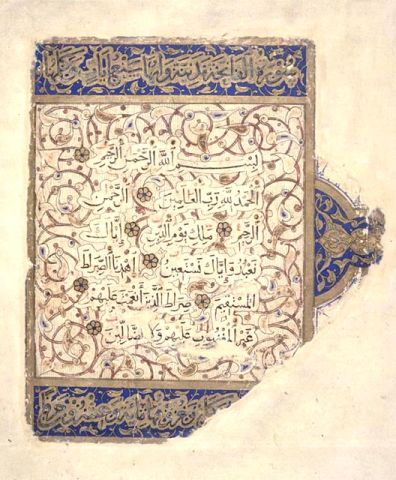
Image: 14th C. Qur'an, Mamluk origin, Library of Congress; Rights obtained.

A BREAKTHROUGH project which helps understand the Qur'an AS REVEALED -not just 'as explained.'

---------------------------------------------------------------------------

Sunday, May 23, 2010

Day 116; Qur’an 11:61-83, page 229 + 230

Welcome Friends:  Ahlan wa sahlan!
Isn’t it interesting to note how the path to God becomes ‘straightened,’ by each consecutive Divine Message, as Awareness is raised to higher levels?   
When we pay attention to detail, we notice that the earlier Messengers only asked their followers for the basics, such as to believe in God, and do good deeds.  In other words, they were commanded to fulfil part -not all- the Commandments on the 'Straight Path' (which we are full accountable for, as revealed in HQ 6: 151-153).  When we compare that to later Messengers, we see the difference. 
Each Messenger was sent to raise the level of Human Awareness and Advancement, relative to Human Knowledge at the time.
Regular Readers will remember that the word ‘mustaqeem’ in Arabic does not mean ‘straight,’ but rather ‘straightened, ‘ as the path humanity was guided to, by God’s Messengers, was ‘straightened’ for them, generation after generation.  Actually, ‘straight’ in Arabic is ‘qiyamقِيَم- ’ as seen in ‘deenan qiyamanديناً قِيَماً-’ which refers to a Standard of Accountability which is upright/straight and free of fault (HQ 6:161).  Remember our beautiful Posting of April 5th? 
REMINDER: The ‘Deen,’ or Standard of Accountability which all God’s Messengers called for, is ‘Islam,’ which simply means Pure Reverence to God.  This Standard is upright/straight, and free of fault, and a person with pure reverence to God is ‘Muslim,’ as are all His Messengers.  
Yusuf Ali’s Translation of this Chapter
Muhammad Asad’s Translation of this Chapter.
Their commentaries can only be read in verse by verse view.

COMMENTS:
1.  Our Reading today begins with Verse 61-62 (from page 228), and its reference to the tribe of Thamood/Thamud, and their Prophet Saleh, peace upon him, whom we mentioned earlier in Posting of April 10th. 
Notice what he asks of them, and God’s bounties of which he reminds them. 
As for them, they show their reluctance at forsaking what their forefathers worship!

PAGE 229 Arabic Qur’an.

2.  Prophet Saleh continues to present his case to his people in Verses 63-64, but they pay no heed to him, and defiantly kill the camel.  In Verses 65-66 he pronounces the ultimatum of three days, a truthful promise.  When it comes to pass, Saleh is saved with those who believed with him, as the others receive what they had denied (Verse 67).  
And after they had gone (Verse 68), it was as if they had never been!  

Isn’t that something to think of, especially since each of us naturally sees oneself as the ‘center of the universe’?   

3.  We begin Prophet Abraham’s narrative, peace upon him, in Verse 69.  As we mentioned earlier, each repetition adds value, usually in the form of new information. 

Read these verses carefully, they are absolutely beautiful! 

The Messengers come to Abraham with greetings of ‘Peace!’ to which he responds, and thereupon offers them a roasted calf.  But when they do not extend their hands to eat (70), he becomes fearful of them, which is when they tell him that (as God’s angelic messengers) their mission is directed at the people of Lot.  His wife appears/laughs (71), to which they give her glad tidings of Isaac (a son) after whom there will also be Jacob (a grandson).  Another explanation for the word 'dahik-ضحك' is 'to appear,' which is in fact the original connotation of the Arabic word, after which it came to denote laughter (see 1,000 year old definition in footnote).

IMPORTANT NOTE: This verse offers Qur’anic evidence that Isaac is NOT the son whom Abraham was commanded to sacrifice!

PAGE 230 Arabic Qur’an.
4.   Verse 72 shows us her response, where she refers to her husband as her “ba’lبعل- ” and in Verse 73 the messengers reassure her of God’s command.  
We mentioned the difference between the word “ba’l” and “zawj” on March 1st, and here is an excerpt:

“The difference between the two seems to be related to the ‘zawj’ being a literal ‘mate,’ one of a couple where there is no other woman for him, whereas the “ba’l” is a companion-in-marriage (who may have other wives -OR- as some have postulated- whose sexual relationship with his wife is inactive due to old age or to being in the midst of a divorce).” 

5.  Verses 74- 75- 76 tell us that, when Abraham realized what their mission was, he pleaded with them with regard to Lot’s people (perhaps to grant Lot, peace upon him, more time to convince them).  But it seems that the time was up for Lot’s people (AND they were about to prove that beyond any doubt, as we shall soon see!). We also remember what we had discussed on April 12, of which is this excerpt:

The ‘people of Lot- قوم لوط’ were violating one of the Inviolables
of the Straight path (commandment number 4),
and seem to have been the first group ever
to regularly and openly practice
homosexual acts ‘in open assemblies’ (HQ 29:29).

6.  Verses 77- 78- 79 continue to add detail to an unbelievable scene:  The contrast between Lot’s fear for his handsome guests, contrasted to his people’s frenzied sexual desire in them!  We can almost hear them pounding at his door as he shields them with futile argument, feeling the shame of exposing his noble visitors to such treatment… until he prays for support (80).  That’s when he finds out that those whom he was trying to shield WERE the support he was praying for, as they tell him who they are, and what their mission is (81).  Here we learn that Lot’s wife was doomed for not supporting Lot, and perhaps agreeing with what had been going on in town. 

7.  Verses 82- 83 describe the end of Lot’s people.

Wasn’t it interesting to note how, those perceived as being ‘most vulnerable,’ turned out to be the strongest support?
Also, that morning seems such a long way off when under severe pressure! 

Enough said! 
Our next Reading is from HQ 11:84-100.

Peace unto all!

ضحك: دليل الانكشاف والبروز. من ذلك الضَّحِك ضَحِك الإنسان. ويقال أيضاً الضَّحْك، والأوَّل أفصح. والضَّاحكة: كل سنٍّ تبدو من مُقَدَّم الأسنان والأضراس عند الضَّحِك. قال ابنُ الأعرابيّ: الضَّاحِك من السَّحاب مثلُ العارض، إلاَّ أنَّه إِذا بَرَقَ يقال فيه ضَحِك. والضَّحُوك: الطَّريق الواضح. ويقال أَضْحَكْتَ حوضَك، إِذا ملأتَه حتى يفيض.

Friday, May 21, 2010

Day 115; Qur’an 11:45-60, page 227 + 228

Welcome Friends:  Ahlan wa sahlan!
Yusuf Ali’s Translation of this Chapter
Muhammad Asad’s Translation of this Chapter.
Their commentaries can only be read in verse by verse view.

COMMENTS:
1. Our Reading today begins with Verse 45 (from page 226), as Prophet Noah, peace upon him, calls upon his Lord, regarding his son who was not saved from the flood.  (Remember the exchange which took place in yesterday’s Reading between father and son?)  Here he asks God why his son was not saved, despite his being ‘of his family.’

PAGE 227 Arabic Qur’an.

2.  Verses 46- 47 report the exchange which took place between Noah and his Lord, after Noah alludes to God’s promise to save his family.  Here Noah is told that his son is not ‘of his family,’ and furthermore that his son ‘is’- OR ‘has committed’ – an unrighteous deed.
The first literal understanding (of some) is thought to refer to the boy/man not being Noah’s genetic son.  The second metaphorical understanding (of most commentators) is that he was not ‘of Noah's family’ because he did not believe his own father, which also was the unrighteous deed he committed, which indicates that a true family is less about genetics and more about shared values. 
See also HQ 66:10 where the ‘betrayal’ of the wives (of Prophets Noah and Lot, peace upon both) is explained by Yusuf Ali as ‘spiritual betrayal.’
Anyway, this matter is Unseen (Gheyb) and has no bearing on us today, so we’ll leave it right there!

3.  Verse 48 begins by informing Noah that his ‘disembarkment’ (off of the Arc- and his descent upon the land and into the life that awaits him) would be in Peace and of much ‘abiding benefit’ (which is the meaning of ‘barakaat’ بركات-), which seems to be in answer to his prayer in HQ 23:29. 
As Readers will notice, although stories may seem to be ‘repeated’ at times, there is added value in each occurrence of the story in the Qur’an.  Many of those who do not believe the Qur’an to be ‘Truth,’ after studying it, have found great difficulty in explaining how, despite so many recurrences, the narratives only enhance and never contradict each other.  That alone is proof that the Qur’an has a single Truthful source since, as we all know, fabrication always leads to conflicting reports.

4.  As one historic narrative ends and another begins, Verse 49 readdresses Prophet Muhammad, peace upon him.

With Verse 50 begins the section on Prophet Hud, peace upon him (after whom this Chapter is named).  He calls upon his people (the tribe of ‘Aad) to worship God, other than Whom there is no god.  Except for the ending, this narrative is quite similar to what we read earlier about Hud in HQ 7:65.
Put "اعبدوا الله ما لكم من إله غيره" in Tanzil to see the other Prophets who made this same call to their people.
In Verse 51, he assures them that he seeks no personal benefit from them.
Put أسألكم أجر in Tanzil to see other Prophets who said the same.
  
5.  Verse 52 shows the personal and ecological revenues humanity can earn from mending destructive habits! 
‘Asking God’s Forgiveness’ means repenting from past wrong-doings, while ‘returning to Him’ means spending the rest of our lives undoing past wrongs, and attempting to do everything in line with the rest of God’s Creation, focusing upon Him as our DESTINATION. 
If we indeed worked WITH nature, and did so FOR the general well-being of all creatures on earth…would the skies be sent with abundance upon us (snow, rain, sunshine, wherever they are needed)?  Would we also be strengthened in our persons?
Although we might only say ‘Yes!’ driven by Faith, one thing is certain:  Every day we see more evidence of how our wrongdoing has diminished the bounties of this earth and all upon it, including ourselves.  It only follows logically that reversing our wrongs would replenish earth’s bounties.  See this important concept in 30:41.

We notice that this same Promise was also said by Noah to his people in HQ 71:11, which raises another argument against limiting the word ‘midraara’ (abundance) to rain, as Ali put it.  I prefer Asad’s interpretation.

Hud’s people respond to him quite harshly, in Verse 53.

PAGE 228 Arabic Qur’an.
6.  Their response continues in Verse 54, after which Hud denounces them, seeking God as his witness. 
In Verse 55 he challenges them, while in Verse 56 he relies upon God to whom all creatures are subject.  Hud also mentions here, that his Lord is on a Straight Path.  
In Verse 57 he announces that he has fulfilled his duty to them, with advice and final warning. 
Verse 58 brings God’s judgment upon them all, except for Hud and those who had believed with him.

7.  Then, Verse 59 begins with “And that was (the tribe of) ‘Aad,’ which ends their story, and serves to refocus our attention on the Messenger Muhammad, to whom this narrative was revealed, AND on his tribe, Qureish, for whom this narrative was a lesson.  
Verse 60 tells us that they were followed by اللعنة or ‘deprivation,’ in both this world and upon Resurrection (for accurate linguistic interpretation see March 16th.)  Excerpt below:

'La'ana' لعن in Arabic is not a simple swear-word, or a 'curse,' but has the physical connotation of being deprived of all that is good; condemned to banishment from God's Favor.”

Enough said! 
Our next Reading is from HQ 11:61-83.
Have a great Weekend!

Peace unto all!

Let's TWEET this!

Tweet me!