CLICK IMAGE: Tanzil Website


OUR MISSION:
UNCOVERING the original message of the Arabic Qur'an by using Lexicons compiled more than 1,000 years ago.

ISOLATING Fact from Fiction.


RECOVERING Hope and regaining the perspective where Humanity is one, God's Message is one, and our Future CAN become one we all look forward to!


© 2010 IQRATHECHALLENGE: INTELLECTUAL PROPERTY PROTECTED BY D.M.C.A. ALL RIGHTS RESERVED.

© 2010 IQRATHECHALLENGE: INTELLECTUAL PROPERTY PROTECTED BY D.M.C.A. ALL RIGHTS RESERVED.
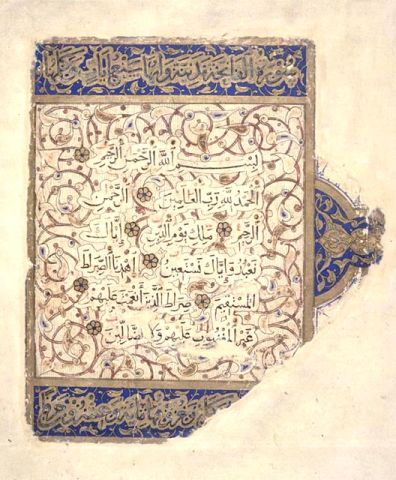
Image: 14th C. Qur'an, Mamluk origin, Library of Congress; Rights obtained.

A BREAKTHROUGH project which helps understand the Qur'an AS REVEALED -not just 'as explained.'

---------------------------------------------------------------------------

Thursday, August 12, 2010

Day 173; Qur’an 23:57-74, page 346

Welcome Friends:  Ahlan wa sahlan!
Yusuf Ali’s Translation of this Chapter.
Muhammad Asad’s Translation of this Chapter.
Their commentaries can only be read in verse by verse view.


COMMENTS:
PAGE 346 Arabic Qur’an.

1. In our last Reading (Verses 51- 52), we heard of God speaking directly to all Messengers, telling them that theirs is a single community, with a single Lord.  This is a VERY important announcement we should all bear in mind. 
Then, their followers were described, destroying this unity as they broke-off into factions, each (ironically) rejoicing in the heavy burden which they had just incurred!

Today we can see this so clearly, it is heart-breaking!  Not only have the so-called ‘followers of Messengers’ destroyed the unity which the Messengers were periodically sent to reinstate, but some have also maligned each other’s Messengers, as if their own had been detached from the Brotherhood of Messengers, and even cursed each other's Deity, as if He were not God Himself, Whom they so righteously worshipped.

Look through history books:  Isn’t it strange that the most reprehensible of deeds against Humanity were committed by people who called themselves ‘Believers in God?’   

This is why here, at iqrathechallenge we find it PARAMOUNT to reinstate this unity.
Humanity is one.  Our Lord Is One.  His Messengers are one brotherhood…. and so should people of Faith be:  One in Humanity, respecting each other’s manner of expressing their belief in God- even when that manner seems alien to us. 
Who are we to judge?!! 
It is God Who shall judge each of us, alone, by what potential He has given each, and how each of us has used His bounty, grown, and responded.

2.  And so, in Verses 57- 61 we arrive at the most beautiful of descriptions regarding people whom we should aim to be:  People who:

· Are so much in awe of their Lord, that they’ve become tender/ gentle mellow [i]  مشفقون-. ('Shafaq' describes the rose-colored sky at sunset, in its delicate, tranquil softness.)
·  Believe in His Signs.
·  Do not associate anything or anyone with Him.
·  Whatever they present/ give unto others, is offered with hearts/ minds that are vigilant, in (the knowledge) that they are returning unto their Lord.
Please note, that ‘wajilوَجِل- ’ and ‘vigil’ are related, denoting watchfulness and devoted self-observance!
What a magnificent frame for our gifts and donations:  KNOWLEDGE that we are in fact, even as we extend a helping hand… returning unto Him…so we give with devotion… and observance.

Verse 61confirms that it is indeed, THESE persons, who hasten in all that is Good and Beneficial, and it is they who are ‘foremost/ shall outrun’ all others (Ali/ Asad).
May we be among them!

3.  Verse 62 includes a recurrent statement which appears here for the fifth time (HQ 2:233; 2:286; 6:152; 7:42), BUT we seem not to have discussed it yet!
This statement is very important: 
According to Commentators, including Yusuf Ali and Muhammad Asad, this verse indicates that God does not place a burden on any ‘soul/ human being’ ‘greater than it can bear/ more than he is well able to bear..’ which is not a wrong interpretation, but it may have led to misunderstanding its intent.

Let me explain: 
Copy + paste كلف نفس إلا in Tanzil and see the 6 instances where this concept is mentioned (minus HQ 4:84 which is not relevant here).

Note the different occasions wherein we are charged (NOT burdened!):

·Caretaking and financial support.
·Earning from our deeds, both good and bad.
·Giving/ taking just measure in trade.
·Performing good deeds.
·Caretaking and financial support.
                       
A literal translation:

‘We do not charge a Self except with its capacity, and with us is a compilation that tells the Truth, and they shall not be wronged.’

See the difference?  Now, the question is:
When these occasions arise:
What is our best capacity?  What deeds are we capable of doing, bearing in mind that everything, Everything, EVERYTHING is compiled, and we shall not be wronged?

What are our TRUE limits? 

I believe that this is the intent of this verse.
God knows each Self and its capacity, and He shall not judge beyond its limits… but how far BEFORE we reach our limits…. do we usually allow ourselves to lax... and stop?

Look at HQ 65:7.  It is explicit: 

It tells us clearly that God does not charge a Self except with WHAT HE HAS PROVIDED IT WITH in the first place.  THAT detailed account, dear Reader, is the Compilation mentioned in our Reading today!  But read on:

4. Verses 63- 68 continue, with reference to Verse 62, stating that they shall not be wronged, those who were charged with their God-given capacity, those whose hearts/ minds remain oblivious of this fact, up until the point in time when the affluent amongst them start suffering…  THEN only do they cry out to God!
(Doesn’t that scene ring a bell?)

5. Verses 69- 72 respond to the allegations of Qureish against ‘their Messenger,’ and we notice here that this Message is considered ‘their Reminderذِكرِهم- ’ and it is one which they disregard… despite the fact that its Messenger had asked them for no recompense.

6.  In Verses 73- 74 we find the assertion that ‘you,’ indicating the Messenger Muhammad, are inviting them (Qureish) to the Straight Path, but that any who do not believe in the Hereafter, would be inclined to tilt away from this Path.

Put ‘straight path’ in ‘Search this Site’ for details.                            

Enough said!

Our next Reading is from HQ 23:75-104.

Peace unto all!


[i] (شفق) يدلُّ على رِقَّةٍ في الشيء، ثم يشتقُّ منه. فمن ذلك قولهم: أشفقت من الأمر، إذا رَقَقْت وحاذَرت. الشَّفَق: النُّدأة: التي تُرَى في السَّماء عند غُيُوبِ الشَّمس، وهي الحمرة. وسمِّيت بذلك للونها ورقّتها.

Wednesday, August 11, 2010

Day 172; Qur’an 23:31-56, page 344 + 345

Welcome Friends:  Ahlan wa sahlan!
Yusuf Ali’s Translation of this Chapter.
Muhammad Asad’s Translation of this Chapter.
Their commentaries can only be read in verse by verse view.


COMMENTS:
PAGE 344 Arabic Qur’an.

1.  Verse 31 points to the passage of time, with a new generation (that replaced the generation of Noah, whose story was mentioned in the preceding verses, peace upon him).  
Verse 32 presents us with this new Messenger’s appeal -without giving us his name.  We might find out who he is however, by cross-referencing his appeal below, putting اعبدوا الله تتقون in Tanzil,:

  “..Worship God! You have no other god but Him; Will you not be Aware?”
  
After doing that, we find out that these words were said by Prophet Hud (in HQ 7:65), so this Messenger is most likely to be Hud, peace upon him. 

It is interesting to note that Asad finds the Messenger’s identity irrelevant, seeing that the Qur’an has not divulged it.  I agree that this is a universal appeal, probably offered by all Messengers… yet:  It is exciting to rediscover the Qur’an’s amazing coherence!  

2. Verses 33- 38 present us with his people’s arguments:
First, we notice the three characteristics of the chieftains: 
They had denied; they had belied the Meeting of the Hereafter, they had been living in excess in their immediate, lowly life.

Their arguments are similar to Qureish’s arguments against the Messenger Muhammad, peace upon him. 
They disbelieve in him, being unable to obey a human who eats and drinks as they do.  They disbelieve in Resurrection, being unable to see dead dust and bones rise up again. 
They think he is a mere man, lying against God, to which the unnamed Messenger responds, in Verse 39.

Verses 40- 41 show us their End.

3. Verse 42 concludes this narrative, pointing to the passage of time, and to new generations that come into play.

PAGE 345 Arabic Qur’an.

Verse 43 is a statement which shows us that each community/ civilization has a natural sequence in which it evolves, from birth, maturity, to decay, and in Verse 44 we are told that Messengers were sent, one after the other.  We note that communities who belied their Messengers went through stages of self-destruction.

4.  Verses 45- 47- 48 summarize Moses’ story with Pharaoh, while Verse 49 specifically mentions ‘the Compilation’ sent to Moses, as guidance for his people.

Verse 50 mentions rendering the’ Son of Mary and his mother’ as a Sign.

5.  Verses 51- 52 speak directly to all Messengers, as God tells them that theirs is A SINGLE COMMUNITY, and that He is their Lord, so they should worship Him.
Verse 53 follows, showing us how their followers broke off into different parties or groups, each of them ‘farehفَرِح- ’ by what they had.  As we might remember, ‘fareh’ could mean ‘rejoicing/ delighting’ and it could also mean: burdened[i].

6.  Verses 54- 56 address Prophet Muhammad, peace upon him, as they speak about his people, Qureish.  They are so confident in their prosperity, that they do not feel their own Reality.

7.   
Ramadan
(3)
Ramadan is a big help for teenagers because it helps them realize, year after year until they reach full adulthood, how much more powerful and independent they are becoming.  Among the valuable life-lessons which Ramadan teaches, is Self-respect.

Print out this ‘Teen Motto,’ and gift it to the Teenager in your life:

I Respect Myself


I respect my Self,
therefore I will become a better person.
I respect my Mind,
therefore I will support it with knowledge.
I respect my Conscience,
therefore I will comfort it by good conduct.
I respect my Soul,
therefore I will nourish it with faith.
I respect my Body,
therefore I will protect it from harm.

I respect my Desires,
but since they contradict one another
I will be selective:
I will control any desire that does not respect
my Self, my Mind, my Conscience, my Soul, and my Body!

I respect the shortness of Life,
therefore I will make mine special.
I respect the suddenness of Death,
therefore I will be ready.
I respect the eternity of Afterlife where,
If I respect myself now, I will forever be happy.


Enough said!

Our next Reading is from HQ 23:57-89.

Peace unto all!


[i] (فرح) أصلانِ، يدلُّ أحدهما على خلاف الحُزْن، والآخر الإثْقال.
فالأوَّل الفَرَح، يقال فَرِحَ يَفرَح فَرَحا، فهو فَرِح. وأمَّا الأصل الآخر فالإفراح، وهو الإثقال. وقولُه عليه الصلاة والسَّلام: "لا يُتْرَك في الإسلام مُفْرَحٌ" قالوا: هذا الذي أثْقَلَه الدَّين. قال: إذا أنت لم تَبْرحْ تؤدِّي أمانةً  *** وتَحمِلُ أخرى أفرحتكَ الودائعُ.

Let's TWEET this!

Tweet me!