CLICK IMAGE: Tanzil Website


OUR MISSION:
UNCOVERING the original message of the Arabic Qur'an by using Lexicons compiled more than 1,000 years ago.

ISOLATING Fact from Fiction.


RECOVERING Hope and regaining the perspective where Humanity is one, God's Message is one, and our Future CAN become one we all look forward to!


© 2010 IQRATHECHALLENGE: INTELLECTUAL PROPERTY PROTECTED BY D.M.C.A. ALL RIGHTS RESERVED.

© 2010 IQRATHECHALLENGE: INTELLECTUAL PROPERTY PROTECTED BY D.M.C.A. ALL RIGHTS RESERVED.
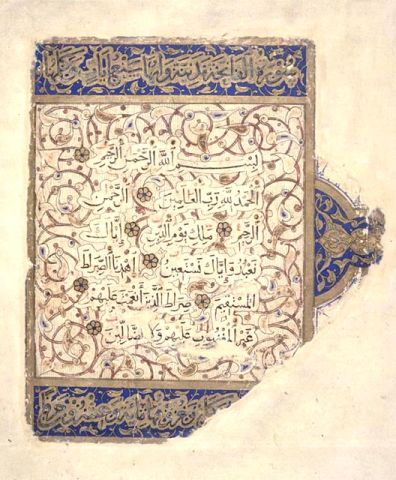
Image: 14th C. Qur'an, Mamluk origin, Library of Congress; Rights obtained.

A BREAKTHROUGH project which helps understand the Qur'an AS REVEALED -not just 'as explained.'

---------------------------------------------------------------------------

Wednesday, September 8, 2010

Day 192; Qur’an 28:60-88; Page 393- 396

Welcome Friends:  Ahlan wa sahlan!
Yusuf Ali’s Translation of this Chapter.
Muhammad Asad’s Translation of this Chapter.
Their commentaries can only be read in verse by verse view.

COMMENTS:
PAGE 393 Arabic Qur’an.
                                                                                                  
1.    Today’s Reading begins with the statement in Verse 60, that the life of this ‘lower-existence’ (‘dunya’) is no more than ‘convenience/ passing enjoyment’ (Ali/ Asad).  Verse 61 elaborates by drawing comparison between someone who gets the best which God had promised, and another who is brought forth on Resurrection Day, having had all the ‘conveniences’ of life (yet earned no good).  We read something similar in HQ 4:77; 9:38; 10:23; 13:26, where each verse shows us the difference.

Verses 62- 63- 64 give us a glimpse of that day, when ‘Associaters’ shall be questioned regarding the ‘Partners’ they had set up to God.  Well-explained by Asad (I like what he said about leaders of thought supposed to have set the community’s faulty standards of social behaviour and moral valuation.”

2.    Verses 65- 66- 67 ask (and respond to) another question of great significance, encouraging a return to God with the performance of good deeds, which is the only route to success. 
We should remember that it is Qureish who was being asked the question/ admonition:
 
“The Day He shall call them and say: What was your response to the Messengers?”

3.    Verses 68- 69- 70  declare God’s Uniqueness as Creator, with none to compare.
His is all Praise in the First (as in HQ 35:1) and the Last (as in HQ 10:10), His is the Judgment, and to Him will you all be returned.
The last part of this verse (in italics) will be repeated in Verse 88 to close this entire chapter

PAGE 394 Arabic Qur’an.

4.    After the beautiful declaration we just read, which began ‘He is God, no god but Heهو الله لا إله إلا هو....’-  we find Verses 71- 72- 73 showing us the Creator’s part, in the most observable of our daily comforts:  the alternation of Day and Night.
  
Then, as Yusuf Ali notes, Verses 74- 75 ‘round off the argument.’  This ‘rounding-off’ is with a warning, citing the need for those who associate with God, to present their evidence on Judgment Day.

5.    Verse 76 mentions ‘Qaroonقارون- ’ for the first time (he is mentioned 4 times in the Qur’an, and is considered the epitome of corrupting Affluence).  Read both Ali and Asad’s explanations; it is interesting to note that Ali relates him to the Biblical personality ‘Korah,’ while Asad sees him as a generic example for all time!

In Verses 76- 77 we hear the advice given to him by (the wise from among) his people, Bani Isra-eel:

·       Not to exult - for God loves not such persons (فرح- who rejoice triumphantly in their gain, without fulfilling its burden of responsibility![i]). 
·       To seek the Hereafter, using the bountiful provisions God had provided for him, without forgetting to make use of them, in Life.
·       To be generous with others, remembering God’s Generosity to him.
·       Not to pursue whatever might corrupt this earth, for God loves not the Corrupters. 

PAGE 395 Arabic Qur’an.

Verse 78 addresses Qaroon’s haughty response, even as it indirectly labels him a ‘mujrim;’ someone who has ‘extracted himself’ from Faith!
Verses 79- 80 recount how he appeared to his people in his full adornment, as well as what was thought and said of him (by both groups of his people) -those who sought the life of this world, versus those who had Knowledge.

Verse 81- 82 tells us what happened to Qaroon, and how those who had envied him learnt their lesson.
Verse 83 announces the characteristics of those who shall prevail in the Hereafter:
They are the Aware, who wanted neither self-exaltation on this earth, nor corruption.

Verse 84 is similar to HQ 6:160; 27:89; it mentions the recompense of Deeds, comparing the Good deed to the Bad.

PAGE 396 Arabic Qur’an.

The next verses of this Chapter help us better understand the important distinction between ‘Qur’an,’ and ‘Kitaab[ii]

6.    Verse 85 informs us (as we noted earlier), that the Qur’aan alone (not the Kitaab) was ‘IMPRESSED’ UPON Muhammad by God - where we said:

“In HQ 28:85, the Qur’an is mentioned as being ‘impressed upon you,’ the word ‘you’ referring to the ONLY person upon whom the Qur’an was literally impressed/ imprinted; someone upon whose heart/ mind ‘qalbقلب- it had descended… Muhammad, peace upon him.”

However, most explanations do not show this meaning:
‘Faradha aleyka/ فرض عليك or ‘impressed upon you’ is translated as:

·       ordained for thee’ by Ali.
·       laid down in plain terms, making it binding on thee’ by Asad.
 
Furthermore, when we research the Arabic connotations of the words راد- معاد[iii] we find that, although they both denote ‘return’... there still is SO MUCH MORE which we have missed (which the Arabs of the time well-understood):
  
In this verse, God is assuring His Messenger that He, who impressed the Qur’an upon him, shall in all certainty return him- AND strengthen him with the RETURNS/benefit- of taking him back, empowered, full circle to where it all began, to what has always been his aspired Destination! 
He also commands him to announce that God knows best who comes bearing Guidance, and who is in manifest error.

Verse 86 tells the Messenger that (God knows that) you had never expected the Compilation to be delivered to you (as it was delivered to other Messengers).  But (so it happened, that it was delivered to you), a Mercy from your Lord, therefore do not be a support to the Deniers.
Note that it is the Kitaab, NOT the Quraan, which he was ‘not expecting to be delivered of.’  This makes perfect sense since, BEFORE he became a Messenger, there would naturally be no mention of ‘Qur’an!’

This verse is better-understood in Asad’s explanation, but I disagree with his considering the address ‘you’ (which is directed to the Messenger), as directed to any ‘Believer.’  We should be very careful how we explain any verse which contains the word ‘Qur’an’ or ‘Kitab,’ as we might easily lose its distinction.

Verses 87- 88 add 4 more commands to the first, making them 5 altogether:

·     Do not be a support to the Deniers (86).
·     Do not let them impede you from the Signs of God after they were delivered to you.
·     Invite/ call (people) to your Lord.
·     Do not be of the Associaters (those who ‘associate’ or set up ‘partners’ with God).
·     Do not call on another deity besides God, there is no God but He, for Everything Is Expiring/ Shall Expire EXCEPT HIS DIRECTION[iv]; His is the Judgment, and to Him will you all be returned.

Notice here the ‘voice’ of God, advising His Messenger, commanding, persuading, dissuading…. so dutifully conveyed by His Messenger!  It is verses such as these which have led many to believe in the Qur’an.
And with this, the Chapter of (Accurate) Accounts ‘Qassas’ comes to a beautiful end.

As for us, dear Reader:  Let us close our laptops today, bearing in mind that everything is indeed ‘expiring’… even as we speak. 
May we all direct ourselves, from this day forward, to the one thing on earth that has no expiry:  God’s Direction.
Amen.     

Enough said!

Our next Reading is from HQ 29:1-25; a New Chapter!
Peace unto all!


[i] We already discussed ‘faraha’ which denotes both exultation AND heaviness /burden.  It is interesting to note that of the 22 times this word and its derivatives appear in the Qur’an, all but 4 mention ‘exultation’ unfavorably.  Exultation is only mentioned favorably when it is accompanied by Faith, and gratitude for God’s bounties (we shall see similar advice later in HQ 31:18; 40:75).

[ii] Regular Readers already know that ‘Qur’an ‘denotes the live interaction which takes place when a Qare’/ قارئ Reader activates the Dynamic of Iqra with its 6 components, whereas ‘Kitaab’ merely denotes a unit of ‘Compiled’ material.  See Aug 25th for grammatical form of the word ‘qur’aan’- being ‘superlative’ and ‘ongoing/ active.’  Put any required word in ‘Search this Site’.

[iii] ردوهو رَجْع الشَّيء. تقول: ردَدْتُ الشَّيءَ أرُدُّه ردّاً.
والرِّدُّ: عِماد الشَّيء الذي يردُّه، أي يَرْجِعُه عن السُّقوط والضَّعْف.
ويقال هذا أمرٌ لا رادَّةَ له، أي لا مرجُوع له ولا فائدةَ فيه.

عود: أصلان صحيحان، يدلُّ أحدهما على تثنيةٍ في الأمر، والآخر جنسٌ من الخشب.
فالأوَّل: العَوْد، قال الخليل: هو تثنية الأمر عوداً بعد بَدْء. تقول: بدأ ثُمَّ عاد. والعَوْدة: المَرّة الواحدة. ومن الباب العِيادة: أن تعود مريضاً.
والمَعَاد: كل شيء إليه المصير. والآخرة مَعادٌ للناس. واللهُ تعالى المبدِئ المُعيد، وذلك أنه أبدأَ الخلْقَ ثم يُعيدهم.
والعِيد: ما يعتاد من خَيالٍ أو هَمٍّ. ومنه المعاوَدَة، واعتياد الرَّجل، والتعوُّد.
والعَادة: الدُّرْبة. والتَّمادِي في شيء حتَّى يصير لـه سجيّةً. ويقال للمواظب على الشيء: المُعاوِد. وفي بعض الكلام: "الزموا تُقَى الله تعالى واستَعيدوها"، أي تعوَّدوها.
ويقال للشجاع: بَطَلٌ معاوِدٌ، أي لا يمنعُه ما رآه شدّة الحرب أن يعاودها. والقياس في كلِّ هذا صحيح.
ومن الباب: العائدة، وهو المعروف والصِّلة. تقول: ما أكثَرَ عائدةَ فلانٍ علينا. وهذا الأمر أعْوَدُ من هذا، أي أرفَق.
ومن الباب العِيد: كلُّ يومِ مَجْمَع. واشتقاقُه قد ذكره الخليل من عاد يَعُود، كأنَّهم عادُوا إليه. ويمكن أن يقال لأنَّه يعود كلَّ عامٍ. وهذا عندنا أصحُّ. وقال غيره، وهو قريب من المعنيين: إنّه سمِّي عيداً لأنَّهم قد اعتادوه . والياء في العِيد أصلها الواو، ولكنها قلبت ياءً لكسرة العين.
ويجمعون العيدَ أعياداً، ويصغرونه على التغيير عُيَيْد.
وأمّا الأصل الآخَر فالعُود وهو كلُّ خشبةٍ دَقّت. ويقال بل كلُّ خشبة عُود. والعُود: الذي يُتبَخّر به، معروف.

[iv] ‘Wajh’ is taken to mean ‘face,’ but it actually denotes ‘direction,’ as in ‘facing towards:’
وجه: يدلُّ على مقابلةٍ لشيء. والوجه مستقبِلٌ لكلِّ شيء. يقال وَجْه الرّجلِ وغَيره. وربَّما عُبِّر عن الذات بالوَجْه. تقول: وَجْهي إليك.
وواجهتُ فلاناً: جعلتُ وجهي تِلقاءَ وجهه.
ومن الباب قولُهم: هو وجيهٌ بيِّنُ الجاه.
والوِجهة: كلُّ موضعٍ استقبلتَه. قال الله تعالى: {وَلِكُلٍّ وِجْهَةٌ} [البقرة 148].
ووجَّهت الشَّيءَ: جعلتُه على جهة. وأصل جِهَتهِ وِجْهَته.
والتَّوجيه: أن تَحفِر تحت القِثَّاءَة أو البِطِّيخة ثم تُضجِعَها.
وتَوجَّهَ الشَّيْخُ: ولَّى وأدْبَر، كأنَّه أقْبَلَ بوجهه على الآخر.

Tuesday, September 7, 2010

Day 191; Qur’an 28:28-59; Page 389- 392

Welcome Friends:  Ahlan wa sahlan!
Today we salute our Partners in faith of Jewish and Christian background, those Purely Reverent to God: Our Reading today includes several most beautiful verses about you!

Yusuf Ali’s Translation of this Chapter.
Muhammad Asad’s Translation of this Chapter.
Their commentaries can only be read in verse by verse view.

COMMENTS:
PAGE 389 Arabic Qur’an.

1.  Today’s Reading (Verse 29) leaps 8-10 years forward: Prophet Moses, peace upon him (now married and travelling with his family), feels comforted by the fire he perceives ‘by the side of the Ttoor.’  ‘Ttoor[i]’ denotes an expanse, a towering ‘height,’ a‘mountain.’
He decides to approach the fire on his own to and return with news and kindling (we read something similar in HQ 20:10 and 27:7, but each time it is recounted we gain more information).

Aside:  ‘Ttoor’ is the origin of the English word ‘tower’ and French ‘tour,’ but, as usual NOBODY MENTIONS THIS, although it really is quite obvious (see footnote). 
If interested, check out this list of ‘Arabic Loanwords.’   I have many other words to add to this list, but they would probably not ‘qualify’ because I did not ‘get them from a leading Etymology Dictionary!’

2.  Verses 30- 31- 32 tell us what God said to Moses (also mentioned previously in Chapters 20 & 27).  Moses answers in Verses 33- 34, expressing his apprehension of being killed by Pharaoh for having killed one of his people.  He also shows his need for his brother Aaron’s support, seeing that the latter is more eloquent.

God grants him his request in Verse 35, promising him victory over Pharaoh and his hosts, who would not be able to get to them.

PAGE 390 Arabic Qur’an.

3.  In Verses 36- 37 we listen to Pharaoh’s people accusing Moses of ‘concocted sorcery,’ and to Moses’ response.

4.  Verses 38- 40 tell us about Pharaoh:  After announcing to his people that he knew of no God other than himself for them, he asked for a lofty building to be erected (as in HQ 40:36) so that he might take a look at Moses’ God …!

Let us compare that with his wife.  Actually, Pharaoh’s wife is considered a paragon of Faith as we see in HQ 66:11:

And God sets forth, as an example to those who believe, the wife of Pharaoh: Behold she said: "O my Lord! Build for me, in nearness to Thee, a mansion in the Garden, and save me from Pharaoh and his doings, and save me from those that do wrong.
(Yusuf Ali)

Let’s think: 
As King, as Ruler leading his people, Pharaoh had the responsibility of guiding them, but as the statement in HQ 20:79 assured us:
‘Pharaoh led his people astray instead of leading them aright!’ (Yusuf Ali)

It comes to mind, to compare him, as Ruler of his people, to the Queen of Sheba, as Ruler of her people!  Where he was an arrogant tyrant, she was an advice-seeking peacemaker.  He couldn’t handle the fact that Bani Isra’eel were free, and went after them even after having witnessed the Nine powerful Signs sent by God, even as his own wife was praying for an abode in Heaven!  The Queen of Sheba needed no forceful Signs; she had became a Believer by simple observation.

It is indicative of the Qur’anic view of womanhood to see examples such as these.  Even before believing in Solomon, the Queen of Sheba was:

·   Farsighted and wise (HQ 27:34): A Queen stating that she should try to prevent invasion, because the known M.O, of invaders is to despoil any township they enter, demeaning its honorable citizens!
·   A Peacemaker (HQ 27:35):  A Queen preferring to defend her nation by interaction, sending an offering rather than an army.

As for Pharaoh and his hosts, Verses 41- 42 show us their violent and ugly end, brought on by the ugliness and violence of their deeds.

In Verse 43 we hear a statement concerning the Compilation delivered to Moses, peace upon him, describing it as ‘….Insight to Cognizant Humans,  and Guidance and Mercy perchance they might Remember.’

PAGE 391 Arabic Qur’an.

5.  In Verses 44- 46 we read the words ‘..and you were not at… when...وما كنت’ FOUR times!  This is one reason why this Chapter is called ‘the Accurate Account,’ because God is giving His Messenger an account of important occurrences which took place at specific locations and times… which he had not witnessed.  Here we ‘hear the voice’ of God showing us His Messenger’s human limitations.
(Again, I don’t agree at all with Asad’s ‘Sinai;’ it is NOT what this verse says.)

We also learn (Verses 47- 48) of one reason why the story of Moses is so often repeated in the Qur’an: 
It seems that some of Prophet Muhammad’s contemporaries had been asking God for a Messenger so that they could follow His Signs and Believe.  When the Truth arrived to them, they asked for something similar to what Moses had received, although they were among those who had denied Moses and Aaron and accused them of being two sorcerers.
In Verse 49 the Messenger, peace upon him, is told to challenge them to produce a better-guiding Compilation which he would then follow, if indeed they were truthful.
Verse 50 shows us that they won’t; they were but ignorantly ‘justifying their actions.’  This ‘ignorant justification’ is called in the Qur’an ‘تتبع الهوى following plummeting desire.’  This ‘Hawa’ is always based on ignorance, so it really is an ‘intellectual’ void.
Ali calls 'ahwaa' (plural of Hawa) ‘lusts,’ while Asad calls them ‘likes and dislikes.’

Dear Reader:
See my response (at bottom) to a Reader’s valuable comment on ‘Desire.’  Let me know what YOU think.   

PAGE 392 Arabic Qur’an.

6. In Verses 51- 52 Qureish are warned that, after having received this Message, they are reminded and have no further excuse-  furthermore, that those who had received (earlier) Compilation, DO believe in it.

Then, Verses 53- 55 describe the People of (earlier) Compilation, who now believe in this Message -in the most beautiful terms.  When it is recited to these people of Jewish and Christian backgrounds they announce that:

· They have Believed in it.
· It is the Truth from their Lord.
· They were Purely Reverent (Muslim) even before it!

Dear Reader:
What you have just read is what most ‘New’ Believers say:  They tell us that they were ‘Purely Reverent’ even before reading the Qur’an or being introduced to what we call ‘Islam.’
 
Q. How is that?
  
A. Because what was ORIGINALLY called Islam is truly universal.  To grasp this concept, see the definition of ‘Islaam’ before you continue.  It is unfortunate that most of us who call ourselves ‘Muslims’ today do not correctly portray ‘Islam.’  Often, those who enter ‘Islam’ by choice do a better job than we do because:
· It was a choice they made in all Awareness.
· They applied it without parental or societal conditioning. 

Actually, ‘Pure Reverence to God’ has no label other than itself.  Purely Reverent people might be perceived as ‘belonging’ to various so-called ‘Religions,’ although their hearts and minds believe purely in One God.  Remember that Prophets Abraham and Jacob, peace upon them, both enjoined upon their children on their death-beds not to die except in Pure Reverence to God.

Deen’ in Arabic does NOT mean Religion.

Remember: According to the Qur’an and the Arabic language, there is nothing called ‘religions.’  It is not a different ‘religion’ that each of us has, but a different system شرعة and a different approach منهاج [ii]– and that’s how God willed it, to see who accomplishes best with what they are given (as explained on March 12th).

So, despite our different systems and approaches, each of us can have only one ‘Deen’ "دين" or ‘Standard of ‘accountability/ liability’ (with regard to ourselves). 

As for God, HIS assessment of us –ie the Standard by which He calls us all to account- is pure and flawless:

“Indeed, the Standard of Accountability to God (by which He holds all to account), is pure and flawless…”
(HQ 3:19)
الدين عند الله الإسلام...) (إن

As we said on Jan. 29th:

This is why the word ‘deen’ HAS NO PLURAL (in other words, the word ‘adyan’ as plural of ‘deen,’ was coined in modern times, and does NOT exist in the oldest lexicon). 
We are often liable to one another, and we are ALWAYS accountable to God:  a debt is ‘deyn,’ and the Day of Accountability is ‘Yawm il Deen.’
'Medina' means 'she to whom all are liable and accountable.'  It is a striking fact that no sooner had Prophet Muhammad, peace upon him, settled in 'Yethrib' that he changed the historic name of this town to one which indicates the new level of civic and moral accountability which would henceforth bind its citizens together and spread around the world!  Civilization is 'medeniyyeh,' for there can be no civilization without accountability, in fact, the more advanced a civilization the higher the accountability of its governing and non-governing citizens to each other and to their laws.  THIS is how early Muslims understood 'Deen' and how they spread their beautiful message.


So, back to our three verses (53- 54- 55) which describe the Believers (of Jewish and Christian backgrounds), listing their qualities and recounting their beautiful declarations of faith (italicized below):  

Firstly, they announced:
·  We have Believed in this Message.
·  It is the Truth from our Lord.
·  We were Purely Reverent to God even before it!

Secondly, such esteemed persons shall be given their reward two-fold because:
· They patiently persevered.
· They warded off the Bad, with Good.
· They spent (on others) of what God had provided them.
· They turned away upon hearing vain talk, stating: 
To each of us our deeds-
Peace upon you-
We shall not pursue the Ignorant!

What beauty of word and of Faith!
I've hyperlinked Muhammad Asad’s interpretation because he is one such person, and his comments show that he understood -and suffered- the hardships of such a pivotal life-change.  A 'must-read' is his beautiful book 'The Road to Mecca' which, by taking us on his personal journey (as journalist Leopold Weiss) from Judaism to Islam, induces soul-searching so deep that it does not matter what 'faith' the reader 'belongs' to.
Among you, my dear Readers, are those who have made a conscious choice such as his.  You are entitled by God to receive a double-reward for whatever you do (and it would be my honor, dear Friend, if you would count me as your assistant in explaining the Qur’an!).

7.  Verse 56 is oft-quoted. 
We should realize that no matter how hard we wished for someone we love ‘to walk in the light of Guidance,’ it is not up to us in the end whether they do or don’t. 
And we remember that this Verse was revealed to Prophet Muhammad:
If WE feel bad when our loved ones do not heed our advice, how do we think the Messenger felt with regard to his own uncles, cousins, and tribe, may God’s peace and blessings be upon him?!
Both Yusuf Ali and Muhammad Asad frame this verse historically in the ‘death of Abu Taleb,’ but I see it as general.

Verses 57 recounts Qureish’s fears of losing their advantage over the other tribes by following Guidance… how little foresight they had!  Their fears are responded to in the same verse; read it and note how God’s Bounties are still plentiful upon the ‘Haram’ which is Inviolable and Secure.  Then they are warned in Verses 58- 59 of dire consequences, as the presence of the Messenger among Wrong-doers is shown to be an ultimatum.
                         
Enough said!
Our next Reading is from HQ 28:60-88.

Peace unto all!


[i] طور: يدلُّ على معنىً واحد، وهو الامتداد في شيءٍ من مكانٍ أو زمان. من ذلك طَوَار الدَّار، وهو الذي يمتدُّ معها من فِنائِها. ولذلك [يقال] عدا طَوْره، أي جاز الحدَّ الذي هو له من دارِهِ. ثم استعير ذلك في كل شيء يُتعدَّى. والطُّور: جبلٌ، فيجوز أن يكون اسماً عَلَمَاً موضوعاً، ويجوز أن يكون سمِّي بذلك لما فيه من امتدادٍ طولاً وعَرضاً.
ومن الباب قولهم: فعل ذلك طَوْراً بعد طَوْر. فهذا هو الذي ذكرناه من الزَّمان، كأنَّه فَعَلَه مَدَّةً بعد مدة.

O.E. torr, from L. turris "high structure" (cf. O.Fr. tor, 11c.; Sp., It. torre "tower"), possibly from a pre-I.E. Mediterranean language.  Also borrowed separately 13c. as tour, from O.Fr. tur. The modern spelling first recorded in 1520s. Meaning "lofty pile or mass" is recorded from mid-14c. The verb is attested from c.1400.

[ii] “…to each of you have We rendered a System and an Approach, and if God had willed He would have indeed made of you a single ‘people/community,’ but (He willed it otherwise) to test (each of) you with what He has granted you, therefore compete towards all ‘virtues/good works,’ unto God will you all return then He will inform you of the matters in which you were (constantly) differing.” (HQ 5:48)

Let's TWEET this!

Tweet me!