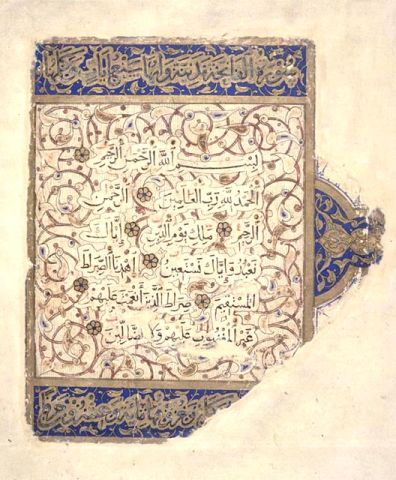
.jpg)
Welcome Friends: Ahlan wa sahlan!
What beautiful life lessons we learn today!
Yusuf Ali’s Translation of our new Chapter.
Muhammad Asad’s Translation of our new Chapter.
Their commentaries can only be read in verse by verse view.
سورة لقمان
Luqmaan
From the Introduction of Yusuf Ali:
The argument of the Final End of Things is here continued from another point of view.
What is Wisdom? Where shall it be found? Will it solve the mysteries of Time, and Nature, and that world higher than physical Nature, which brings us nearer to God?
"Yes," is the answer; "If, as in the advice of Luqman the Wise, human wisdom looks to God in true worship, ennobles every act of life with true kindness, but avoids the false indulgence that infringes the divine law-and in short follows the golden mean of virtue."
And this is indicated by every Sign in nature.
The chronology of the Surah has no significance. In the main, it belongs to the late Makkan period.
From the Introduction of Muhammad Asad:
“REVEALED, like the preceding surah, in the middle of the Mecca period, Luqman owes its title to verses 12-19, where this legendary sage (see note 12) is spoken of as counselling his son. There is no cogent reason to ascribe, as some commentators do, certain verses of this surah to the Medina period. “
COMMENTS:
1. Verse 1 contains the disjointed letters/ sounds (A L M) which introduce the Compilation. The Compilation is described in Verse 2 as ‘hakeem,’ or ‘wise,’ (similar to HQ 10:1).
· Who establish and maintain ‘salaat,’ or Prayer.
· Who, of the Hereafter, are indeed certain.
Verse 5 shows us the outcome for such a category of people; it is THEY who are at guidance from their Lord, and it is THEY who are successful.
2. Verse 6 is about others who procure (and circulate) distractive reports so as to misdirect from the way of God: Lacking knowledge and using ridicule; it is they who shall have a humiliating suffering.
Verse 7 tells us of their arrogant reaction when God’s Signs are rehearsed to them, and their consequential suffering.
Verses 8- 9 follow (after Dissuasion) with two verses of Persuasion, as we are told of ‘God’s Promise in Truth’ to Those who have attained Faith and performed Good Deeds.
3. Verse 10 mentions five aspects of God’s Creation.
In this verse, we find the ‘mountains’ called ‘rawaasi’(رواسي), which literally means ‘anchors,’ and then the verse continues, telling us that the anchors were cast into the earth so as to prevent it from shaking with us upon it. (We already encountered this: see 3 instances where this concept is mentioned- click E for English.)
Also, there are other instances where the mountains are called ‘pegs’ (awtaadأوتاد- ).
Such verses are considered ‘scientific marvels,’ (see illustrations).
Verse 11 is a challenge: This is God’s Creation!
4. With Verse 12 we arrive at the section on Luqmaan, whom we commonly name ‘the wise.’ God granted him wisdom, and told him to ‘make the most of what he was given ‘until it achieves abundance.’
Regular Readers know that ‘the definition of ‘shukr شكر-’ is ‘working in appreciation’ –the opposite of depreciation- until our efforts cause something to become more abundant and increase in value.
Luqmaan was also assured in this verse that one who works in appreciation shall indeed be doing so (shall THRIVE/ appreciate) for oneself; as for one who Denies (kafaraكفر-/ cover): indeed God is Self-sufficient (ghaniغني- ), Praise-worthy.
This ending reminds us of HQ 14:7, which we passed through some time ago:
وَإِذْ تَأَذَّنَ رَبُّكُمْ لَئِن شَكَرْتُمْ لأَزِيدَنَّكُمْ وَلَئِن كَفَرْتُمْ إِنَّ عَذَابِي لَشَدِيدٌ
“And your Lord declared: "If you work in Appreciation, I shall indeed augment/ increase for you, but if you Deny, My chastisement is surely severe."’
This is a general RULE instated by God. Our Appreciation (by WORKING) causes whatever we are working on, to appreciate. It thrives and becomes more abundant, with the result that it brings us the returns for our efforts, multiplied manifold. This goes for anything or anyone we work hard with (whether related to our own self-improvement, to our business, or to our relationships).
On the other hand, NOT working with what we are given is tantamount to DENYING its existence, after which it depreciates and loses all value. Such an outcome would be far more severe a Regret and a Suffering, than not having had that bounty in the first place. It is WE who need both the Bounty AND its Appreciation, not God!
It is highly indicative dear Reader, that immediately after Luqmaan is told to ‘work in appreciation,’ we find him WORKING UPON TEACHING HIS SON:
5. In Verse 13, Luqmaan begins his advice to his son; it is this advice which has made this Chapter so well-known (read both interpretations of Ali/ Asad):.
Note that first and foremost he warned his son of ‘shirk,’ or ‘Associating partners with God’ which is considered the ‘Great Wrong’ظلم عظيم- (put ‘shirk’ in ’Search this Site’).
The next two Verses 14- 15 are an interpolation, meaning that they are not Luqmaan’s words, but rather, they are God’s words regarding parents. Regular Readers will remember that kindness to parents was the SECOND of the Inviolables of the Straight Path/ the Ten Commandments!
Here the verse begins:
‘WE have instructed the Cognizant Human in consideration to both his PARENTS…’
This instruction also appears in HQ29:8 & 46:15, and is VERY important (click E for English). Asad commented on Verse 14 saying:
“Thus, gratitude towards parents, who were instrumental in one’s coming to life, is here stipulated as a concomitant to man’s gratitude towards God, who is the ultimate cause and source of his existence.”
As our Lexicon defines the word ‘wassaaوصّى- [i]’- God’s instruction to Cognizant Humans with regard to parents is ‘to be carried forth, generation after generation.
Note the special consideration given to mothers, who have no choice but to bear the burden of pregnancy and childbirth.
Also note that in these two verses, God speaks to each of us ‘Cognizant Humans’ directly, in the second person singular!
Also note that we owe ‘shukr’ first to God and second to our parents, regardless of their faith. But, as we see in Verse 15, when they happen NOT to be believers in God Alone, it is likely that they would ‘exert themselves against us- (in jihaad) seeking to get us to be like them, wanting us to associate partners with God. In this respect, we should never obey them YET continue to cherish their company because:
The parent-child relationship is not about ‘Faith.’
It is about Unconditional Commitment, both the involuntary and the voluntary.
(Parent to child versus child to parent. The first being innate, requires no prodding!)
So, even if we disobeyed our parents with regard to Faith (when they Associate with God), we should continue to bear them mutually acceptable companionship in this immediate life.
Q. What should our vision be, as we do so?
A. Following the route of those who return ‘home’ to God.
Dear Reader: The Qur’an makes it clear that there is absolutely no excuse for treating our parents with disregard, emphasizing that we should do our best not to hurt their feelings in old age. We should even teach our children to be of service to their grandparents, regardless of whether or not their grandparents share the same faith!
Put ‘old parents’ in ‘Search this Site’ to read more.
6. In Verse 16 we return to Luqmaan’s advice to his son, as he gives him an example of God’s Mastery over all that is subtle and beneath perception (Lateef), and His full Acquaintance with all things (Khabeer), showing him that God can bring forth something the weight of a mustard-seed, hidden anywhere in Creation.
Also, see HQ 6:59 and read these verses- click E for English.
(I am still working on my explanation of these two Attributes ‘Lateefلطيف- ’ and ‘Khabeerخبير- ’)
The following are Ali and Asad’s explanations:
Asad: “…God is unfathomable [in His wisdom], all-aware.”
7. In Verse 17 Luqmaan instructs his son towards ‘Firmness of Purpose,’ which can be gained by:
· Establishing Prayer.
· Demanding the Mutually Acceptable.
· Forbidding the Mutually Objectionable.
· Forbearance, in the face of affliction, with patient Perseverance.
What wonderful advice!
In Verse 18, Luqmaan advises his son on how his demeanor SHOULD NOT be. He uses an Arabic expression, telling him not to ‘turn his cheek away[ii]’ in disregard, inattentiveness, indifference, or disrespect to others. In our words today we might say: ‘Do not brush people off.’
He then tells his son not to walk through this earth in reckless Merriment (marahanمرحاً-[iii]), for God loves not every Arrogant Swaggerer.
We encountered a similar concept in HQ 17:37, but did not comment on it at the time. See both verses here; click E for English.
And if you happen to be thinking of Etymology: Yes, dear Reader! ‘Merry’ is identical in meaning and very similar in pronunciation to the Arabic ‘Merihمَرِح- ’ –which was ‘myrige’ in Old English! As we already know, English Etymology always ignores the Arabic origin of words; here it says that the word is of ‘Proto-Germanic origin’:
“O.E. myrige "pleasing, agreeable," from P.Gmc. *murgijaz, which probably originally meant "short-lasting."
· He should walk with Purpose (qasdقصد- ).
· He should lower (part of) his voice.
He also tells him that the most mutually objectionable voice is that of Asses.
Q. Why Asses?
A. The word ‘Asses’ here is not related to the animal itself, but rather, to the Cognizant Human to whom God sends knowledge, yet becomes a beast of burden. When he carries KNOWLEDGE ON HIS BACK, and does not assimilate it in his mind or impart it to others, he should have no public platform.
I actually spent a lot of time on this, and searched through many commentators’ opinions on this verse, without finding any convincing explanations (many actually wrote so derogatively about the animal, you’d think it was not part of God’s creation!).
I finally understood this verse when I researched QUR’ANIC CONTEXT and found the parable mentioned in HQ 62:5. Then, I realized that this is about the difference between knowledge that is carried in our consciousness versus knowledge simply being ‘carried,’ like a beast of burden.
Therefore, the most objectionable sound would be that of a person who is ignorant by choice, yet raises his voice above others.
Let me know what you think, dear Reader.
Enough said!
Our next Reading is from HQ 31:20-34.
Peace unto all!
[i] ‘Wassaaa’ literally means to ‘adjoin, relate, communicate,’ carrying instruction forward (to the next person, group or generation).
*في معجم المقاييس: (وصي) يدلُّ على وَصلِ شيءٍ بشيء. ووَصَيْتُ الشَّيءَ: وصَلْتُه. ويقال: وطِئْنا أرضاً واصيةً، أي إنَّ نَبتَها متَّصلٌ قد امتلأَتْ منه. ووَصَيْتُ اللّيلَةَ باليوم: وصَلْتُها، وذلك في عملٍ تَعمَلُه. والوصِيَّة من هذا القياس، كأنّه كلامٌ يُوصَى أي يُوصَل. يقال: وصَّيْتُه توصيةً، وأوصَيْتُه إيصاء.
*وقال الراغب الأصفهاني: وصى: الوصية: التقدم إلى الغير بما يعمل به مقترنا بوعظ من قولهم: أرض واصية: متصلة النبات، ويقال: أوصاه ووصاه. ووصى: أنشأ فضله، وتواصى القوم: إذا أوصى بعضهم إلى بعض.
وفي لسان العرب: وصي: أَوْصى الرجلَ ووَصَّاه: عَهِدَ إِليه؛ والوَصِيُّ: الذي يُوصي والذي يُوصى له، وهو من الأَضداد
[ii] االراغب الأصفهاني: الصعر: ميل في العنق، والتصعير: إمالته عن النظر كبرا، قال تعالى: }ولا تصعر خدك للناس{ [لقمان/18]، وكل صعب يقال له: مصعر، والظليم أصعر خلقة.
[iii] مرح: يدلُّ على مَسَرَّةٍ لا يكاد يستقرُّ معها طرباً. ومَرِحَ يَمْرَحُ. وفرسٌ مِمْرَاحٌ ومَرُوح. قال الله تعالى: {وَبِمَا كُنْتُمْ تَمْرَحُونَ} [غافر 75].
ومَرْحَى: كلمةُ تعجُّبٍ وإعجاب. يقال للرَّامي إذا أصابَ: مَرْحَى له.

