CLICK IMAGE: Tanzil Website


OUR MISSION:
UNCOVERING the original message of the Arabic Qur'an by using Lexicons compiled more than 1,000 years ago.

ISOLATING Fact from Fiction.


RECOVERING Hope and regaining the perspective where Humanity is one, God's Message is one, and our Future CAN become one we all look forward to!


© 2010 IQRATHECHALLENGE: INTELLECTUAL PROPERTY PROTECTED BY D.M.C.A. ALL RIGHTS RESERVED.

© 2010 IQRATHECHALLENGE: INTELLECTUAL PROPERTY PROTECTED BY D.M.C.A. ALL RIGHTS RESERVED.
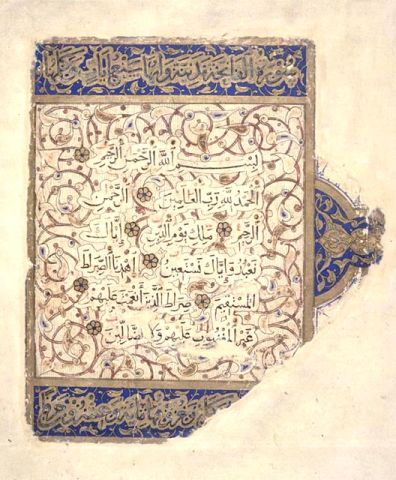
Image: 14th C. Qur'an, Mamluk origin, Library of Congress; Rights obtained.

A BREAKTHROUGH project which helps understand the Qur'an AS REVEALED -not just 'as explained.'

---------------------------------------------------------------------------

Thursday, November 4, 2010

Day 232; Qur’an 40:45-52, page 472-473


Welcome Friends:  Ahlan wa sahlan!
Remember how we found it ‘interesting’ (in our last Reading) that the concept of people ARGUING without manifest proof, appears four times in the Qur’an….  (يجادل في آيات الله and that all four instances are in this Chapter?
Well, dear Reader, what we failed to note then, is that this Chapter, from its very beginning, had placed this issue foremost!
See verses 1-4, where this Chapter began by highlighting the Compilation and God’s Attributes in comparison to Deniers’ arguments!  No wonder then that this issue was stressed upon in this Chapter.
What an eloquent Qur’an; May God help us open our eyes and take note!

Yusuf Ali’s Translation of this Chapter.
Muhammad Asad’s Translation of this Chapter. 
Their commentaries can only be read in verse by verse view.

COMMENTS:

We ended our last Reading as the Man of Faith referred all matters to God, assuring his denying people that there will come a time when they shall be in remembrance of his advice.  Then he committed his affairs unto God[i]

PAGE 472 Arabic Qur’an.

1.    Today’s Reading (Verses 45- 46) take us to the ‘Time’ which the Faithful Man was warning them of: the Hereafter. 
In Verse 45 we find him simply being ‘saved/ preserved’ (Ali/ Asad) from the injuries of their schemes, while they, in contrast are being ‘encompassed’ by dire suffering.

Verse 46 shows us the ‘dire suffering’ of all ‘Who Referred themselves to Pharaoh’… his “Aaal آل-” his people, his family, his hosts...from the very first to the very last of them.
We mentioned this meaning on April 9th when we spoke about the word ‘Ta’weel –تأويل ’ from the root verb ‘awala,’ which denotes both the first and the last; the beginning and end.  We said it was the culmination of things in reference to their beginnings, and that the verb ‘aala, ya’oolu - آل- يؤول’ denoted something or someone returning to the FIRST point of reference.

Let us think hard when we refer ourselves to someone or something in life, and make sure that we deserve a worthy ‘reference’ on Judgment Day!
Why not embrace the reference which the Qur’an gave this wonderful man: ‘rajjul Mu’min’… literally ‘active Believing person?’  (A female would be ‘rajlaa/ rajula Mu’minah.’)  I like that reference. 
May we all be worthy of such a title… Amen!

2.   Now, dear Reader, let us pay closer attention to Verse 46 as it gives us information as to what SEEMS to occur to people such as Pharaoh after they leave this existence.  (I stress ‘seems’ because our interpretation can only remain relative to our perception.  Such future information is ‘gheyb’ to us; part of the ‘Unseen’ which we can try to understand despite our limits.)  

From what most of us understand (which I’ve put between brackets), it seems that Pharaoh and his people, who were first ‘surrounded’ by suffering (at their time of death), shall be ‘displayed/ exposed’ to the Fire morning and evening (after that; ‘when’ exactly, is not mentioned) until the establishment of the Hour (of Judgment).  Upon the establishment of the Hour, they shall be made to enter the most severe of Suffering.
This verse is understood to refer to a ‘stage’ which exists between Death and Judgment, where people are ‘shown’ the consequence they have earned without actually experiencing such consequences physically (yet). 
Now, although today’s verse is particular to the Deniers, such a ‘stage’ DOES seem universal, as we can see in HQ 69:18, where everyone is exposed, and nothing ‘in hiding’…. can remain thus hidden  لا تخفى منكم خافية…..

Dear Reader: 
It is important to realize that this topic is of great interest among most ‘Muslims’ who traditionally believe that this ‘stage’ takes place between Death and Resurrection, and is why they have dubbed it ‘the suffering of the grave’ عذاب القبر—….
Such persons, however, would be very surprised to know that there is no Qur’anic evidence to support such a belief. 
Actually, even Ali and Asad seem to steer away from this ‘commonly-held belief’ without giving the topic unwarranted space (Ali says that ‘they will be brought in front of the fire’ at all times, while Asad says that ‘they had been made to contemplate the fire morning and evening,’ suggesting that this scene is related to life, and to the warnings of prophets and believers).
But we must give it some space here, because our mission is attempting to understand the Qur’an ‘as revealed,’ not ‘as explained,’ therefore:

I shall mention other ‘traditional’ views, such as this famous saying:[ii] ‘When one of you dies, his Resurrection has already occurred and he beholds what he has (earned) of good deeds and bad[iii].’  And another saying by a group (of scholars): “They speak of Resurrection:  Indeed each person’s Resurrection is his death.”  As narrated by Ttabari:  “The Resurrection of each Self is its Death.” 

As for us, dear Reader, here at IQRATHE CHALLENGE: 
We already spoke of this on Oct 12th  with regard to the Man of Faith in the Chapter of ‘Yaasseen,’ where we noted how, right after his speech to his people, he finds himself in Paradise wishing they could know about his beautiful reward!  We marveled then at how seamless his transition was from earthly life to Paradise, where the stage in which they killed him seemed irrelevant to him!  We then said that ‘even Death does not seem to exist for such a person, who is driven by pure Love:  Love of God, and love for the wayward people of his own community.’
But this man was a Believer, and was killed in cold blood, simply for speaking up. 

Q.  Our question is, what is this ‘stage’ after Death, for other people?

A.  Firstly, as far as Qur’anic research has shown to date, although this stage does take place ‘after’ Death, it is not related to ‘the grave’ at all.  Oftentimes, what we find mentioned is a stage after Resurrection (see HQ 7:39-51,  57:12-15).  There is no mention of the ‘Qabr/ grave,’ other than simply being where a dead body is placed temporarily (see all instances in Qur’an for root-verb: (قبر, while graveyards ‘maqaabir’ are considered places we ‘visit.’

Aside:
The English word ‘macabre’ is commonly believed to have its origin in the French ‘danse Macabré or ‘dance of Death’ (1376). 
See its Etymology, dear Reader, and marvel at so-called ‘scholars’ who fail to mention its Arabic origin! 
Maqabré and ‘maqaabri’ مقابري  are one and the same word, both in sound and meaning.
For other similarly ‘ignored’ English words of Arabic origin, put ‘Etymology’ in ‘Search this Site.’  

Secondly, today’s verse and other similar verses about so being ‘displayed/ exposed,’ are all about the Deniers, warning them to take heed before it’s too late (see HQ 42:45, 46:20, 46:34).

Thirdly, another verse which mentions a similar concept is HQ 71:25, where Noah’s denying people are ‘drowned’ and consecutively ‘entered into fire’….
all of which lead us to conclude the following:

The concept we call ‘Time’ is relative. 

To each of us, ‘time’ is related to our personal existence.  Scientists have called our concept of time: ‘space-time.’  Read about it.  Note how everything is ‘curved,’ and how ‘Time’ is relative to each entity’s sphere of existence.  This has been proven by sending atomic clocks out of the earth’s orbit, where upon their return, they were found to have gone slower than clocks on earth. 

Can we even IMAGINE our ‘spiritual’ existence after Death, and the ‘limit’ (وقت[iv]) when the Hour shall be upon us? 
Yes, dear Reader:  What we call ‘time’ in English is called ‘waqt’ in Arabic, defined in our 1,000 year old Lexicon as ‘limit.’ 
This could be related either to ‘time’ or to ‘space,’ which is why we have the words ‘waqt,’ ‘mawqoot,’ ‘meeqaat,’ ‘mawaaqeet’ which help us define the SPAN of time or distance; the ‘meeqaat’ for performing Pilgrimage is also the distance from where your Pilgrimage begins).

When we realize that time is relative, we can better understand the Qur’an when it tells us that:
-One hundred years can be looked back upon as  only a ‘day’ or ‘part of a day,’  (بعض يوم).
-And that the very word ‘yawm’ refers to an ‘event’ rather than a literal ‘day,’ as we mentioned on April 9th.
-Also, why much of what takes place in the Hereafter, is mentioned in the PAST tense.

‘Past- Present-Future.’  These are the names WE have designated to something which is RELATIVE to our existence on this earth!

3.   Back to our verses, which warn the Deniers to take heed before it’s too late:  In Verses 47- 48 we are shown a scene in the Fire, where we find people arguing: Those who are ‘weak’ (the followers) together with the ‘Arrogant’ (the followed), sharing the same fate and each attempting to shirk their responsibility. 
We encountered a similar verse in HQ 14:21.

PAGE 473 Arabic Qur’an.
4.    Then, in Verses 49- 50 they all plead with the Keepers of Hell, asking for their suffering to be lightened.  The Keepers respond with a valid question, asking them whether or not they had received their own Messengers with clear evidence, to which they reply that indeed they have.  The final part of the verse emphasizes the futility of their calls.

5.     In Verses 50- 51 the tone changes, as we hear God’s ‘voice’ asserting that He shall succor/ make successful His Messengers AND Those Who attained Faith, both in the immediate/ lowly Life AND on the ‘day’ when the Witnesses أشهاد arise.

Then that ‘day’ is described as one where the excuses of the ‘wrong-doers’ shall not avail them, as they are deprived of all that is good (and banished from God's Favor), for them is a dire abode.

The verb ‘shahada’ has two nouns:  ‘shaahed’ and ‘shaheed.’
Arab commentators have said that  شهداء‘shuhadaa’ is the plural of ‘shaheed,’ while ‘ash-haad’ is the plural of ‘shaahed’ (and as we can see, ‘shaahideen/ shaahidoon’ is also the plural of ‘shaahed’).
Anyway, mentioned only twice in the Qur’an, it must refer to something distinct from all others.  Perhaps this word refers to ‘angelic’ witnesses.
I hope I’ll be able to get more information on that grammatical distinction.

Enough said!
 
Our next Reading is from HQ 40:53-68.

Peace unto all!


[i] His prayer ‘UfawwiDdu amree ilal Lah’ أفوض أمري إلى الله is only mentioned this once in the Qur’an.  Another, more common expression is ‘tawakkaltu alal Lah’ توكلت على الله (I place my trust in God) which does appear 7 times in the Qur’an as an intention/ ‘prayer,’ with 61 derivations of its verb.  God tells us that He is ‘ni’mal wakeel’ نعم الوكيل- the Best Trustee!

[ii] which some have attributed to Prophet Muhammad, peace upon him, while others disagree.

[iii] "إذا مات أحدكم فقد قامت قيامته يرى ما له من خير وشر"
أخرجه أبو نعيم في ((الحلية)) (6/267-268)، وابن عساكر في ((تاريخه)) (37/214)، وأورده الديلمي في ((مسند الفردوس)) (1/285/1117). وقال العجلونـي في ((كشف الخفاء)) (1/151 ط- دار الكتب العلمية): ((وأخرجه العسكري عن أنسٍ وقال الإمام أبو جعفر الطبري في ((تفسيره)) (29/174): ((وكانت جماعةٌ تقول: قيامة كلِّ نفسٍ موتها. ذكرُ مَن قال ذلك: حدثنا أبو كُريبٍ قال ثنا وكيعٌ عن سفيانَ ومسعرٍ عن زيادِ بنِ علاقةَ عن المغيرةِ بنِ شُعبةَ قال: يقولون القيامة القيامة، وإنما قيامة أحدهم موته)). قلت: رجال إسناد هذا السند، رجال الصحيح)).

[iv] (وقت) يدلُّ على حَدِّ شيءٍ وكُنْهه في زمان وغيرِه. منه الوقْت: الزَّمان المعلوم. والموقوت: الشَّيء المحدود. [و] المِيقاتُ: المصير للوَقْت. وقَتَ له كذا ووَقَّته، أي حدَّدَه. قال الله عزَّ وجلّ: {إنَّ الصَّلاَةَ كانَتْ عَلَى المُؤْمِنِينَ كِتَاباً مَوْقُوتاً} [النساء 103].

Wednesday, November 3, 2010

Day 231; Qur’an 40:23-44; page 469-472


Welcome Friends:  Ahlan wa sahlan!
I am suddenly having BIG trouble formatting  these posts!  Don't know what's going on with Blogger!
Anyway, excuse the form... content is most important!
Today we encounter another ‘Man of Faith’ whose beautiful words we should take to heart as the best advice, after which we commit our affairs unto God Who, of us, His Worshippers, Is All-Seeing!

وأفوض أمري إلى الله إن الله بصير بالعباد

Yusuf Ali’s Translation of this Chapter.
Muhammad Asad’s Translation of this Chapter
Their commentaries can only be read in verse by verse view.


COMMENTS:
PAGE 469 Arabic Qur’an.

1.     Verses 23- 25 mention Moses, peace upon him, whom God sent as Messenger, to Pharaoh, Haamaan, and Qaaroon (Pharaoh’s most influential compatriots/ aides) with Signs and manifest (evidence of) Authority/ ‘SsulTtaan’ (although other Messengers also came with such authority, this is mentioned 5 times with regard to Moses موسى سلطان مبين). 

(We already spoke of Qaroon on Sept 8th., who was ‘the epitome of corrupting Affluence’).

These people’s responded by labeling Moses a ‘lying sorcerer,’ and announcing that the children of those who attained Faith with him should be killed, while their women should be left alive. 
The verse ends by announcing that the guile of the Deniers can only end in misdirected loss ضلال.

PAGE 470 Arabic Qur’an.

2.     In Verse 26 we find Pharaoh expressing his desire to kill Moses, saying that he feared Moses would cause people to ‘change their Accountability,’ and alleging that he would also cause ‘corruption’ to surface through the land.  

Of course he feared that Moses would change people’s Accountability! 
The ‘system’ whereby Pharaoh ruled had made sure that his subjects were only accountable to him, their ‘Lord Most-High-ربكم الأعلى- .’  Prophet Moses, on the other hand, was preaching Accountability to God Alone.  

As for his allegation that Moses would cause ‘corruption’ to surface through the land:
He was voicing the nonsensical argument which Humanity keeps hearing from despots who see themselves as the ‘anchor’ which keeps a nation on ‘solid ground’…whereas in reality such rulers are the ‘dead weight’ which prevents a nation from soaring to its potential.

POTENTIAL.  That is what we are accountable for. 
And those of us who happen to be in influential positions (government, education, parenthood) are also accountable for uncovering the potential of our dependents.

That is a big responsibility, and is an important part of our Accountability to God; our Deen!

Regular Readers know that ‘Deen’ is ‘Accountability,’ and that the word ‘religion’ is a bad translation of ‘Deen.’  This is because God Is One and Accountability is One. 
What we humans have called ‘Religions’ through the ages are in reality myopic, man-made, concepts.  The fact that there is NO plural to the Arabic word ‘deen’ in any old lexicon, tells us that the ‘pluralized’ word ‘adyaan’ which we hear so often, is of recent coinage.
New Readers:  Please put ‘Deen’ in ‘Search this Site’ and see Posting of Sept 7th.

So ‘Yes!’  Of course Pharaoh feared that Moses would change people’s Accountability. 

Also in Verse 26, we find Pharaoh sarcastically urging Moses to call upon ‘his’ Lord…  to which Prophet Moses eloquently responds in Verse 27, announcing : 

“…I have sought refuge in my Lord and in your Lord from every Arrogant (person) who does not believe in the Day of Reckoning!”

3.      And now we arrive at Verses 28 -45, where we find another beautiful soliloquy by a man of Faith. 

We encountered the first such monologue on Oct. 12th
(Although both were addressed to the people of Pharaoh, these beautiful statements do not seem to have been made by the same man.  They seem to have been said at different times and, as we know, the first man continued his monologue after leaving this earth to another, most beautiful existence…. presumably after having been killed for voicing his sentiments!).
 
As we can see, this Faithful man -who had been concealing his faith from his community- could not stand as silent witness to the injustices planned by Pharaoh and his men against Prophet Moses and his people.  So, this Man of Faith presents his people with forceful and convincing arguments, making sure to begin his address endearingly with ‘O, my People!’
He does so FOUR times (يا قومِ   HQ 40: 29, 30, 38, 39).

4.     Notice Pharaoh’s response to his people in Verse 29, as he says that he only shows them ‘what he sees,’ from his own viewpoint, alleging that it is he who guides them to the ‘steady, well-determined path’ (which correctly and dependably leads to its destination….. رشد[i]…).
The term ‘sabeel al rashaad’ appears twice in the Qur’an (both in this Chapter):  first as an allegation of Pharaoh’s, and then in Verse 38 as a promise by the Faithful Man, who asks his people to follow him.
‘Sabeel al Rushd’ appears once in HQ 7:146, ALSO RELATED TO MOSES’ STORY WITH PHARAOH. 
This IMPORTANT verse explains how people come to ignore God’s Signs/ Evidence:  They are naturally put off, becoming blinded and deafened to the truth, AFTER committing Arrogant behavior against others on this Earth, in defiance of what is Right. 
Theirs is simply a matter of continuing in error, despite all the warning signals.
Let us think of this, whenever we find ourselves unable to comprehend such persons! 

We also notice in verse 31, 34 that Pharaoh and his people seem acquainted with the stories of previous Prophets such as Noah and Joseph, as well as the people of ‘Aad and Thamood.  We also realize that they were in doubt of Joseph, and had no expectation that God would send any Messenger after him.

In Verses 32- 33 he warns them of the ‘Day/ Time’ of mutual ‘calls of distress’ (يوم التناد) as they call unto one another without avail. 
This is yet another ‘attribute/ name’ given to the Final Day!

PAGE 471 Arabic Qur’an.

5.     Verse 35 mentions a practice ‘loathsome’ to God, and loathsome to Those who Have Attained Faith : 

The loathsome practice is ‘arguing’ IN or ABOUT God’s Signs or Evidence, without having acquired ‘manifest proof/ authority.’

Note that a person gains manifest ‘proof/ authority,’ and that it is not inherent.

Evidence, evidence, evidence. 

One would think that after such verses, no one would dare say anything about God or the Qur’an without manifest proof and evidence from the Qur’an itself.  Unfortunately, this has not been historically true.

This concept appears four times in the Qur’an….  (يجادل في آيات الله)and interestingly, all four instances are in this Chapter. 
Notice the verse-ending which tells us how every ‘heart/ mind’ of the arrogant, self –exalting person is ‘imprinted.’  We mentioned this quality of human nature on April 13th,  where we said that once persons belie –or consider ‘untrue’ –what the Messengers give them of evident messages بينات  … they will never turn around one day and believe in them.  This description of one’s heart/mind becoming indelibly imprinted appears 11 times in the Qur’an
Readers who do not know Arabic would be interested to know that we use the same word (طبع) to indicate ‘temperament/ character,’ and (تطبع) to indicate something we have become used to, as an acquired ‘habit.’  (Nature and nurture?)

In Verse 36-37 we realize the extent of Pharaoh’s arrogance and self-exaltation, ‘imprinted’ upon his heart/ mind: He wanted to erect a structure which would raise him to the skies so he could ‘look upon’ the God of Moses!  But his guile ended in total detriment/ loss/ failure (Arabic: ‘tabaab’[ii]).

6.     Then, in Verse 39, we return to the beautiful words of the Man of Faith, as he calls upon his people to follow his guidance telling them to compare this immediate/ lowly Life -which is nothing but temporary convenience- to the Hereafter, which is the Abode of Security.  This life is considered a ‘time of advantage,’ when people simply make use of what they have.. “mataa’-”
[iii]متاع- … is mentioned 11 times in the Qur’an.

Verse 40 gives us the ‘standard’ by which people are well-recompensed: The one condition for that beautiful reward is being a Person of Faith!
See HQ 28: 84

PAGE 472 Arabic Qur’an.

7.     In Verses 41-42 the Man of Faith tries to show them how ridiculous their calls are, as they call upon him to follow them (their calls are not heard, but are referred to in his response).  He wonders how they could call him to the Fire even as he calls them to Deliverance, and how they could call him to associate with God, partners which he has no knowledge of, while he is calling them to the Omnipotent Forgiver.

We end today’s Reading with Verses 43-44, where the Man of Faith refers all matters to God, assuring his people that there will come a time when they shall be in remembrance of what he is saying to them. 
Then he commits his affairs unto God, for certainly God is, of His Worshippers, All-Seeing!  And we do the same…
 Enough said!

Our next Reading is from HQ 40:45-60. 

Peace unto all!


[i]  رشد:
 معجم المقاييس في اللغة:
رشد:  يدلُّ على استقامةِ الطريق. فالمرَاشِد: مقاصد الطُّرُقِ. والرُّشْد والرَّشَد: خِلافُ الغَيّ. وأصاب فلان من أمره رُشدْاً ورَشَداً ورِشْدة. وهو لِرِشْدةٍ خلاف لِغَيّة.
لسان العرب:
رشد: في أَسماء الله تعالى الرشيدُ: هو الذي أَرْشَد الخلق إِلى مصالحهم أَي هداهم ودلهم عليها، فَعِيل بمعنى مُفْعل؛ وقيل: هو الذي تنساق تدبيراته إِلى غاياتها على سبيل السداد من غير إِشارة مشير ولا تَسْديد مُسَدِّد.
الرُّشْد والرَّشَد والرَّشاد: نقيض الغيّ. رَشَد الإِنسان، بالفتح، يَرْشُد رُشْداً، بالضم، ورَشِد، بالكسر، يَرْشَد رَشَداً ورَشاداً، فهو راشِد ورَشيد، وهو نقيض الضلال، إِذا أَصاب وجه الأَمر والطريق. والمراشِدُ: مقاصِدُ الطرق. والطريقُ الأَرْشَد نحو الأَقصد.
الراغب الأصفهاني:
الرشد والرشد: خلاف الغي، يستعمل استعمال الهداية، يقال رشد يرشد، ورشد.

[ii] تب: التّباب، وهو الخُسْران. وتبّاً للكافر، أي هلاكاً لـه. وقال الله تعالى: {وَمَا زَادُوهُمْ غيْرَ تَتْبِيبٍ} [هود 101]، أي تخسير. وقد جاءَت في مقابلتهما كلمةٌ، يقولون استَتَبَّ الأمر إذا تهيّأَ. فإن كانت صحيحةً فللباب إذاً وجهان: الخُسْران، والاستِقامة.

[iii] (متع: يدلُّ على منفعة وامتدادِ مُدّةٍ في خيرٍ. منه استمتعت بالشَّيء. والمُتْعة والمَتَاع: المنفعة في قوله تعالى: {بُيُوتاً غَيْرَ مَسْكُونَةٍ فيها مَتَاعٌ لَكُمْ} [النور 29].، ومتَّعت المطلَّقة بالشَّيء، لأنَّها تنتفع به. ويقال أمْتَعْتُ بمالِي، بمعنى تمتَّعت. ويقولون: حبل ماتِعٌ: جيِّد، ومعناهُ أنَّ المدّة تمتدّ به. ويقولون: مَتَع النَّهارُ: طال. ومَتَع النباتُ مُتُوعاً. ومَتَع السّرابُ: طالَ في أوَّل النهار مُتوعاً أيضاً. والمتاع من أمتعة البيت: ما يستمتع به الإنسانُ في حوائجه. ومتَّع الله به فلاناً تمتيعاً، وأمتَعَه به إمتاعاً بمعنىً واحد، أي أبقاه ليستمتع به فيما أحب من السرور والمنافع.

Let's TWEET this!

Tweet me!