CLICK IMAGE: Tanzil Website


OUR MISSION:
UNCOVERING the original message of the Arabic Qur'an by using Lexicons compiled more than 1,000 years ago.

ISOLATING Fact from Fiction.


RECOVERING Hope and regaining the perspective where Humanity is one, God's Message is one, and our Future CAN become one we all look forward to!


© 2010 IQRATHECHALLENGE: INTELLECTUAL PROPERTY PROTECTED BY D.M.C.A. ALL RIGHTS RESERVED.

© 2010 IQRATHECHALLENGE: INTELLECTUAL PROPERTY PROTECTED BY D.M.C.A. ALL RIGHTS RESERVED.
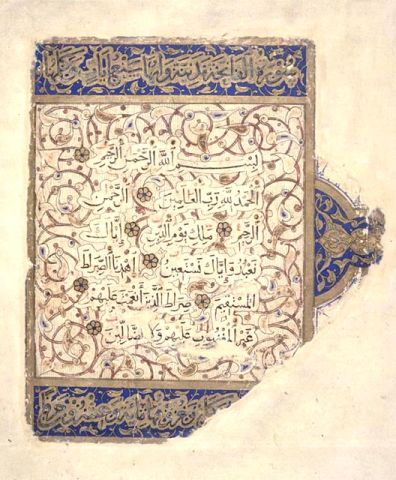
Image: 14th C. Qur'an, Mamluk origin, Library of Congress; Rights obtained.

A BREAKTHROUGH project which helps understand the Qur'an AS REVEALED -not just 'as explained.'

---------------------------------------------------------------------------

Thursday, January 13, 2011

Day 304; Qur’an 97: 1-5 page 598


Welcome Friends:  Ahlan wa sahlan!
Yusuf Ali’s explanation of this Chapter.
Muhammad Asad’s explanation of this Chapter.
Laleh Bakhtiar’s explanation of this Chapter.


سورة القدر
'Power/ Utmost Projection’

From Introduction of Yusuf Ali:

'The Night of Power/ Honor'
“The chronology of this Surah has no significance. It is probably Makkan, though some hold that it was revealed in Madinah. The subject matter is the mystic Night of Power (or Honour), in which revelation comes down to a benighted world---it may be to the wonderful Cosmos of an individual and transforms the conflict of wrongdoing into Peace and Harmony---through the agency of the angelic host, representing the spiritual powers of the Mercy of God.”


From Introduction of Muhammad Asad:

'Destiny'
“OPENING with a reference to the revelation of the first five verses of the preceding surah - that is, to the beginning of Muhammad's prophetic mission - Al-Qadr undoubtedly belongs to a very early part of the Mecca period.”

COMMENTS:

This is such an important Chapter.
Firstly, it is crucial for our faith in God that we fully comprehend the meaning of the word 'qadr,' which is not, as many Believers think, about Him decreeing and imposing our fate upon us!
The traditional understanding -which we have shown evidence against- revolves around unsupported belief in human 'pre-destination:' Traditionalists believe that whatever takes place in our lives was already 'pre-ordained' by God; 'pre-written' in a 'kitaab.' We have already discussed 'kitaab,' so I shan't get into that topic here, but since this Chapter is about 'Qadr,' we must revisit the root-verb 'qadara' (please put it in 'Search').

Regular Readers will remember that Yusuf Ali had earlier said:

“The root qadara not only implies power, ability, strength, but two other ideas which it is difficult to convey in a single word, viz., the act and power of estimating the true value of a thing or persons... and the act and power of regulating something so as to bring it into correspondence with something. "Judgment of values" I think sums up these finer shades of meaning. ...”

    Please read our earler discussion of 'Qadr' by putting the words 'Utmost Projection' in 'Search.'
    Also see our explanation of the beautiful Chapter 87, which tells us that God 'qaddara' everything, and guided/ gifted قدّر فهدى:

    'Motivate yourself/ Glorify the Attribute of your Lord Most High:
    Who created, and thereupon 'sawwaa/ duly proportioned (all Creation) in a process.
    And Who projected to the utmost (all capabilities),
    and thereupon guided and gifted (each to fulfillment)'

    Creation and the process of 'taqdeer' go together, as we realized earlier, see here.
    Secondly, it is crucial for our faith IN, and benefit FROM, the dynamic Qur'an, that we try to comprehend the significance of 'Laylatul Qadr:'
    It is not as simple as many Believers think; it is not just about commemorating a certain 'night' every year in Ramadan. It is about appreciating the magnificent occurrence, the momentous occasion, the wonder that is awarded to us Cognizant Humans, resulting in the possibility of our living a relationship with God at a level of Awareness and Knowledge of Him (and ourselves) that would not have been possible without the Qur'an (which tells us so much about both), PLUS the amazing fact that everything we are and everything we have:

    HAS THE CAPACITY TO BE PROJECTED TO ITS UTMOST

    That is what few of us realize!
    Think about that.
    The Time of Qadr is when God's Message to Humanity was sent down as; when the 'kitaab/ compilation' became, for OUR benefit, Qur'an (I).
    Unfortunately however, most of us 'Muslims,' having lost track of the dynamism of Qur'an, have been revering the static 'Kitaab' for the past thousand years.

PAGE 598 Arabic Qur’an
  1. In the first verse we find echoed the words ‘We have indeed sent it down on...إنا أنزلناه '
    We'd heard these words earlier, in HQ 44:3 (see all 3 instances in Qur'an). Also, put the word 'anzala' in 'Search' to understand its meaning.
    Regular Readers will remember that the Qur'an, God's Message to Humanity, is instrinsically Supreme, and exists in 'Secured Radiance/ Looh MaHhfouth’  (في لوح محفوظ-) (HQ 85:22):
    ‘But it is a Supreme Qur’an. In Secured Radiance.’
    بَلْ هُوَ قُرْآنٌ مَّجِيدٌ ﴿٢١﴾ فِي لَوْحٍ مَّحْفُوظٍ﴿٢٢﴾

    Such is its existence in itself (i).
    As related to us, however, it had to be rendered to a humanly comprehendible state ('anzala') in preparation for its transmittal (to God's Messenger, peace upon him, and then to us).
    This momentous event (taking place for our benefit but still apart from us) is what these verses seem to be telling us about:

    ‘We have indeed 'anzalnaahu' sent it down (rendering it comprehendible)
    on the Night of power/ of Utmost Projection…’ 

    The term 'night' here could be related to what we understand as 'night,' relative to our knowledge of space and our earthly existence, or to the (as yet) absence of 'light/ enlightenment,' or to a time of utter 'sakeena,' as we (spoke about earlier and) can see in these verses linking 'night/leyl' with 'sakan.'

    But there is more information out there, regarding 'Laylatul Qadr.'
    Regular Readers (and most Muslims) know that this 'Night of Power/ Projection' also refers to the event when the initial 'Tanzeel/ Transmission' was sent down from our Lord/Sustainer; the 'tanzeel' which began as Muhammad was meditating in the cave of Hiraa, and the command came to him that he should 'IQRA!' (ii) Historians tell us that this incident took place in the month of Ramadan, which is also why worshippers commemorate 'Laylatul Qadr' during Ramadan, seeking it mostly in its last ten nights.
    The Qur'an mentions clearly that 'the month of Ramadan is that in which the Qur'an was sent down/ transmitted (HQ 2:185):

    'The month of Ramadan in which the Qur'an was sent down; 
    a guide to Cognizant Humans 
    and manifestations of (the) Guidance and (the) Criterion...'

    Most Muslims take this, not only to refer to the above mentioned 'iqra' verses, but also to the 'descent' of the entire Qur'an to a state closer to us. As we described earlier, this seems to be about it being rendered comprehendible -'anzala.'
    After that initial Revelation of 'IQRA,' parts of the Qur’an began to be 'sent down/ transmitted' from within the complete, compiled state (preserved 'on high') to the Messenger Muhammad... its verses transmitted separately as per people's needs (without adherence to its compiled arrangement), over a period of 21-23 years. Finally, when the 'WaHi/ Exclusive Information/ Revelation' was completed, the verses were put together and reassembled into a 'compiled' state. That took place in the final two Ramadans of Prophet Muhammad's life, when he was reported to have recited the entire Qur'an (in its present order, as per God's instruction) overseen by Angel Gabriel. The only thing which we know that the Messenger did NOT do himself, is name the Chapters; their 'titles' came naturally depending on how people recognized them.

    Everything we mentioned is about the Compilation in its informative state, transmitted to us orally. Compiling it in writing came many years later.

    Q. And what is it, in the Qur'anic structure, which made it possible to preserve each verse intact, so as to bring the compilation together again, orally at first, and then in writing?

    A. The 'nujoom' (✷), the markers / stars, which 'underpin/ anchor' the contents of each verse separately, so that verses do not infringe upon each other and lose their intent!
    Regular Readers will remember how important these markers are (put 'underpinnings' in 'Search'), and will recall the verses (HQ 56: 75-80) which vow 'by the placement of markers/ stars' (see footnote iii). Tampering with these placements is most grievous: God's words should NEVER be taken out of context! (Yet many have done so to suit their purposes, incurring questioning on Judgment Day. Remember the verse about the 'Segmenter/ Muqtassim' who, having rendered The Qur'an into segments is promised that he SHALL, 'by your Lord' be QUESTIONED as to this deed (HQ 15: 71-93)?! This is all about the importance of CONTEXT in understanding Qur'anic intent (two things are paramount in understanding the Qur'an: the Arabic Language itself on one hand, and Qur'anic context on the other).

    2. Verse 2 tells the Messenger/ Listener 'Maa adraaka,' that he would not be able to 'pursue to determine/ he would not be able to perceive' what Laylatul Qadr is (put 'daraa' in 'Search'). Some Commentators see this as a rhetorical question, as in 'How would you/ could you perceive what it is?Zamakhshari (iv) explains this as: 'Your perception has not attained the munificence and paramount eminence (of Laylatul Qadr).'

    3. Verse 3 tells us that this 'Night of Qadr' is of more 'kheyr' (advantage/ commendation) than an 'alf' (multitude/ thousand) of 'shahr' (enlightenment/ month).

    What I understood from this, is that the event in which the Qur'an was imparted to us is of such magnificent enlightenment, that it cannot be compared to any other occurrence in the history of Creation. However, all WE need to do is to appreciate that event without necessarily understanding it, since the Messenger himself was told: 'Maa adraaka.'

    Read slowly to attempt grasping its meaning:

    -'Kheyr' implies everything that is worthy, commendable, and advantageous.... similar to Goodness + Beneficial, put together).

    -'Shahr' literally means 'luminescence/ enlightenment.'

    The word 'shahr' came to be understood as 'month' because of the moon's luminosity in its various stages. Interestingly, most world civilizations have adopted similar connotations to this concept, month = moon (see footnote v).
    The word 'shuhra' means 'fame/ prestige' and 'shaheer/ mash-hoor' mean 'acclaimed/ famous,' all from this single root-verb 'shahara.'
    So is 'shahr' about enlightenment and acclaim, or merely about a 'month'...?
    God knows best.

    4. Verses 4-5 give us three important descriptions of this event/ night of Qadr/ Ultimate Projection:
  • The Custodians/ Angels oft-descend during this entire event.. all descending together with the Al RooH/ The Spirit (who is probably the Custodian/Angelic Messenger delivering exclusive information/ waHi-وحي from God to His Messengers, believed to be Angel Gabriel). What a magnificent event, as all these heavenly creatures descend in multitudes to escort God's Message to Mankind! (The verb 'tanazzal' is in present continuous; see Asad's view on its grammatical form vi).

  • They descend with God's general Announcement/'ithn' regarding every matter / 'amr.' Regular Readers will remember that the word 'ithn' is related to 'athaan' and does NOT mean 'permission, (although that is how we now use it. Put 'ithn' in 'Search').
    So here we have these Custodians/ Angels descending in hosts, escorting God's Message to us, His general Announcement to the world, fulfilling God's commands.

  • 'Salaam/ Peace' it is, until the appearance/ outlook of 'Fajr/ Eruption/ Break of 'Day.' See these verses in both Yusuf Ali and Muhammad Asad's interpretations.

    Their interpretation helps us understand this as a recurrent theme, thus:
    Once every year, there is a commemoration to that first Night of Ultimate Potential/ Projection. Everything is possible during this commemoration, when the Custodians/ Angels descend in hosts, and every good intention and supplication one makes is answered in one way or another. Don't forget that taking care of us is one of the duties of these Custodians (HQ 13:11, and 40: 7-9)!
    But this time of 'Ultimate Projection' is our time when, if we pushed ourselves to do more, we would be that much closer to fulfilling our potential as per God's projection of our gifts and talents.

    Some modern-day scholars have added that 'fajr' could also be referring to the time when our world erupts, and comes to an end.
    God knows best.
    We cannot surmise what exactly the earliest Recipients of Qur'an may have understood from these words, but we have no doubt that they, having witnessed Qur'anic Revelation and lived WITH the Messenger himself... we have no doubt that they appreciated, more than we could ever do, the magnitude of the Event, 'Laylatul Qadr,' when God sent the Qur'an down for the benefit of Humanity.

    May we be appreciative and humbled by this knowledge.
    Amen.

    Peace unto all!
____________________
i
    Such is its existence in itself for the purpose of 'Thikr/ Evocation/ Remembrance.' Remember we said that it is only is a 'reminder' when we interact with it!
    We discussed this in HQ 80:11; we said that the Qur'an, in its intrinsic state, it is held in Eminently-held 'SsuHuf صُحُف receptacles/ plates/ sheets/ records' (see 9 occurrences in Qur'an), Exalted and Purified. These 'SsuHuf' are retained by (Cognizant Beings who are) 'Safara/ Retainers and Revelators' (and are) Eminent, generous and Forthcoming (which seems to refer to the Custodians/ Angels in charge of holding/ revealing them).


(IQRA: One word which means so much; our entire research is based on ints six components related to Information Processing.)

    ‘I do but vow by the placement/ site of 'nujoom/ stars/ markers'
    And that is indeed a mighty oath, if you (all could) discern/ know
    It is indeed an eminent Qur’an
    In a safeguarded/ shielded Compilation
    None touches it except the Purified
    A Transmission (sent down) from the Lord-Sustainer of the Worlds/ Peoples’
:قال الزمخشري:
    "ولم تبلغ درايتك غاية فضلها ومنتهى علوّ قدرها.."
v
Isn't human language interesting?
In English (and most European languages), the word 'month' actually comes from the word 'moon' (see Etymology here).
The lunar month still is an integral part of the Muslim Calendar. See here for amazing facts on world calendars.


شهر: يدلُّ على وضوحٍ في الأمر وإِضاءة. من ذلك الشَّهر، وهو في كلام العرب الهِلال، ثمَّ سمِّي كلُّ ثلاثين يوماً باسم الهلال، فقيل شهر. قد اتَّفق فيه العربُ والعجم؛ فإنَّ العجم يسمُّون ثلاثين يوماً باسم الهلال في لغتهم.  والشُّهرة: وضوح الأمر. وشَهَرَ سيفَه، إِذا انتضاه. وقد شُهِر فلانٌ في الناس بكذا، فهو مشهور، وقد شَهَرُوه.أَشْهَرْنا بالمكان، إِذا أَقَمنا به شهراً. وشَهْرانُ: قبيلة.

M. Asad: “The grammatical form tanazzalu implies repetition, frequency, or multitude; hence – as suggested by Ibn Kathīr – “descending in hosts.”

Wednesday, January 12, 2011

Day 303; Qur’an 96: 1-19 page 597


Welcome Friends:  Ahlan wa sahlan!
Yusuf Ali’s explanation of this Chapter.
Muhammad Asad’s explanation of this Chapter.
Laleh Bakhtiar’s explanation of this Chapter.

سورة العلق
'The Clinging (Relationship)’

From Introduction of Yusuf Ali:

“Verses 1-5 of this Surah were the first direct Revelation to the Holy Prophet (peace be upon him).
After that there was an interval or break (Fatrah), extending over some months or perhaps over a year. Surah 68 is usually considered to have been the next revelation in point of time. But the remainder of this Surah (96:6-19) came soon after the Fatrah, and that portion is joined on to the first five verses containing the command to preach, because it explains the chief obstacle to the delivery of the message to man, viz, man's own obstinacy, vanity, and insolence.”


From Introduction of Muhammad Asad:

“THERE IS no doubt that the first five verses of this surah represent the very beginning of the revelation of the Qur'an. Although the exact date cannot be established with certainty, all authorities agree, in that these five verses were revealed in the last third of the month of Ramadan, thirteen years before the hijrah (corresponding to July or August, 610, of the Christian era). Muhammad was then forty years old.
Verses 6-19 of this surah are of somewhat later date i.”


COMMENTS:

Regular Readers will remember the importance of this Chapter in that it holds the very first verses ever revealed to the Messenger Muhammad, peace upon him... verses which introduce and command him/ us to uphold the dynamic of 'iqra.'
PLEASE recall this all-important term before continuing (put 'six components' in 'Search').

PAGE 597 Arabic Qur’an
  1. The first-ever verses to be revealed were the following:

    “IQRA! Read/ Recite/ Peruse' by (invoking) the attribute 
    of your Lord-Sustainer Who created (ii).
    He created the Cognizant Human 
    from 'Alaq/ a Clinging/ Relationship.
    'IQRA! Read/ Recite/ Peruse' 
    and your Lord is the Most Magnanimous.
    He Who 'defined/ taught' by Differentiation.
    'Defined for/ Taught' the Cognizant Human 
    that which he did not know.”

Tradition not only tells us that these were the first verses revealed, but it also tells us the story of its revelation. We have two similar stories, with both citing the Prophet, peace upon him, as responding to the Angel who commanded him three times 'Iqra!' by saying (as is commonly explained) that he 'cannot read': “Maa aqra'/ Maa ana biqaari” meaning “I don't read/ I am not a Reader.” Interestingly, the word “Maa” could either be a negative adverb as in “not,” or a pronoun as in “what,” which would then transform the statement into a question. This means that his response “Maa aqra” could have been asking: “What should I read/ recite/ peruse?”
Both seem plausible, but when we recall the definition of the word 'iqra' we realize that he was probably not questioning the command, but rather:
Understanding the meaning of the word (loaded with its many components), he must have been apprehensive of the burden being put on his shoulders. Here was something he was supposed to undertake, gather, carry, witness, and eventually disseminate to others.... a huge burden which only became bearable when he was assured that he would be doing so 'by the Attribute of his Lord Who Created,' with God's help.

Then Verses 3- 4 continue to reassure the Listener, commanding him -again- that he should 'iqra'... adding that his Lord is The Most Eminent and Magnanimous, who 'demarcated' (everything) by the 'qalam/ differentiation' (iii). Here we think of everything in creation, each distinguished from the other by distinctive features. Then comes Verse 5, which is specific for us, telling us that God had 'defined for/ taught' the Cognizant Human (specifically, and no one else) 'taught him that which he did not know.' Here again, a grade of differentiation for Cognizant Humans, ABOVE that of all other creatures.

  1. The command 'Iqra' cannot be explained by one word. It is about processing and disseminating information; it is the all-important dynamic which got us into our research project.
    When the 'Insaan/ Cognizant Human' activates the dynamic of 'iqra, he consciously becomes part of the construct of RaHmaan> Quraan> Insaan, and becomes receptive to both His Creator and to the Qur'an (we spoke of this in HQ 55: 1-4, where we learnt that Al RaHmaan is Our Lord/Sustainer Who creatediv).
    In this verse, it is interesting to note that the Insaan/ Cognizant Human alone is specified as being created of 'alaq.'
    Doesn't this makes certain explanations (such as ‘clot of blood' / 'that which clings in the uterus') unlikely... since there has to be in this description something differentiating humans from all other mammals?! Put 'alaq clot' in Search to see this verse as an excellent example of how Qur'anic interpretation has changed with time, dependent on people's knowledge.
    In fact, most interpretations of this verse have been contextually and linguistically inaccurate. Note that the 'Cognizant' Human alone was created from ‘alaq,' NOT the physical ‘human specie’/ ‘Bashar.’ It is about our cognizant selves, and NOT our physical selves, and since it is specific to Cognizance, it can be none other than the ‘quickening’ of God’s ‘spirit’ (نفخ فيه من روحه...) which rendered the ‘bashar’ into ‘insaan.’ Put ‘insaan bashar’ in ‘Search this Site.’

    THAT is the specific 'relationship' we have had with God from the moment we were created, whether we'd noticed it or not. (‘Alaq’ علق) is the clinging relationship WHICH TIES US COGNIZANT HUMANS to God and shall reel us back to Him upon the death of our physical bodies.

  1. After these Verses 1-5 had given us all this important information, Verses 6-7 tell us of human nature.
    Indeed, the Cognizant Human does 'yaTghaa/ transgress.' When he beholds/ attains it (knowledge) he becomes (arrogantly) self-sufficient.
    The word 'istaghnaa/ self-sufficient استغنى' is a negative human-trait in the Qur'an, showing one's feelings of superiority to others. It seems that, by nature, we are prone to excess. When we succeed in obtaining what others don't have, we convince ourselves that we need nothing and no one, and go on to commit further excesses and transgressions. Everything is a 'power-tool' to Transgressors, especially what is 'sacred' to others and can be used to overpower them.
    This Chapter is about Information Processing, and that is why it warns us indirectly regarding the misuse of Knowledge. Verse 8 asserts to each of us, that to our Lord is The Return!

  2. Verses 9-14 speak to Prophet Muhammad/ the listener's observation of a certain aggressive type, asking the rhetorical question three times “Have you seen the one who....?” In this indirect way we are told of this unpleasant person's actions of forbidding a worshipper from prayer/ connection, and his belying (the Message) and turning away (from it).
    The rhetorical question then asks: Does he not know that God observes (him)?

  3. Verses 15- 18 hold dire warning for this person, in that if he does NOT cease what he is doing, God shall take him forcefully by the forelock, the 'lying, wrong-doing' forelock/ naaSiyah, challenging him to call upon whomever he wishes (for none can help him), while God calls upon the 'Shovers/ Zabaaniyahv' (believed to be 'angels of punishment' who shove wrong-doers into the Fire).

  4. Regular Readers probably remember the word 'naaSiyah' (put 'forelock' in 'Search') which appears 4 times in the Qur'an. 'NaaSiyah/ forelock' stands for the area at the center of our forehead, and the fact that it is called 'lying and wrong-doing' is VERY interesting in this context!

    The human brain contains the following main lobes: 
    The Frontal lobe, the Occipital lobe, the Temporal lobe, and the Parietal lobe.
    The Pre-Frontal Cortex, lying directly behind the forehead, represents the bigger part of the frontal lobe. It influences initiative and judgment and is responsible for forming that person’s character (and for fabricating lies)... which is why this verse is said to hold another 'Scientific Marvel' of the Qur'an.


  5. The final verse commands the listener NOT to obey such a person, but rather, to prostrate and draw close (to God).
    This concept of drawing closer to God by prostrating to Him is well-known. In HQ 56: 37 we notice that the Deviant can approach us from any of our four sides, but never from above or below. Both directions are our pathways to God, related to prostration and supplication, and other aspects we do not fully understand.
    Some say that with our foreheads to the ground, we release all negativity into the earth. Others say that their studies have proven that, of all the body postures which increase alpha waves, prostration is most prominent.
    At any rate, it is only when the body is in sync with consciousness that the Cognizant Human can begin to achieve his highest potential.
    Our 34 daily prostrations are excellent practice, but we can do much better when we realize their importance and plan to make the best use of them.
    And so ends this VERY IMPORTANT Chapter, which deserves to be read and reread... IQRA!


Peace unto all!

______________
i
As reported by Muhammad Asad:
“At that period of his life "solitude became dear unto him, and he used to withdraw into seclusion in a cave of Mount Hira [near Mecca] and there apply himself to ardent devotions" consisting of long vigils and prayers (Bukhari). One night, the Angel of Revelation suddenly appeared to him and said, "Read!" Muhammad at first thought that he was expected to read actual script, which, being unlettered, he was unable to do; and so he answered, "I cannot read" - whereupon, in his own words, the angel "seized me and pressed me to himself until all strength went out of me; then he released me and said, 'Read!' I answered, 'I cannot read....' Then he seized me again and pressed me to himself until all strength went out of me; then he released me and said, 'Read!' - to which I [again] answered, 'I cannot read....' Then he seized me and pressed me to himself a third time; then he released me and said, 'Read in the name of thy Sustainer, who has created - created man out of a germ-cell! Read - for thy Sustainer is the Most Bountiful One...'": and so Muhammad understood, in sudden illumination, that he was called upon to "read", that is, to receive and understand, God's message to man. The above excerpts are quoted from the third Tradition of the section Bad' al- Wahy, which forms the introductory chapter of Bukhari's Sahih; almost identical versions of this Tradition are found in two other places in Bukhari as well as in Muslim, Nasa'i and Tirmidhi.”

Most Believers can recite Chapter 92 by heart: ‘Iqra bissmi Rabbilkallathee khalaq..’ which begins with a direct command to the Messenger to: ‘IQRA ‘read/ recite/ peruse,’ invoking the attribute/ name of your Lord who created.’  Although we might feel confident that the Messenger, peace upon him, had done just that, HE WAS NEVER REPORTED to have read the Qur’an with the invocation: ‘In the name of my Lord/Sustainer who created.’ 
What does this mean? 
Does it mean that HE had not obeyed the direct command regarding his Qur’anic reading, or does it mean that OUR information today, is lacking?
Of course, it is OUR information today, which is lacking!
The Messenger HAD indeed obeyed this command, and had also relayed it to the Believers,who understood it. 
We, by rote, continue to do what they did, without realizing that we are fulfilling that command. 
How is that?
Think: Don’t we always begin reading/ perusing Qur’an with the invocation: ‘Bismil-Lah al-Rahmaan al-Raheem’?
Yes, dear Reader. ‘Al Rahmaan’ IS: Our Lord/Sustainer who created’ !! 


Qalam:
The root verb ‘qalama’ (according to our 1030 year old Lexicon), is ‘to smoothen, set straight, arrange by filing,’ and ‘Qalam’ is something filed, formed by filing, into a pencil, reed, stick, column (see Etymology below), yet Qur’anic context shows us that this term is about how our brain ‘files’ and records the differences between one entity and another to facilitate recognition and reference!  Indeed, all creatures learn and mark out everything around them by ‘qalam,’ as is indicated in HQ 96: 1-4.  We see children differentiate colors, shapes, and sounds by ‘qalam,’ and we know how well animals and birds identify different scents, shapes, sounds,vibrations, electro-magnetic signals... all by ‘qalam.’ 
Note: Even today, to ‘file’ one’s nails in Arabic is: ‘taqleem’ al athafer!
It is interesting to see how Arabic diacritics/ tanween was incorporated into the Latin word:
ETYMOLOGY: Merriam-Webster:
“COLUMN: from Latin columna from columen."

The -en ending is none other than
قلمٌ - قلمٍ - قلماً ‘Columen’ is ‘qalam,’ its final consonant diacritized, the ‘tanween’ indicating subject, object, object of preposition.

    ‘Al Rahmaan’ is not only our ‘Source,’ but He is ‘Our Sustainer (Rabb) who created/ ربنا الذي خلق[ii]’… who brings everything together FOR US, from inception to completion…. preparing, then rearing and fostering, and finally giving each of us our due. It is He who created us (and no one else) from ‘alaq/ relationship’ WITH HIM; no one else has this distinction.

v 
زبن: أصلٌ واحدٌ يدلُّ على الدّفع. يقال ناقة زَبُون، إذا زَبَنَتْ حالبَها. والحرب تزبِنُ النّاسَ، إذا صَدَمتهم. وحربٌ زَبُون. ورجلٌ ذو زَبُّونةٍ، إذا كان مانعاً لجانبِه دَفُوعاً عن نفسه
ويقال فيه زَبُّونَةٌ، أي كِبر، ولا يكونُ كذا إلاّ وهو دافعٌ عن نفسه. والزَّبانِيَةُ سُمُّوا بذلك، لأنّهم يدفعون أهلَ النار إلى النار. فأمَّا المُزابَنَة فبيع الثمر في رؤوس النّخل، وهو الذي جاء الحديث بالنَّهي عنه. وقال أهل العلم: إنّه مما يكون بعد ذلك من النِّزاع والمدافَعة.  

Let's TWEET this!

Tweet me!