Welcome Friends: Ahlan wa sahlan!
So far this has been great, considering that my internet broke down yesterday. All I could think of was, “What am I going to do now?” But things eventually worked out, thankfully.
It seems that our Iqra project has arrived at the global community just in time. I have started receiving feedback, and know that many of you have completed yesterday’s challenge. Thank you for your thought-provoking comments
It was such pleasure comparing Yusuf Ali and Muhammad Asad’s explanations, both so beautiful. Sometimes I lean more towards Asad, but today Ali’s explanation seemed to flow more easily. Didn’t you stumble over the word ‘iniquitous’?
COMMENTS:
1. Having faith AND doing good deeds (Verse 25): These two characteristics ALWAYS come together in the Qur’an. Believers can only be considered such AFTER their deeds bear witness to what is in their hearts and minds. That’s understandable: what is hidden can be of no use unless it becomes a source of service to oneself and others.
2. I like Muhammad Asad’s explanation in his commentary about those who ‘break their bond with God’ (yanqudduna ‘ahdal-Lahi), and that it refers to a person’s ‘moral obligation’ to use his inborn intellectual and physical gifts (Verse 27).
For Asad’s full commentary go to: http://www.islamicity.com/QuranSearch/
What Asad calls ‘bond,’Ali calls ‘covenant.’ This could relate to HQ:7:171, the covenant between God and Humanity:
Y. Ali's translation: “When thy Lord drew forth from the Children of Adam - from their loins - their descendants, and made them testify concerning themselves, (saying): "Am I not your Lord (who cherishes and sustains you)?"- They said: "Yea! We do testify!" (This), lest ye should say on the Day of Judgment: "Of this we were never mindful": (172) Or lest ye should say: "Our fathers before us may have taken false gods, but we are (their) descendants after them: wilt Thou then destroy us because of the deeds of men who were futile?" (173)
It seems to be echoed in the concept Dr. Deepak Chopra speaks about when he says in his book 'How to know God', that the brain actually is HARD-WIRED to seek Him.
3. The informative exchange which took place between God and the angels is interesting, and concerns us only in what it informs us. The angels’ question makes us think that they found it incredible that God would allow Humans to inherit this earth, seeing that we could spread corruption and shed blood. It is a valid question, and the angels were able to ask their Creator freely why humans, of all creatures, would NOT become extinct one day. (By the way, this question gave Dr. Jeffrey Lang the title to his book, “Even Angels Ask.” His books ask many questions related to Qur’an as they seek a path for lost American Muslim youth.)
4. It is wondrous to be peering in -from our point in existence- to the first Cognizant Human’s foremost steps on this earth! His lack of knowledge until God ingrained it in him (‘allama means to imprint, impress), and as the knowledge of his surroundings and their attributes were impressed upon him, he certainly did impress the angels with his ability to convey this new-found knowledge in full 'bayaan'. (Remember that Chapter Al Rahmaan HQ 55:3-4 tells us that God created the Cognizant Human, then taught, or imprinted into him 'al bayaan,' which is this ability.) Then we watched as Adam was being deceived until he slipped, and finally God’s deliverance of him even BEFORE he asked for forgiveness. The very fact that Adam asked for forgiveness could not have taken place had he not felt repentant and received God’s guidance on what to do in such circumstances. It is noteworthy that mention of the words he was inspired to say 'kalimaatin' AND God’s forgiveness of him 'fa taaba aleihi' are joined together in the Qur’anic verse. God is indeed closer to us than our jugular vein (HQ 50:16).
Tomorrow will begin to get tougher, as we do Verses 38-57, mostly about the ‘children of Israel.’ A reminder: We shall NOT associate the Qur’an with politics or unrelated history. Enough said!
Peace unto all!
© 2010 IQRATHECHALLENGE: INTELLECTUAL PROPERTY PROTECTED BY D.M.C.A. ALL RIGHTS RESERVED.
.jpg)
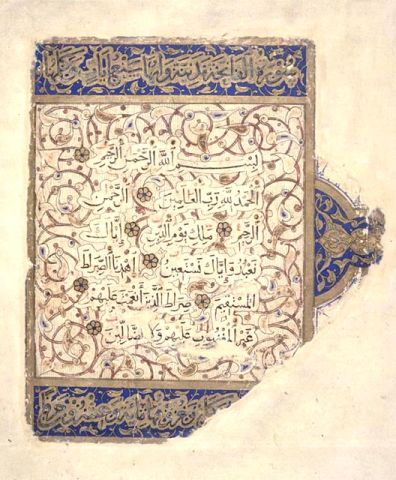
Image: 14th C. Qur'an, Mamluk origin, Library of Congress; Rights obtained.
Sunday, January 3, 2010


Saturday, January 2, 2010
Day 2 of Qur’an Reading:
Welcome, Friends: Ahlan wa sahlan!
How was your reading so far? Do tell!
I will know better which way to go when you tell me what you think.
It might sound simple to read 2 pages a day. One would think that the difficult part is studying the words and understanding their intent, but in reality, the difficult part is MAKING TIME…every single day. And we have only just begun!
Qur'an Pages 3 and 4 were read today, corresponding to verses 6-24 of Chapter 2, titled 'Al Baqara' (translated as 'The Heifer' by Y. Ali, or The Cow by M. Asad).
COMMENTS:
As we saw yesterday in verses 1-5, the Qur'an said that there was no doubt in it, as a compilation, being Guidance to the Mindful. Wasn't that precisely what Believers were asking for in the Opener? "Guide us to the straight course..." A prompt response to their prayer is only one verse away- and they can grasp it, IF they are mindful!
What Y. Ali calls 'the Unseen,' Asad describes as 'that which is beyond human perception.' I like that as an interpretation for 'Ghayb'.
We were given the characteristics of the 'Mindful Believers' in 2 verses, and the characteristics of the opposing group, 'allatheena Kafaru,' Those who Conceal or cover, in 2 verses as well. Both groups are clear-cut and obvious, so describing them is quite straightforward.
After that however, we find that it takes 15 verses no less, to describe the third group, a group that neither Believes nor Denies, but is conveniently one or the other depending on circumstance. Physically present with Believers, whilst spiritually absent. This group is that of The Hypocrites (verses 6-20). The Qur'anic description of their state brings their loss to life and, especially in Arabic, we see, hear, and feel their turmoil.
In verse 21 the Qur'an calls upon us as 'Naas,' or 'cognizant Humans' to worship Our Lord. 'Naas,' the plural of 'Insaan,' denotes a Being of Cognition; the human upon reaching the stage of communication and intelligence. Root verb: 'A-na-sa': to find companionship in, to see, to find 4:6; 20:10. It is quite important that this verse calls upon us as Cognizant Beings to worship Him, motivated by the desire to remain Mindful. Remind me dear Friends to tell you more about this, as Mindfulness is the birthright of cognizant beings, but it requires some effort on our part.
'Rabb' is translated as "Guardian-Lord' by Ali, and 'Sustainer' by Asad, and appears in old Lexicons and in Asad's valuable commentary link below as the following: The Arabic term RABB means much more than 'Lord'. It refers to someone who has a just claim to possession and authority over something, as well as the task of rearing, sustaining, fostering and bringing it together from inception to final completion! That is a presence to rely on indeed. Without a definite article 'the', any male head of a family is called rabb, such as in rabb ad-dār ("master of the house") because he has authority over and is responsible for its maintenance and well-being, and a female would be rabbat ad-dār ("mistress of the house"). With 'THE' however ('al' in Arabic), the designation 'Al Rabb' is exclusive to God as the sole fosterer and Sustainer of all. Asad commentary link: http://www.islamicity.com/QuranSearch/
The parts we read today, end with a challenge to confound the idolatrous Arabs of the 7th Century A.D. who had reached their peak in eloquence. It is oft-repeated in the Qur'an, and remains to this day, that if they were in doubt of what God had sent to His worshipper (meaning Prophet Muhammad, peace upon him), then they should 'produce a 'sura,' a 'supreme construct', such as this. If they do not- AND THEY ARE ASSURED THAT THEY SHALL NOT- then they should beware of the consequences.
As we go along we will realize how superior the Qur'anic construct actually is, so enough for today!
Peace unto all!
Subscribe to:
Posts (Atom)