CLICK IMAGE: Tanzil Website


OUR MISSION:
UNCOVERING the original message of the Arabic Qur'an by using Lexicons compiled more than 1,000 years ago.

ISOLATING Fact from Fiction.


RECOVERING Hope and regaining the perspective where Humanity is one, God's Message is one, and our Future CAN become one we all look forward to!


© 2010 IQRATHECHALLENGE: INTELLECTUAL PROPERTY PROTECTED BY D.M.C.A. ALL RIGHTS RESERVED.

© 2010 IQRATHECHALLENGE: INTELLECTUAL PROPERTY PROTECTED BY D.M.C.A. ALL RIGHTS RESERVED.
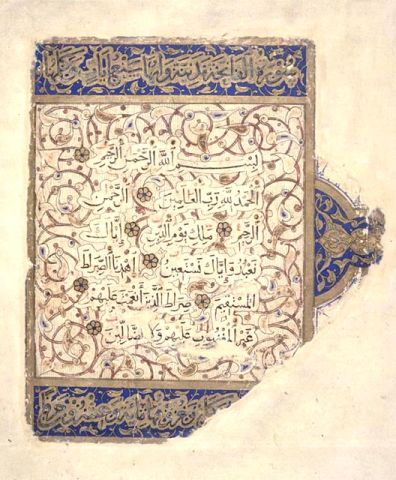
Image: 14th C. Qur'an, Mamluk origin, Library of Congress; Rights obtained.

A BREAKTHROUGH project which helps understand the Qur'an AS REVEALED -not just 'as explained.'

---------------------------------------------------------------------------

Sunday, January 31, 2010

Day 27; HQ 3:23-37; pages 53+54

Welcome Friends:  Ahlan wa sahlan!
What a challenge the last Posting was, with so many important concepts to deal with!  Although many of you voted for the linguistics, do tell me when they get too heavy.  Voice your opinions to see the changes you need.
With today being our 'one month' mark, committed readers among us have begun to feel great positivity in themselves.  By understanding the Qur’an -and logging on daily…even briefly-  we’ve been able to cultivate a better understanding of Faith, of Life, and of our responsibility towards each other.  It is up to us, the educated, to BE the change we desire in this world.   

COMMENTS:

1.     Verses 23-25:
‘Hast thou not turned thy vision to those who have been given a portion of the Book.. /Art thou not aware of those who have been granted their share of revelation (aforetime)…(Yusuf Ali & Muhammad Asad respectively*)…

The Qur’an addresses Prophet Muhammad here, peace upon him, with regard to Followers of earlier Messages, stating that, what those people received back then was, in fact, a portion of the ‘Kitaab,’ or Compilation, and that although they were called upon to consider it Arbitrator between them, some of them turned away in refusal. 
This is somewhat similar to HQ4:44 which says:

‘Did you not perceive/‘see in unto’ those who were given a portion of the Compilation, how they are purchasing (their own) Loss, and aspiring that you (too) lose the Way?  

Some readers would have noticed that, just as God Is One, His Standard of  Accountability (‘Deen’) is one, and His Compilation (‘Kitaab’) is also one!  Although He sent down His Compilation in stages, it was nevertheless one divine Unit, ‘updated’ according to Humanity’s advancement, and completed almost 1500 years ago.  It is interesting to note that despite the fact that the Qur’an mentions many Messengers prior to Muhammad, peace upon them all, and tells us of the Messages they brought, it considers all their Messages part of one Compilation, ‘Kitaab.’ We already read something of that in HQ2:213.
A grave warning is issued in verse 25 to Followers of earlier Revelations who took the Hereafter lightly and refused their own Message. 

2. Verses 26-27 are most beautiful supplications and praise unto God.  Yusuf Ali’s note 369 is worth reading, and ends with the words: “All is, will be, must be, right in the end.”
Although verse 26 is about God’s Power and Dominion, very few commentators noted that the Arabic ‘yad’ is a word which originally denoted power, ability, aid (see Jan. 24 for Arabic definition in footnote).  Because it has also come to denote the extremities of our upper limbs (our hands) they have applied that translation to God.  In Arabic we say ‘yad,’ and the word is accurate no matter how we understand it.  In English however, it is more appropriate that we declare to God: ‘In Your Power is all Good,’ rather than: ‘In Your Hand is all Good.’

3.  Verse 28 issues a grave warning to Believers, that God is the One to be Aware of when, even in a measure to ward off the Deniers’ harm, they procure the support of Deniers rather than other Believers.

 
4.  The following verses 29-30 tell us that God knows the deepest intentions even as He knows all that is in the heavens and on earth- and He has Power over all… and His shall be the reckoning, on the Day when every Self shall be confronted with its Deeds…!  Read on.  
This picture is perhaps most intimidating for those of us who are clever at avoiding confrontation and quick to brush off blame.  On that day our skills cannot help us, and no matter how hard we sought to, we would NOT be able to put any amount of distance between ourselves and our Deeds…

5.  In Verses 31-32 the Messenger Muhammad, peace upon him, is told to show Humanity the power of LOVE, and the steps they should take, so as to fully partake in God’s Love and Forgiveness.

6.  In Verses 33-37 we find the reason behind the naming of this Chapter, as well as the beginning of historical narration of previous Messengers, Jesus, Zachariah and John, peace upon them all. 
The narration starts with an expectant mother making a beautiful supplication to God and dedicating her unborn child to Him.  Then she gives birth to a daughter and names her Mary.  She is the grandmother of Jesus!
An interpolation catches our attention: '..and not alike is the male to the female...' What is the meaning of this part (HQ: 3:36)? 
Since we know that male and female are not alike, we tend to imagine that this indicates that the male is better, or inherently superior.  What comes as a surprise to many is that, in this case, the opposite is true.  Grammatically speaking* (and perhaps because Mary was to become the Mother of Jesus peace upon him), the way this statement is formulated indicates female advantage over male.  At the very moment when Mary was born, Mary's mother is assured that a female is not akin to a male, in the same way as we might exclaim that silver is not akin to gold.  Yet generations upon generations of us understood it backwards!

7.  Mary’s mother prays to God to protect her infant daughter, as well as her daughter’s offspring, from the Banished Deviant.  God accepts the child who grows up in Goodness, with unmatched faith and devotion to God.  Mary never ceases to astound Zachariah, in whose care she was placed. 
Verse 37 must be read several times to grasp the power of this young girl’s response to her guardian upon being asked where she was getting her sustenance from, and to understand his reaction to this (verse 38).
But that is for tomorrow!


Enough said!

Tomorrow’s reading is from HQ 3:38-52.

Peace unto all!
·         I prefer Y. Ali’s translation of verse 23 to M. Asad’s because the former is closer to the original.  When M. Asad uses the word ‘aware’ for the Arabic (yara) which means ‘look,’ and then specifies ‘their share’ when it says ‘a share’ (naseeban), we get sidetracked from Qur’anic intent.
 
·            الأنثى هي "المُفَضَّل" والذكر هو "المُفَضَّل عليه."

Friday, January 29, 2010

Day 26; HQ 3:10-22; pages 51+52

Welcome Friends:  Ahlan wa sahlan!
It is taking time to find a well-balanced Tagalog explanation of the Qur’an.  
I would appreciate directions.

COMMENTS:
1.     The first three verses in today’s Reading (HQ 3:10-12) are about 'Allatheena Kafaru' those who Denied/Concealed/Covered-   ‘Kafara’ literally means to cover, a reference to those who Deny or conceal The Truth.  What Truth? 
This truth or Reality is inherent to ourselves as Humans, in that our Selves are indeed, OF HIM, The Creator.  Those who had spent their entire Earthly lives in Denial will find- in their Afterlife- no use in either wealth or offspring.  These stunted Selves will watch helplessly as other Selves, high in self-actualization and achievement, return in peace unto their Divine Sustainer (HQ89:27-30).  This stage would be, to the latter, the final leg of their glorious journey towards Him, to enjoy everlasting existence.  How could the two ever be considered alike (HQ45:21)?  The steel-sharp vision (which Death bequeaths) is a rude awakening to the Deniers as they become fully aware (HQ50:22) of their Reality.  They bite on their own hands in Despair (HQ25:22-30), and all they can say is: ‘Alas!’  They have placed themselves in the single, most agonizing situation ever known to Man: Eternal REGRET.  
(To read more, copy-paste this word- حسرة - in the Tanzil website, topmost image.)

2.     Although Verse 13 is understood to allude to the Battle of Badr, it is of general import, showing how victory could be in the hands of a small group which has powerful Conviction - over any other, although larger and better-armed (Yusuf Ali note 352, 353; Muhammad Asad note 9).  

3.     “Alluring unto Humans is the love of what they desire in nisaa/'women’ and children…”  Verse 14 lists for us what is most alluring to us, and what is indeed most desired on this earth.  Yusuf Ali explains in his note 354, showing us that this description fits any day and age, and includes all our ‘pedigree’ or ‘brand’ luxuries. 
The word ‘nisaa’ (which usually means women) should be widely applied- certainly WITHOUT sexual connotation- because the desire itself is related to Cognizant Humans in general, ‘Naas,’ and not to males alone.  In today’s market research we know the desirability of an attractive female figure and its effectiveness in the sale of any product to both males and females (called HAM’s –Highly Attractive Models).  This helps us better understand the mention of ‘nisaa’ (women) in this verse.  Interestingly, there are those who have offered a very different, seemingly far-fetched though not implausible interpretation, saying that ‘nisaa’ here could mean ‘innovation' since the root-verb ‘nasa’a’ also means to bring ‘later on,’ * in which case the verse would indicate Human love and desire for novelty.  Back to our verse; this list is similar to a much shorter list (which does NOT mention ‘nisaa’) in HQ18:46:

“Wealth and children are Adornment of this world's life: but good deeds, the fruit whereof endures forever, are of far greater merit in thy Sustainer's sight, and a far better source of hope.”

4.     In Verse 15 we find listed what are indeed far better than the short-lived desires mentioned in verse 14, and here we are told of Purified Mates (not gender-related), and the Best benefit of all: God’s Good Pleasure/His Goodly Acceptance… and in God’s Sight are all His devotees.
We have a humble prayer in verse 16, and in Verse 17 we are given 5 beautiful traits of those Devotees to emulate.

5.     In Verse 18 God Himself bears witness to His Uniqueness (there is no god but He), and then states that the angels do so too, as well as those endowed with knowledge.  If we wish to be in the ranks of the most noble of His creatures, we should bear the same witness with them: I bear witness that there is no deity except The One True God!

6.     Verse 19 deserves special attention because it is a verse that, instead of bringing acceptance, has brought much conflict due to faulty explanation.  It starts off by saying (in accurate linguistic translation):
“God’s standard of Accountability is pure and flawless…” 
We’ll try to illustrate these important concepts: 
·        ‘Deen’ in Arabic does NOT mean Religion*.  ‘Deen’ means ‘accountability/liability,’ (with regard to ourselves) or the assessment thereof (with regard to God, as in this verse).  This is why the word ‘deen’ in the oldest 10th century lexicon HAD NO PLURAL. The plurals we have today (‘adyan’ and 'dayanaat') seem to have appeared centuries later as a reflection of people's concepts in this regard (the earliest I found was the plural 'adyaan' in the 12th century lexicon of Al-Ragheb Al-Asfahani).
-We are often liable to one another, and we are ALWAYS accountable to God:  a debt is ‘deyn,’ and the Day of Accountability is ‘Yawm il Deen.’
- 'Medina' means 'she to whom all are liable and accountable.'  It is a striking fact that no sooner had Prophet Muhammad, peace upon him, settled in 'Yethrib' that he changed the historic name of this town to one which indicates the new level of civic and moral accountability which would henceforth bind its citizens together and spread around the world!  Civilization is 'medeniyyeh,' for there can be no civilization without accountability, in fact, the more advanced a civilization the higher the accountability of its governing and non-governing citizens to each other and to their laws.  THIS is how early Muslims understood 'Deen' and how they spread their beautiful message. 
-Muhammad Asad says that “Deen” is a ‘Moral Law,’ explained in his rendering of (The Fig) 95:7:
”فما يكذبك بعد بالدين* أليس الله بأحكم الحاكمين“

“What, then, [O man,] could henceforth cause thee to give the lie to this moral law?  8) Is not God the Most Just of judges?”

He adds: “Since the moral law referred to here has been stressed in the teachings of all monotheistic religions, its truth ought to be self-evident to any unprejudiced person; its negation, moreover, amounts to a negation of all freedom of moral choice on man's part and, hence, of justice on the part of God, who, as the next verse points out, is - by definition - "the most just of judges.”
·        ‘Islam’ denotes far more than the restricted, present-day usage of the word*.
The word ‘Islam’ is derived from the three letter root verb ‘sa-la-ma.’  Our Lexicon defines it as “mostly related to purity, or freedom from defect or weakness.'  It also says,“Therefore God calls Himself: ‘Al Salam’, and the heavenly Domain: ‘Dar Al Salam’. ‘Silm’ also reflects this meaning in peace or tranquility (freedom from troubles of war). Another reflection of this is in submission to God, because one would then be free of denial or rejection.” 
Therefore: Purity, wholesomeness, peace, and tranquility are not only stronger connotations of ‘sa-la-ma,’ but they are active testimony to our faith.  
This is how early Muslims understood Islam.  清真寺
It is no coincidence that in China, where the first mosque outside Arabia was built more than 1,300 year ago, Islam is still called in Chinese, ‘the Religion of Purity and Truth’.  The tragic paradox is that, although we revere the Arabic Qur’an revealed 1,400 years ago as a Message of truth preserved for all Time, we have often in effect, ‘altered’ it ourselves by misinterpreting and misrepresenting it.
In other words:  Islam literally means 'Pureness' (from fault or defect).  The Chinese, being the earliest recipients of Islam in 674 AD, only 47 years after Emigration, retained the original meaning: Islam in Chinese is “Yisilan Jiao”or “Pure true Faith.” A mosque is qīngzhēn sì, "pure truth temple.”
If we read the entire verse we'd understand how and why humanity diverged after Truth became known to them. 
But we first have to recognize the following:
 
'Islam' is not what WE have made it out to be, but is something worthy of being 'indal Lah-' RELATIVE to God Himself.  The Qur'an NEVER addresses 'Muslims,' but sometimes addresses Humanity (Naas), People of previous Scriptures, and MOSTLY addresses 'Allatheena Aamanu,' those who have attained to Faith (ie, it addresses Mu'mins rather than Muslims).  So both Islam and Eman have their own characteristics and are NOT interchangeable.
 
When God says, "Inna Deena indal Lahi-l Islaam" He is referring to HIS standard of Accountability (how He holds us all accountable), a Standard pure, flawless, and free of bias and other deficiency known or unknown to us.

Only with such a Standard can all of us be truly served by His Justice.

7.     The second half of Verse 19, as well as Verses 20-22 discuss the Followers of previous scriptures, how they diverged, and how we should address them in any dispute they might have with us.  And then the verse tells Prophet Muhammad, peace upon him, that with regard to those who deny God’s Signs, who kill the Prophets without justification, and who kill those who enjoin equity- he (the Prophet) must ‘announce to them a grievous penalty.’ 
Muhammad Asad’s note 48 of Chapter 2, ‘The Heifer,’ makes it clear with reference to the Bible (Mathew 23:37, 23:34-35, Luke 11:51) that this refers to the killing of John the Baptist, Zachariah and others, as mentioned by Jesus: ‘O Jerusalem, Jerusalem, thou that killest the prophets and stonest them which are sent unto thee.”  


Enough said!

Tomorrow’s reading is from HQ 3:23-37.

Peace unto all!
·         نسأ: تأخير الشَّيء. والنَّسِيئة: بيعُك الشَّيءَ نَسَاءً، وهو التَّأخير. تقول: أنسأتُ. ونَسأَ الله في أجلِك وأنسأ أجلَك: أخَّره وأبعده.
·         سلم: معظم بابه من الصّحّة والعافية؛ فالسّلامة: أن يسلم الإنسان من العاهة والأذَى. قال أهلُ العلم: الله جلَّ ثناؤُه هو السلام؛ لسلامته مما يلحق المخلوقين من العيب والنقص والفناء. ومن الباب أيضاً الإسلام، وهو الانقياد؛ لأنَّه يَسْلم من الإباء والامتناع. والسِّلام: المسالمة. ومن الباب السَّلْم وهو الصُّلح. قال الله تعالى: {وإِنْ جَنَحُوا لِلْسَّلْمِ فَاجْنَحْ لَهَا} [الأنفال.
·       وفي مفردات القرآن للراغب الأصفهاني:
دنت الرجل: أخذت منه دينا، وأدنته: جعلته دائنا، وذلك بأن تعطيه دينا.
والتداين والمداينة: دفع الدين، قال تعالى: }إذا تداينتم بدين إلى أجل مسمى{ [البقرة/282].
والدين يقال للطاعة والجزاء، إن الدين عند الله الإسلام{ [آل عمران/19]، وقوله: }لا إكراه في الدين{ [البقرة/256]، قيل: يعني الطاعة، فإن ذلك لا يكون في الحقيقة إلا بالإخلاص، والإخلاص لا يتأتى فيه الإكراه }فلولا إن كنتم غير مدينين{ [الواقعة/86]، أي: غير مجزيين. وجعل بعضهم المدينة من هذا الباب.

Let's TWEET this!

Tweet me!