CLICK IMAGE: Tanzil Website


OUR MISSION:
UNCOVERING the original message of the Arabic Qur'an by using Lexicons compiled more than 1,000 years ago.

ISOLATING Fact from Fiction.


RECOVERING Hope and regaining the perspective where Humanity is one, God's Message is one, and our Future CAN become one we all look forward to!


© 2010 IQRATHECHALLENGE: INTELLECTUAL PROPERTY PROTECTED BY D.M.C.A. ALL RIGHTS RESERVED.

© 2010 IQRATHECHALLENGE: INTELLECTUAL PROPERTY PROTECTED BY D.M.C.A. ALL RIGHTS RESERVED.
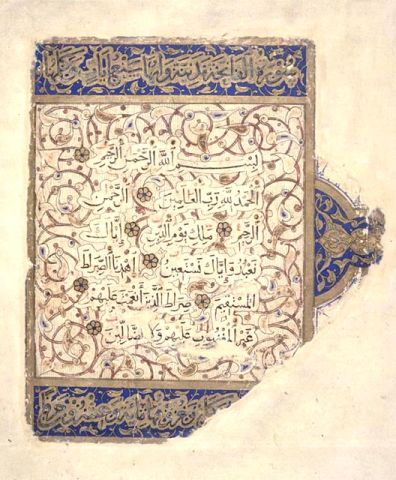
Image: 14th C. Qur'an, Mamluk origin, Library of Congress; Rights obtained.

A BREAKTHROUGH project which helps understand the Qur'an AS REVEALED -not just 'as explained.'

---------------------------------------------------------------------------

Friday, March 12, 2010

Day 58; HQ5: 41-50, pages 115+116

Welcome Friends:  Ahlan wa sahlan!
It is indeed such a privilege to have one’s mind occupied by the Qur’an; reading, researching….and praying… asking God’s Guidance to the Truth, to the best that we can understand.  You will find much to think about today, dear Friends, and much motivation.
Thank you, dear Friends, for this partnership!
COMMENTS:
1.     Although Verse 41 is addressed to the Messenger, Muhammad, peace upon him, it is also intended for all who might grieve over those who rush into Denial, either from among their own ranks or from other ‘Faiths.’ 
Those who rush into Denial will be disgraced in this world, and suffer severely in the Hereafter.
Verse 42 describes them, in that they are oft-listeners to falsehood, oft-consumers of what is forbidden (again the repetitive form of the verb, similar to what we read in the last two Postings: sammaa’ سمّاع rather than sami’ سامع ; akkaal أكّال rather than aakel آكل). 
The Messenger Muhammad, peace upon him, was told that if they came to him for judgment, he should judge with Justice between them or let them be, for God loves the Just.  But then the next verse (43) asks how is it that they would come to him for judgment (in the first place), despite having the Torah, in which is God’s judgment (which they have received and supposedly believe)?  The verse asserts that such persons are indeed not Believers.
In his note 57 Muhammad Asad describes the mentality of this group, saying that “they are not really prepared to submit to the judgment of the Torah…nor the judgment of the Qur’an..”
Again, although this might be discussing People of (earlier) Compilation, it serves as a lesson for all time, especially for Believers in the Qur’an NOT to look elsewhere for God’s Judgment!

2.     Verses 44 begins by praising the Torah, revealed by God, containing both Guidance and Enlightenment and considered the standard by which prophets who were pure of direction (towards God) offered judgment unto the Jews.  Muhammad Asad tells us in note 58, that this implies that the Torah was intended only for them “and was never meant to have universal validity.”  The verse ends by stating that those who do not judge according to what God has revealed are indeed Deniers.

3.      Verse 45 tells us that of the judgments in the Torah (which they obviously were attempting to avoid by bringing their grievances to the Messenger to judge), were compiled/brought together UPON them  كتبنا عليهم: a life for a life, and an eye for an eye, and a nose for a nose, and an ear for an ear, and a tooth for a tooth, and the wounds (also) by retribution, AND that they could forego retribution as a charity to others, in which case God would consider it an atonement of his past sins.

4.     Muhammad Asad (our Torah expert) tells us something VERY interesting in this regard:  After telling us (note 61) to check out these severe retributions in Exodus 21:23 (link below), Asad adds (note 62) that the Forgiveness part of this verse (in italics above) is nowhere to be found in the five books currently considered the Torah!  He says that the Pentateuch (with its five books) “does not contain this call to forgiveness which is brought out with great clarity not only in the Qur’an but also in the teachings of Jesus..” and he continues, explaining that this may have been part of the original message to Bani Isra-eel, and was either corrupted with time, or deliberately abandoned by its followers, whom the Qur’an accuses of ‘distorting the meaning of the revealed words.’  Isn’t it strange that forgiveness and giving up legal retribution is NOT to be found in the Pentateuch?
Isn’t THAT food for thought!

Now let us think:
Isn’t it terrifying when we, as Believers in the Qur’an, compare this to what OUR own people have done? 
Many of our scholars are finally speaking up, showing how damaging similar acts have been to our faith and to our existence.  The famous scholar Yusuf Qardawi, for example, has protested quite plainly that we have zealots who have ‘abrogated’ or rendered ‘null and void’ what they count as between140-200 Qur’anic verses! *  What are these verses mostly about?  Fair treatment and forgiveness (!!!). 
No wonder the Qur’an goes on and on, about what happened to the People of (earlier) Compilation and how their Revelations were corrupted!  When we think about it, there really is no need to erase a few paragraphs to cause corruption in a compilation: 
It could remain intact WHILE being voided of the weight of some instruction, while other instruction is misinterpreted.  Although such a Compilation would not be corrupt in itself, it would be corrupted in our minds, in our understanding and application of it. 
But before we rush to throw all the blame on our figures of authority, perhaps we should shoulder part of the responsibility, if not for anything else, then just for being silent about this.  During our decades of silence, so-called ‘explanations and translations’ of the Qur’an have spread all across the globe, together with thousands of other publications that veil much of the Qur’ans illumination and void many of its most beautiful concepts, literally taking us all backward to a second ‘Jaahiliyyah’ جاهلية or ‘Period of Ignorance.’ 
BUT we can come out of this darkness and be positive forces to our societies and to the world once again because: 

We have our Arabic Qur’an. 
We believe in what it holds. 
We trust and rely on God Who sent it.
We have the beautiful example of the Messenger and the first Recipients, as God Himself has described them.
In the guidance of the Qur’an, with the aid of God who sent it TO US, we can BE the change we desire!  
                                                                               
5.     Verses 46-47 discuss Jesus Son of Mary, who followed in the footsteps of the earlier prophets, confirming the truth of what (remained) of the Torah, and receiving the Evangel in which was Guidance and Illumination, as well as Admonition for the Aware.  Therefore the People of the Evangel are told to judge by its standards, and those who do not, they indeed are the Noncompliant (iniquitous/those who rebel-Ali/Asad).  Perhaps now we can better understand the complications of – and the many reasons for - Jesus’ ‘corrective’ mission!

6.     Verse 48 discusses THIS Compilation, addressing its Deliverer, Muhammad, peace upon him, telling him that God revealed it to him in Truth and as a DETERMINANT of the truth of earlier Compilation (notice that the Compilation always is singular), and that he should judge between people with what has been revealed by God and not follow anyone’s desires.

An interesting statement in the center of the verse says that:
 “…to each of you have We rendered a System and an Approach, and if God had willed He would have indeed made of you a single ‘people/community,’ but (He willed it otherwise) to test (each of) you with what He has granted you, therefore compete towards all ‘virtues/good works,’ unto God will you all return then He will inform you of the matters in which you were (constantly) differing.”

It is not a different ‘religion’ that each of us has, but a different system شرعة and a different approach منهاج – and that’s how God willed it, to see who accomplishes best with what they are given!  Isn’t that a totally new way to look at it?  This fact should have been known to anyone who read the Arabic Qur’an!

7.     The last two verses tell the Messenger again, peace upon him, to judge as per what he had received (read full verses), and asks eloquently at the end: …
“…Do they then seek judgment by the standards of Ignorance (جاهلية Jaahiliyyah)?’ 
And Who could be of better Judgment than God, for- قوم يوقنون -People of Inner Certainty?”


Enough said!
Our next Reading is from HQ5: 51-64

Peace unto all!

* "ووصل الأمر إلى أنهم قالوا إن آية السيف نسخت مائة وأربعين آية في كتاب الله، بل بعضهم قال نسخت مائتي آية، وإن هذه الآيات موجودة في المصحف خطًا ولفظًا ومعدومة المعنى: http://www.qaradawi.net/site/topics/article.asp?cu_no=2&item_no=7197&version=1&template_id=211&parent_id=16
*(شرع) شيءٌ يُفتَح في امتدادٍ يكون فيه. من ذلك الشّريعة، وهي مورد الشَّارِبة الماء. واشتُقّ من ذلك الشِّرْعة في الدِّين، والشَّريعة. قال الله تعالى: {لِكُلٍّ جَعَلْنَا مِنْكُمْ شِرْعَةً وَمِنْهَاجَاً}  [المائدة 48]، وقال سبحانه: {ثُمَّ جَعَلْنَاكَ عَلَى شَرِيعَةٍ مِنَ الأَمْرِ}  [الجاثية 18]. ويُقال أشرعْتُ طريقاً، إِذا أنفذتَه وفتحتَه، وشرعت أيضاً. وشَرَعْت الإِبلَ، إِذا أمكنتَها من الشّريعة. هذا هو الأصل ثم حُمِل عليه كلُّ شيءٍ يُمدُّ في رفعةٍ وغير رفعة. من ذلك الشِّرَع، وهي الأوتار، واحدتها شِرْعة، والشراع جمع الجمع ومن ذلك شِرَاع السَّفينة، وهو ممدودٌ في علوٍّ.

Thursday, March 11, 2010

Day 57; HQ5: 32-40, pages 113+114

Welcome Friends:  Ahlan wa sahlan!
Put on your ‘thinking-caps’- today is tough! 
Sorry for missing the Post (March 9th).  Our blog is ever-present on my mind, so-much-so that when I left my desk for the day, I thought that I had already posted it.  Imagine my shock when I realized that I hadn’t!
COMMENTS:
1.     In yesterday’s Reading prophet Muhammad, peace upon him, was commanded to tell the People of (earlier) Compilation the story of the two brothers.  When we read it, we noticed the raging impact envy could have upon a self-aggrandizing personality, in contrast to the amazing restraint which Awareness could bring (just imagine not putting up one’s arm in self-defense). 

Some of you might have asked themselves:“Why does God ask His Messenger to mention THAT story to the People of (earlier) Compilation? The answer is in other verses, such as what we read earlier, in HQ2: 109:

“Many among the People of (earlier) Compilation wish they could render you, after your faith, into Deniers, out of selfish envy within themselves, [even] after the truth has become clear to them. Then, overlook and forgive, until God brings about His command: indeed, God Is, over all, Capable.”

By laying the truth out for all to see, God was showing them that He is the Source of this new Message, giving warning, even as He allowed such persons a final chance to make amends.  This story, with all its lessons, should stand out in our minds for all time.

2.     The answer also appears in the verse immediately after it, Verse 32, when the Qur’an continues along the same subject saying:

Because of that, we compiled/put together UPON Bani-Isra’eel that whoever kills someone other than in legal retribution or for spreading corruption on earth, it shall be as though he had killed all Humans, and whoever saves a life, it shall be as if he had saved the lives of all Humans…”  
Read the verse to the end… no further comment is necessary, for both Y. Ali (note 737) and Muhammad Asad (note 35) write of it quite eloquently in their footnotes.  As Ali says: “To kill or seek to kill an individual because he represents an ideal is to kill all who uphold the ideal… What could be stronger condemnation of individual assassination and revenge?”
Muhammad Asad, on the other hand, ties these verses to Verse 15, indicating that it is part of what the People of (earlier) Compilation have been concealing (from others as well as themselves).
3.     Verse 33 grabs our attention as to its severity.  It seems that certain acts against Humanity are considered very serious, and therefore trigger the harshest retribution. Such acts of aggression could be against Humanity’s Moral/Spiritual existence, or its Physical existence.  With regard to moral/spiritual Aggressors, the Qur’an calls their acts ‘waging war against God and His Messenger,’ while the physical aggressors are those who ‘strive throughout the Earth in corruption’.

There are two ways of looking at this verse, one well-explained by Yusuf Ali, and the other just as well-explained by Muhammad Asad.  It is worthwhile to read both their notes in their entirety.

As I understood, according to the first viewpoint we are told to bear in mind that this retribution is one that is according to ‘law,’ meaning that no one has the right to go out and mete retribution at will; it has to be taken through legal channels and carried out by the judiciary, who are necessarily appointed and approved by the community.  Such Judiciaries would specify the deeds and mete out a corresponding retribution from this list:
These four manners of retribution are intended to replace all other manners of retribution, as well as to disgrace the Aggressors in this immediate life, even while it promises them great suffering in the next:
Death, Crucifixion, the alternate ‘cutting off’ of hands and feet, and Banishment from the earth.
Yusuf Ali tells us that in the New Testament, in Mathew 27:38 it tells us that during Jesus’ time thieves were crucified. He also tells us (he was a lawyer!) that such penalties were features of the Criminal Law for centuries, including, in English Law, ‘hanging, drawing and quartering,’ and in old Arabian tribal custom, the “piercing of eyes and leaving the unfortunate victim exposed to the tropical sun... 

As for Muhammad Asad, he tells us that this verse is a statement of fact, and that this is indeed what takes place on earth: Aggressors will inevitably meet such dire ends to their crimes on earth.  He says it is a declaration to the inescapability of retribution which such people bring on themselves.  He also draws our attention to all the verbs; they are in the oft-occurring tense ‘yuqqattal’ being (oft-killed) rather than ‘yuqtal’(killed) – ‘yusallab’ being (oft-crucified) rather than ‘yuslab’ (crucified)- and seeing that no one can be killed more than once, it must be discussing an overall phenomenon, that Aggressors will inevitably generate oft-occurring killings against themselves, crucifixions, banishments etc.  Asad says: “In short, the attempt of the commentators to interpret the above verse as a ‘legal injunction’ must be categorically rejected, however great the names of the persons responsible for it.”
Do read their notes (Asad’s takes the entire page!) if you wish to understand this.
 
4.     Verse 34 shows that God is Forgiving when such wayward persons feel remorse for their aggression and make amends BEFORE being overpowered. 
It is only when we are still capable of continuing our wayward ways that our repentance has true value, as in HQ10:91 when Pharaoh expressed his faith while drowning, to no avail.

5.     Verse 35 calls on those who have attained Faith, to be Aware of God, and seek the means of approach unto Him, and to strive hard in His cause, that they may be Successful.  Four steps that grant us Success:

Faith +Focus (on God) + Finding the Means + Effort (towards God) = Success.

This is about success in life, so if we find ourselves unsuccessful, one of these four is lacking!
Verse 36-38 shows us what the Deniers will feel on Judgment Day when nothing will be accepted from them, even if it had been in their power to offer the entire earth in ransom.  Their utmost hope is to get out of their Fire but they shan’t, for theirs is a lasting suffering.  Remember what one brother said, “…Indeed, God accepts the deeds/offerings of the Aware!...” (إنما يتقبَّل الله من المتقين...)

6.     Verses 38-39 discuss the misunderstood issue of ‘cutting off the hands’ of thieves, which, as Yusuf Ali tells us in his interpretation (he follows the narrow rendering of the word ‘yad’ as ‘hand’) is similar to what is mentioned in the New Testament in Mathew 18:8:  “If thy hand or thy foot offend thee, cut them off, and cast them from thee.”

Before we get into that however, we have to get a few important points out of our way:
·        Firstly, usage:
The Arabic ‘yad’ is a word which originally denoted power, ability, aid (see Jan. 24 for Arabic definition in footnote).  For verification, let us count the verses in our Readings so far (from the beginning of the Qur’an till today’s verse) that have used the word ‘yad’ or its plural ‘aid  أيد’. 
Of the more than 20 times this word (or its derivatives) was used, only a few literally indicate the limb, or ‘hand.’  Of these, we find the two verses on ablution HQ4:43; 5:6, and verse 2:249 on cupping water to drink, and perhaps 5:28 which we passed through recently, where the brother who is Aware tells the Aggressor that he would not ‘put his hand out’ to defend himself!
‘Qata’ means to cut, but also to halt, to terminate, to traverse  etc..(actually, do take a look yourselves at the various meanings of this word!  Copy + paste: قطع at: http://translate.google.com/#ar|en| 

·        Secondly, conjugation:
Note that there are three plurals in Arabic, a ‘dual’ plural which identifies the subjects as ‘two,’ (called muthannaa  مثنى-) and a plural which identifies the subjects as three or more in general (males alone or males and females), and finally a plural which identifies the subjects as three or more females alone. 
In this verse we have TWO human subjects (the thieves), ‘dual’ muthannaa, yet when their ‘yad’ are mentioned (translated as hands) we find out that not one, nor two ‘hands’ are being discussed, but a plural of hands; three or more!  Indeed, the context indicates that ALL the ‘hands’ of these two thieves are to be ‘cut off,’ or ‘impeded!’

·        Thirdly, the NOUN ‘al saariq’ السارق which our regular Readers will immediately notice, is a label (and we DO know the difference between labeling persons, versus simply using a verb to describe their actions- see Posting March 4th.).  Had these 2 persons simply ‘stolen,’ the Qur’an would NOT have branded each of them separately as ‘the Thief.’ This ‘label’ is in stark contrast to the story of Prophet Joseph, peace upon him, and his brothers; when the youngest brother was made to appear as a thief, one of his brothers said (HQ12:81): “…Return (all of you) to your father and say, O our Father, your son stole, إن ابنك سرق and we can bear witness only in what we know…”  They did NOT say, ‘Your son is a Thief,’ because such a label would imply a history of thieving.  In a nutshell: the label ‘the Thief’ is reserved for persons who earned the label, ie: REPEAT OFFENDERS!  
  
And The (male) Thief and The (female) Thief, subsequently ‘cut off’ (for both) all their ‘yad’ أيديهما in requital for what they both have incurred, a prevention نكالاً *from God, for God is All Powerful, Wise.”
Traditionally, scholars have said that although the verse grammatically indicates ‘cutting off ALL their hands,’ what should actually be cut off is the right hand of each.  They DO take mitigating circumstances into account (as in a famine), and have set a minimum value for what is stolen to deserve retribution, but they do NOT differentiate between the first time, or a repeat offense.  To fully understand this issue (and get it out of your way once and for all) read Muhammad Asad’s note 48 which explains when the actual ‘cutting of hand’ is applicable, “within the context of an already-existing, fully functioning social security scheme, and in no other circumstance.”

Some of us might argue for the actual ‘cutting-off’ of hands, saying that when wisely implemented, nobody will ever steal again.  Some of us will argue that this seems to be a narrow, incongruent Reading of the verse, and that the Qur’an leaves the matter open to a society’s best judgment on how to mete retribution from its wayward children, effectively putting a ‘halt’ to thieving by helping the poor, or providing therapy for kleptomaniacs, or reforming and imprisoning- or even more severely punishing- Thieves who are beyond reform. 
Nevertheless, let us end this subject here, and move on to the end of the verse.

Here, we notice the reasons given: Requital (for the deed), Prevention from God.
And the next verse tells us that if any such person repents and makes amends, God forgives them for He is Oft-forgiving and Unceasingly Compassionate.  Doesn’t this verse, which clearly mentions making amends (together with Forgiveness and Compassion) seem to fit with Reform better than severe Retribution?


7.     Verse 40 returns all matters of Dominion over Heaven and Earth to God, who allows to suffer, or forgives whomever He wills, for He Alone, of everything, is Capable.


Enough said!
Our next Reading is from HQ5: 41-50

Peace unto all!

(نكل)  يدلُّ على مَنعٍ وامتناع. ونَكَل عنه نُكولاً يَنكِل. وأصل ذلك النِّكْل: القَيْد، وجمعه أنكال، لأنَّه يَنْكُل: أي يَمنَع. والنِّكْل: حديدة اللِّجام.

Let's TWEET this!

Tweet me!