CLICK IMAGE: Tanzil Website


OUR MISSION:
UNCOVERING the original message of the Arabic Qur'an by using Lexicons compiled more than 1,000 years ago.

ISOLATING Fact from Fiction.


RECOVERING Hope and regaining the perspective where Humanity is one, God's Message is one, and our Future CAN become one we all look forward to!


© 2010 IQRATHECHALLENGE: INTELLECTUAL PROPERTY PROTECTED BY D.M.C.A. ALL RIGHTS RESERVED.

© 2010 IQRATHECHALLENGE: INTELLECTUAL PROPERTY PROTECTED BY D.M.C.A. ALL RIGHTS RESERVED.
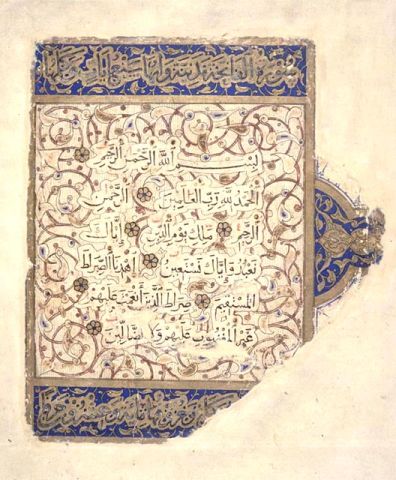
Image: 14th C. Qur'an, Mamluk origin, Library of Congress; Rights obtained.

A BREAKTHROUGH project which helps understand the Qur'an AS REVEALED -not just 'as explained.'

---------------------------------------------------------------------------

Saturday, March 13, 2010

Day 59; HQ5: 51-64, pages 117+118

Welcome Friends:  Ahlan wa sahlan!
COMMENTS:
 
1.     For new-comers: See Posting Feb. 7th. so that you get an accurate idea as to what the Qur’an is saying in today’s Reading.  Relationships of friendships and cooperation between us and all people in general are encouraged, especially since these are the building-blocks to knowledge and mutual respect.  On the other hand, especially during times of combat, Guardianship and Intimacy, where Believers might be ‘under the wing’ of someone else, are warned against and discouraged, even when such persons are one’s own parents or siblings who have clearly chosen Denial over Faith (HQ9:23).  In other words, unless someone shares their standard of Accountability, Believers are NOT to put themselves in their hands and under their patronage ولي,* however they may be related.  Perhaps the most important reason is that, when one is given guardianship over another, the latter becomes, in effect compliant to the guardian regardless of whether or not the guardian holds one’s best interests at heart.  Chances are, if they do not share the same standards, that they won’t.  Intimacy is also discouraged because at that level of a relationship people let their guard down, and may end up losing much more than they had bargained for, including their well-being and their Faith.

I must ask Muslim youth who are with us on our page today, NOT to misread this and then question their relationship with guardians, or pass judgment over siblings with regard to their faith, especially if, in your perception, their faith does not seem to be as ‘genuine’ or ‘strict’ as your own.  God Alone knows what our hearts hold, however, if you set the best, most heart-warming and welcoming example as to what you believe in, they will enjoy your company, admire you, and would also be more likely to gradually adopt your standards IF yours are indeed better than theirs.  Patient forbearance IS the name of OUR game. 

Today’s Reading, Verse 51, begins with a call to those who have attained Faith, telling them not to take as Protectors/Intimates either the Jews or the Christians, and whoever does, will indeed be one of them, for God does not guide the wrongdoers.  The reason given in this verse for this restriction is that, from what seems to be the point of view of these two groups, they are only Protectors/Intimates of each other.  We also have to remember that when these verses were revealed in Medina, many Believers had already severed their pre-existing alliances, except for Abdul-Lah Ibn Ubeyy Ibn Salool (dubbed ‘the Head of the Hypocrites) who had an alliance with Bani Qeynuqaa بني قينقاع  (one of the 3 Jewish tribes of Yethrib).  He was reluctant to sever this alliance, saying that he feared that he might need them at the end of the day (doubting that Believers will prevail)*.  The next verses tell us more about his kind.


2.     Verses 52-53 give us the characteristics of those who (say they are Believers but) actually rush into these two groups, indicating their haste to forge intimate alliances with them, and tell us that in their hearts/minds is a Disease (identified in HQ2:10 as Doubt/Hypocrisy).  The verse tells us that Believers also wonder about their change of face, and the verse ends by calling such indecisive persons, ‘Losers.’  It is worthwhile to mention here, that it is NOT our call to identify as ‘hypocrites’ those who seem to belong to our group in body but not in spirit.  We should remember that during the Prophet’s time, peace upon him, only after a person had actually died a hypocrite was he so identified, when the Prophet did not pray for the deceased (obeying God’s command in HQ9:84).  It is never our call to label people, for we do not know what their hearts hold (or how they might evolve), as we were so beautifully instructed in HQ4:94.

3.     Verse 54 is a warning to Believers who desert their Standard of Accountability.  If you do so, God will bring forth, in your stead, others whom He loves and who will love Him.  (They would be) humble unto the Believers, invincible unto the Deniers, striving in the way of God fearing no reproach from anyone.  That is God’s ‘Grace/Favor’ (Ali/Asad) granted to whomever He wills, for God is Infinite, All-knowing. 
We notice here that desertion IS its own ‘punishment,’ for one has actually deserted God’s Favor in life and in the Hereafter.
  
4.     Verses 55-56 tell us WHO we should consider our Protectors/intimates: God, His Messenger, those amongst the Faithful who are active in regular prayer, giving the needy their dues, and bowing to God.  And therein is a promise, that those who do take God, His Messenger and the Believers as Protectors/intimates, indeed (they would have earned to be named) the ‘Partisans/Fellowship’ of God (Ali/Asad), and must certainly triumph/be victorious (Ali/Asad).  It is interesting to note that حزب الله*  ‘Hizb-Allah’ is mentioned again in HQ 58:22, countered by ‘Hizb-al-Sheytaan’ or the ‘party of the Deviant,’ in HQ58:19.
 
5.     Verse 57-58 repeats the same call to the Faithful, and gives us yet another reason not to take specific persons from among the People of (earlier) Compilation, or the Deniers as ‘protectors/intimates,’ and that reason is Disrespect.  If someone mocks our standard of Accountability, or makes it into a subject of ridicule, there is no way that we can be friends on any level.  There is no generalizing here to include everyone; this is quite specific.
Verses 59-60 tell the Messenger what to say to People of the (earlier) Compilation, asking them why they find fault with us when we believe in God Alone, and all His Revelations, while they are delinquent (in their duty to their own Compilation)?
In Verse 60 he is told to remind them of the moral degradation of their forefathers who disobeyed God into the status of apes and swine.  Muhammad Asad’s note 77 discusses this issue, giving us reasons for these two metaphors.  Although some commentators believe this to be literal, others have said that we have in Iblees إبليس a good example, in that he was not degraded or dubbed ‘Sheytaan’ until after he had disobeyed and was condemned/banished from God’s Mercy لعنه الله.  Therefore, since Verse 60 tells us quite clearly that these people were banished from God’s Mercy, and ends by saying that these are worse in status- this illustrates that the ‘ape’ and ‘swine’ depiction is one of worth and stature among God’s creation, and NOT that they were turned into animals.

6.     Verses 61-63 tell us of those whose lips say words of faith while their entire comportment is one of Denial; they hasten into deeds of hindrance and aggression, and consume what is forbidden, while neither their ‘Men of God’ nor their Rabbis, do anything to prevent them.  Verse 62 ends by saying ‘..Evil indeed is what they (the people) were doing/performing… يعملون, while verse 63 ends by saying: ‘..Evil indeed is what they (their Spiritual Leaders) were manufacturing/constructing…يصنعون’. 
This shows us the great responsibility of Spiritual Leaders who, in effect, help shape their congregations!

7.     Verse 64 discusses an accusation leveled by certain Jews against God, that his ‘hand’ is tied; to be tight-fisted means to be stingy!  God Himself responds to that, saying that it is they whose hands are in fact tied/they who are tight-fisted and stingy, while both his ‘hands/aidings’ are extended to bestow (of His abundance) as He wills (for the definition of ‘hand,’ or ‘aid’ see Jan 24th & March 11th). 
Some might ask why does God say ‘both’ here, about Himself?  Usually, in Arabic, we consider the upper hand as that which gives, and the lower hand as that which takes.  God gives and does not take, so ‘both’ are said to be extended here.  Also, He is describing His relationship to us here, and we know that everything in our lives is in ‘pairs,’ even negativity and positivity; He gives us only Positivity, while negativity is of our own doing, as in HQ4:79.  Muhammad Asad’s note 81 explains.

The rest of the verse tells the Prophet that such persons will only increase in their Denial because of what is revealed to him, and they will find enmity and hatred being sown amongst themselves till the Day of Resurrection. 
According to Yusuf Ali’s explanation, whenever they wage war against the innocents, God extinguishes it in His Mercy.   Muhammad Asad, on the other hand, says that every time they light the fires of war to gain full victory over each other, God extinguishes it so that none of them is a clear victor, and their state of constant conflict continues.
The verse ends by saying that God loves not The Corrupters.   

Enough said (on my part) BUT not on yours.  I await your comments!
Have a great weekend!
Our next Reading is from HQ5: 65-76
Peace unto all!


*(ولي) يدلُّ على قرب. يقال: تَباعَدَ بعد وَلْي، أي قُرْبٍ. وجَلَسَ ممّا يَلِيني، أي يُقارِبُني
ومن الباب المَوْلَى: المُعْتِقُ والمُعْتَق، والصَّاحب، والحليف، وابن العَمّ، والنَّاصر، والجار؛ كلُّ هؤلاءِ من الوَلْيِ وهو القُرْب. وكلُّ مَن ولِيَ أمرَ آخرَ فهو وليُّه.

*من الكشاف للزمخشري: وعن عبادة بن الصامت رضي الله عنه أنه قال لرسول الله صلى الله عليه وسلم: إنّ لي من موالي من يهود كثيراً عددهم، وإني أبرأ إلى الله ورسوله من ولايتهم وأُوالي الله ورسوله فقال عبد الله بن أبيّ: إني رجل أخاف الدوائر لا أبرأ من ولاية مواليّ وهم يهود بني قينقاع.
  *(حزب) هو تجمُّع الشيء. فمن ذلك الحِزب الجماعة من النّاس. قال الله تعالى: {كُلُّ حِزْبٍ بِمَا لَدَيْهِمْ فَرِحُونَ} [الروم 32]. والطائفة من كلِّ شيءٍ.

Friday, March 12, 2010

Day 58; HQ5: 41-50, pages 115+116

Welcome Friends:  Ahlan wa sahlan!
It is indeed such a privilege to have one’s mind occupied by the Qur’an; reading, researching….and praying… asking God’s Guidance to the Truth, to the best that we can understand.  You will find much to think about today, dear Friends, and much motivation.
Thank you, dear Friends, for this partnership!
COMMENTS:
1.     Although Verse 41 is addressed to the Messenger, Muhammad, peace upon him, it is also intended for all who might grieve over those who rush into Denial, either from among their own ranks or from other ‘Faiths.’ 
Those who rush into Denial will be disgraced in this world, and suffer severely in the Hereafter.
Verse 42 describes them, in that they are oft-listeners to falsehood, oft-consumers of what is forbidden (again the repetitive form of the verb, similar to what we read in the last two Postings: sammaa’ سمّاع rather than sami’ سامع ; akkaal أكّال rather than aakel آكل). 
The Messenger Muhammad, peace upon him, was told that if they came to him for judgment, he should judge with Justice between them or let them be, for God loves the Just.  But then the next verse (43) asks how is it that they would come to him for judgment (in the first place), despite having the Torah, in which is God’s judgment (which they have received and supposedly believe)?  The verse asserts that such persons are indeed not Believers.
In his note 57 Muhammad Asad describes the mentality of this group, saying that “they are not really prepared to submit to the judgment of the Torah…nor the judgment of the Qur’an..”
Again, although this might be discussing People of (earlier) Compilation, it serves as a lesson for all time, especially for Believers in the Qur’an NOT to look elsewhere for God’s Judgment!

2.     Verses 44 begins by praising the Torah, revealed by God, containing both Guidance and Enlightenment and considered the standard by which prophets who were pure of direction (towards God) offered judgment unto the Jews.  Muhammad Asad tells us in note 58, that this implies that the Torah was intended only for them “and was never meant to have universal validity.”  The verse ends by stating that those who do not judge according to what God has revealed are indeed Deniers.

3.      Verse 45 tells us that of the judgments in the Torah (which they obviously were attempting to avoid by bringing their grievances to the Messenger to judge), were compiled/brought together UPON them  كتبنا عليهم: a life for a life, and an eye for an eye, and a nose for a nose, and an ear for an ear, and a tooth for a tooth, and the wounds (also) by retribution, AND that they could forego retribution as a charity to others, in which case God would consider it an atonement of his past sins.

4.     Muhammad Asad (our Torah expert) tells us something VERY interesting in this regard:  After telling us (note 61) to check out these severe retributions in Exodus 21:23 (link below), Asad adds (note 62) that the Forgiveness part of this verse (in italics above) is nowhere to be found in the five books currently considered the Torah!  He says that the Pentateuch (with its five books) “does not contain this call to forgiveness which is brought out with great clarity not only in the Qur’an but also in the teachings of Jesus..” and he continues, explaining that this may have been part of the original message to Bani Isra-eel, and was either corrupted with time, or deliberately abandoned by its followers, whom the Qur’an accuses of ‘distorting the meaning of the revealed words.’  Isn’t it strange that forgiveness and giving up legal retribution is NOT to be found in the Pentateuch?
Isn’t THAT food for thought!

Now let us think:
Isn’t it terrifying when we, as Believers in the Qur’an, compare this to what OUR own people have done? 
Many of our scholars are finally speaking up, showing how damaging similar acts have been to our faith and to our existence.  The famous scholar Yusuf Qardawi, for example, has protested quite plainly that we have zealots who have ‘abrogated’ or rendered ‘null and void’ what they count as between140-200 Qur’anic verses! *  What are these verses mostly about?  Fair treatment and forgiveness (!!!). 
No wonder the Qur’an goes on and on, about what happened to the People of (earlier) Compilation and how their Revelations were corrupted!  When we think about it, there really is no need to erase a few paragraphs to cause corruption in a compilation: 
It could remain intact WHILE being voided of the weight of some instruction, while other instruction is misinterpreted.  Although such a Compilation would not be corrupt in itself, it would be corrupted in our minds, in our understanding and application of it. 
But before we rush to throw all the blame on our figures of authority, perhaps we should shoulder part of the responsibility, if not for anything else, then just for being silent about this.  During our decades of silence, so-called ‘explanations and translations’ of the Qur’an have spread all across the globe, together with thousands of other publications that veil much of the Qur’ans illumination and void many of its most beautiful concepts, literally taking us all backward to a second ‘Jaahiliyyah’ جاهلية or ‘Period of Ignorance.’ 
BUT we can come out of this darkness and be positive forces to our societies and to the world once again because: 

We have our Arabic Qur’an. 
We believe in what it holds. 
We trust and rely on God Who sent it.
We have the beautiful example of the Messenger and the first Recipients, as God Himself has described them.
In the guidance of the Qur’an, with the aid of God who sent it TO US, we can BE the change we desire!  
                                                                               
5.     Verses 46-47 discuss Jesus Son of Mary, who followed in the footsteps of the earlier prophets, confirming the truth of what (remained) of the Torah, and receiving the Evangel in which was Guidance and Illumination, as well as Admonition for the Aware.  Therefore the People of the Evangel are told to judge by its standards, and those who do not, they indeed are the Noncompliant (iniquitous/those who rebel-Ali/Asad).  Perhaps now we can better understand the complications of – and the many reasons for - Jesus’ ‘corrective’ mission!

6.     Verse 48 discusses THIS Compilation, addressing its Deliverer, Muhammad, peace upon him, telling him that God revealed it to him in Truth and as a DETERMINANT of the truth of earlier Compilation (notice that the Compilation always is singular), and that he should judge between people with what has been revealed by God and not follow anyone’s desires.

An interesting statement in the center of the verse says that:
 “…to each of you have We rendered a System and an Approach, and if God had willed He would have indeed made of you a single ‘people/community,’ but (He willed it otherwise) to test (each of) you with what He has granted you, therefore compete towards all ‘virtues/good works,’ unto God will you all return then He will inform you of the matters in which you were (constantly) differing.”

It is not a different ‘religion’ that each of us has, but a different system شرعة and a different approach منهاج – and that’s how God willed it, to see who accomplishes best with what they are given!  Isn’t that a totally new way to look at it?  This fact should have been known to anyone who read the Arabic Qur’an!

7.     The last two verses tell the Messenger again, peace upon him, to judge as per what he had received (read full verses), and asks eloquently at the end: …
“…Do they then seek judgment by the standards of Ignorance (جاهلية Jaahiliyyah)?’ 
And Who could be of better Judgment than God, for- قوم يوقنون -People of Inner Certainty?”


Enough said!
Our next Reading is from HQ5: 51-64

Peace unto all!

* "ووصل الأمر إلى أنهم قالوا إن آية السيف نسخت مائة وأربعين آية في كتاب الله، بل بعضهم قال نسخت مائتي آية، وإن هذه الآيات موجودة في المصحف خطًا ولفظًا ومعدومة المعنى: http://www.qaradawi.net/site/topics/article.asp?cu_no=2&item_no=7197&version=1&template_id=211&parent_id=16
*(شرع) شيءٌ يُفتَح في امتدادٍ يكون فيه. من ذلك الشّريعة، وهي مورد الشَّارِبة الماء. واشتُقّ من ذلك الشِّرْعة في الدِّين، والشَّريعة. قال الله تعالى: {لِكُلٍّ جَعَلْنَا مِنْكُمْ شِرْعَةً وَمِنْهَاجَاً}  [المائدة 48]، وقال سبحانه: {ثُمَّ جَعَلْنَاكَ عَلَى شَرِيعَةٍ مِنَ الأَمْرِ}  [الجاثية 18]. ويُقال أشرعْتُ طريقاً، إِذا أنفذتَه وفتحتَه، وشرعت أيضاً. وشَرَعْت الإِبلَ، إِذا أمكنتَها من الشّريعة. هذا هو الأصل ثم حُمِل عليه كلُّ شيءٍ يُمدُّ في رفعةٍ وغير رفعة. من ذلك الشِّرَع، وهي الأوتار، واحدتها شِرْعة، والشراع جمع الجمع ومن ذلك شِرَاع السَّفينة، وهو ممدودٌ في علوٍّ.

Let's TWEET this!

Tweet me!