.jpg)
Classical Arabic … (continued from March 20th, 27th).
When Classical Arabic became the medium of instruction and information during Islam’s Golden Age of knowledge[1] (8th-13th century), it spread across ethnicities and faiths as THE language of theology, philosophy, arts and sciences. Although referred to as the ‘Islamic Renaissance,’ it was also during this period that Jewish philosophy developed[2], and from this period that the Christian Revival emanated.

COEXIST
For that short time in human history, the aspirations of a multi-ethnic, [3] multi-faith society were built around elements conducive to accomplishment.
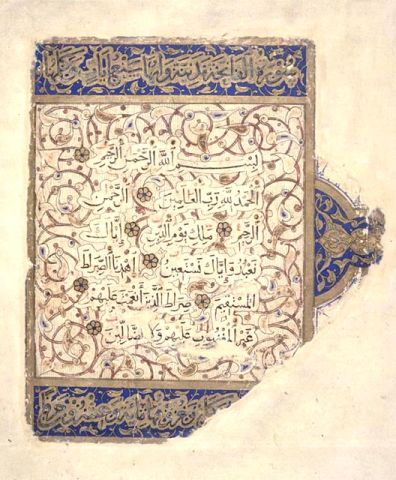
As Islam spread into regions of different ethnicities, Arabic intermingled with the local languages. Classical Arabic however, having been standardized by the Qur’an, did not yield to transformation. What, in fact, did take place was a parting of ways, as spoken Arabic began to transform on its own. But the parting of ways did not go very far, for the Qur’an had also set a standard for the articulation of sounds. When Muslims learn to recite the Qur’an, they are taught the art of ‘Tajweed,’ or ‘improvement,’ a voiced technique that applies original emphasis and resonance upon each sound in the Arabic alphabet as it joins another. Thus, Arabic enunciation was also standardized by the Qur’an.
When literacy gained ground this past century, more and more Arabs learned Classical Arabic. Literate Muslims felt that they could understand the Qur’an better should they apply themselves to studying Classical Arabic[4]. This brought new interest into a field which had been dominated for many centuries by didactic scholars and their dogma.
After 2001, this became more of a necessity due to general malaise and media attacks on Arab heritage and the Muslim faith. Today, enlightened Scholars, as well as disciplined enthusiasts of many backgrounds, are attempting to better understand the Arabic Qur'an. By reading from its linguistic sources, conducting contextual cross-reference and verification, they are uncovering the misinterpretation and misapplication of its teachings that have constituted major setbacks for Arab and Muslim communities. And now, with the media transporting information and entertainment into every home in both Classic Arabic and the vernacular tongue, Arabs in both continents have become increasingly familiar with each other’s local dialects[5]. Arabic has not only re-united Arabs, but has also become , since 2001, the most important language to learn.
After 2001, this became more of a necessity due to general malaise and media attacks on Arab heritage and the Muslim faith. Today, enlightened Scholars, as well as disciplined enthusiasts of many backgrounds, are attempting to better understand the Arabic Qur'an. By reading from its linguistic sources, conducting contextual cross-reference and verification, they are uncovering the misinterpretation and misapplication of its teachings that have constituted major setbacks for Arab and Muslim communities. And now, with the media transporting information and entertainment into every home in both Classic Arabic and the vernacular tongue, Arabs in both continents have become increasingly familiar with each other’s local dialects[5]. Arabic has not only re-united Arabs, but has also become , since 2001, the most important language to learn.
In fact, the Qur’an is a source of linguistic pride to Arabs of all faiths. What some might not realize is that anyone who claims to have studied the Arabic language through the ages, whether at scholarly gatherings or in schools[6] and colleges, anyone with a proper claim to knowledge of Arabic would have had to study its highest literary form in the Qur’an. This applies to each and every philosopher, scientist, thinker; anyone who partook knowledge from its sources during the Golden Age of Islam. During those times, everyone who gained a higher education, did so in Arabic.
Lamented Bishop Alvarus Paulus of Cordova[7]:
“Alas! All talented young Christians read and study with enthusiasm the Arab books; they gather immense libraries at great expense; they despise the Christian literature as unworthy of attention. They have forgotten their language. For everyone who can write a letter in Latin to a friend, there are a thousand who can express themselves in Arabic with elegance….”[8]
But he need not have grieved. It was these young scholars who, in fact, heralded a new era of Christian thought[9].
But he need not have grieved. It was these young scholars who, in fact, heralded a new era of Christian thought[9].
It is a known fact in theological circles, that the pearls of wisdom in Christian and Jewish thought derived much inspiration from the literature of Islamic Arabia [10]. That, in itself, is a source of pride to those of us who see humanity on a single plane.
Human advancement is one unit, each generation of diverse people building upon its predecessors; the pearl of knowledge growing larger and more valuable as layer grows upon layer of beautiful nacre. Such an age of human interaction and acceptance[11] is sought by many today, including this author; a revival of that exemplary time in history nostalgically named ‘La Convivencia.’[12].

Statue of the great scholar and philosopher, Averroes (ibn-Rushd), (1126-98 AD), Cordoba, Spain.
Notice the attire, the robe, the head-dress, and the book in his hand. Although this was common attire in the Muslim world, these became symbols of knowledge in the West; scholars would attempt to EARN them in universities and then proudly bring them home, law-makers would wear them in courtrooms to distinguish themselves.
Today, all students around the world, proudly don the 'Abaya' and the 'fez' (with tassle !) in their graduation ceremonies!
Dear Reader:
In today’s world, English is the medium of knowledge, and everyone else is repeating the lament of the Bishop of Cordova:
“Alas! Our talented young read and study English with enthusiasm. They have forgotten their language. For everyone who can write a letter in our language to a friend, there are a thousand who can express themselves in English with elegance….”
BUT WE NEED NOT GRIEVE. IT IS SUCH PERSONS WHO WILL HERALD A NEW ERA OF HUMAN THOUGHT, and you, dear Reader, are such a person!
[1] Accomplishments in sciences philosophy, etc are too numerous to mention. See http://www.1001inventions.com
[2] From Saadia Gaon (892-942), to Ibn Gabirol (Avicebron), Bahya ibn Pakuda, Judah ha-Levi (1140) to Moshe Maimonedes, also known as Musa Ibn Maymun (1135 –1204).
[3] Islam by then had spread to embrace people of Chinese, Indian, African, ethnicities.
[4] To learn firsthand, rather than from what is translated and conveyed by Imams and scholars.
[5] The closer the country the more similar the dialect. Dialects of Western Arabia (NW Africa) are considered the most difficult to understand.
[6] The word ‘school’ in Arabic is ‘madrassa,’ a connotation misused today by western media.
[7] Deceased 861A.D.
[8] R.W. Southern, page 21, Western Views of Islam in the Middle Ages (1962).
[9] From ‘Christian Philosophy:’ “There has been considerable interaction between Christian philosophy, Jewish philosophy and Islamic philosophy. Many Christian philosophers are well read in the works of their Jewish and Islamic counterparts, and arguments developed in one faith often make their way into the arguments of another faith.” (http://en.wikipedia.org/wiki/Christian_philosophy
[10] Islamic era studies about creation had such influence that a position taken by Thomas Aquinas’ was called the media via, meaning ‘the middle way between Avicenna and Averroes.’
“The impact of Arabic philosophers such as al-Fārābī, Avicenna and Averroes on Western philosophy was particularly strong in natural philosophy, psychology and metaphysics, but also extended to logic and ethics” (D. N. Hasse, 2008)[10].
[11] The Arabic word ‘taqabbul’ or acceptance, is used when discussing relationships with others. ‘Tahammul,’ or tolerance is usually related to hardship, etc..and not to relationships.
[12] ‘Coexistence.’

