CLICK IMAGE: Tanzil Website


OUR MISSION:
UNCOVERING the original message of the Arabic Qur'an by using Lexicons compiled more than 1,000 years ago.

ISOLATING Fact from Fiction.


RECOVERING Hope and regaining the perspective where Humanity is one, God's Message is one, and our Future CAN become one we all look forward to!


© 2010 IQRATHECHALLENGE: INTELLECTUAL PROPERTY PROTECTED BY D.M.C.A. ALL RIGHTS RESERVED.

© 2010 IQRATHECHALLENGE: INTELLECTUAL PROPERTY PROTECTED BY D.M.C.A. ALL RIGHTS RESERVED.
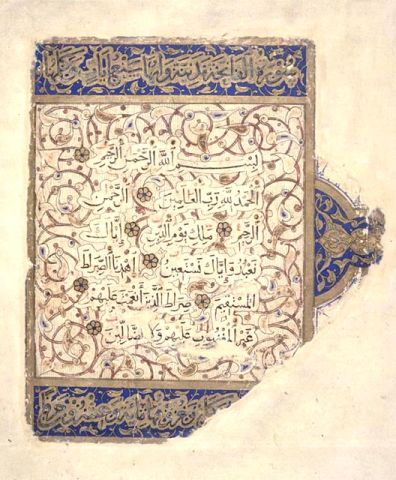
Image: 14th C. Qur'an, Mamluk origin, Library of Congress; Rights obtained.

A BREAKTHROUGH project which helps understand the Qur'an AS REVEALED -not just 'as explained.'

---------------------------------------------------------------------------

Wednesday, June 9, 2010

Welcome Friends:  Ahlan wa sahlan!
As you noticed, we had to keep Page 254 for today. 
This is due to the all-important final concepts that bring the Chapter of Thunder to a close.

COMMENTS:
1.   We notice four things in Verse 37:

“Indeed We have bestowed this an ‘Arabic’- Self-Expressive Ordinance, and if you were to follow their desires after the knowledge that has come to you, you will have none to protect you from God, or to shield you!”

·       This is revealed: an ‘Arabiعربي- ’ Self-expressive Ordinance.
·        Quite clearly here, God is addressing His Messenger. 
Indeed, the entire conclusion to this Chapter is taken up by this address, but in Verse 37 the ‘Voice of God’ is easily identifiable as it is dutifully received by His Messenger and then transmitted to the world:
‘…and if thou dost follow their caprices, after the knowledge that has come to thee, thou shalt have no protector against God, and no defender”  (Arberry).
·       Being a Revelation of clearly expressed Ordinances, the Messenger can, and indeed MUST, apply it to himself on one hand, and guide others to it as well, regardless of people’s desires.
·       As for the people: Since it is ‘Arabi’ and clearly expressed, they have absolutely no excuse in not understanding its wisdom; in other words, when they refuse to follow the Messenger or his Message, the reason will NOT be that the Revelation was incomprehensible, but that they themselves were lacking.

Dear Readers: 
This is serious business!  You might ask:  How about us, today, when WE do not truly comprehend God’s Message, yet do NOT want to be in a position where we have none to protect or defend us from God..?
The answer is that, as long as we are truly TRYING to comprehend it, we cannot be blamed.
We must use EVERYTHING in our power to try and understand what God is telling us; we must seek original Qur’anic intent, with the help of the references at hand. 
It frightens me to think, dear Reader that our responsibility in this Information Age surpasses the responsibility of all the past generations combined.  But then I think:  What an opportunity to be alive today, opening with our fingertips entire libraries, any book of which our predecessors would have spent years searching for!

2.     Verse 38 continues to address the Messenger, giving him responses to Qureish’s unreasonable demands, related to his being ‘just one of them’ rather than an angel, and to ‘miracles.’ 
Then, at the end of verse 38, and beginning of verse 39 we find two VERY important statements (in my translation):

‘… to each Term a Compilation.’ (38)
 “God dissolves what He wills, and affirms, and in His tenure is the Source of the Compilation.” (39)

Wow.  All in a nutshell. 
At first, we find mention of A ‘Compilation,’ any compilation sent by God according to the ‘Term’ to which it belonged.  Then we find that the dissolution of certain parts, and the affirmation of others, is all according to His Will; the Source itself being in His Tenure!  Indeed, what an eloquent, self-expressive (Arabi) Ordinance!
  
For ‘Compilation,’ Ali said ‘Book’ and Asad’ said ‘Revelation.’  Zamakhshari explained that to each generation is an Ordinance which best fits the life requirements.  See Verses 38- 39 in Arberry’s explanation, and notice, dear Reader, that LESS IS MORE.  This is why I advise Readers to always read at least two or three explanations of the Qur’an to get to the correct meaning, one of which should be a concise, literal explanation.

3.     AGAIN, in Verse 40  we distinctly hear ‘God’s Voice’ discussing the Prophet’s death, and his responsibility as Messenger, which is solely to convey the Message, NOT TO HOLD PEOPLE ACCOUNTABLE!  Isn’t that something WE should learn from?

4.    Both Yusuf Ali and Muhammad Asad’s explanations of Verse 41 are interesting, although I prefer Arberry’s, because it remained literal.  Some persons have explained the verse differently, relating it to a ‘Scientific Marvel’ rather than to people and life.  (A ‘Scientific Marvel’ is related to the Qur’an mentioning a scientific fact unknown at the time of Revelation).  
Dr. Zaghloul Al Najjar has deduced such a ‘marvel’ from this verse; check it out at YouTube.

But we must always bear in mind that, not only do the linguistic marvels of the Qur’an surpass the scientific, but ‘Arabi’ IS, in fact,the Qur’an’s DEFINING characteristic.  This means that, even when we do end up finding ‘scientific’ marvels, we can only do so based on the correct linguistic definitions.  Without the original language we cannot obtain correct references to anything! 

The last part of the verse, returns all judgment to God, and tells us that no one can follow-up on (or amend) His judgment, and that He is swift in holding Account.
  
5.     Verse 42 tells us of the devising of those who Deny, and announces that, ‘….. to God
Belongs all Devise, and that Those who Denied will come to know to whom shall be ‘the final outcome, or end  عقبى الدار. ‘The final outcome/ end’ is explained as ‘who gets home in the end/ to whom the future belongs’ (Yusuf Ali/ Muhammad Asad).

6.   The Chapter of Thunder concludes by responding to Qureish, who alleged that Muhammad is not a Messenger.  He is told to respond by saying that God suffices as witness between him and his people, as also suffices the witness of ‘he who has knowledge of the Compilation.’

A most eloquent conclusion to this Chapter! 

Enough said!
 
Our next Reading is from HQ 14: 1-10.

Peace unto all!

P.S.  Did you notice, in the right side-bar:  “What is Taught in Schools Today, versus What Should be Taught”? 
When there is Truth in our narration of the Past, we will come closer to Agreement in our Present, and to Fellowship in our Future!  

Tuesday, June 8, 2010

Day 129; Qur’an 13: 28-36, page 253 + 254

Welcome Friends:  Ahlan wa sahlan!
Yusuf Ali’s Translation of this Chapter.
Muhammad Asad’s Translation of this Chapter.
Their commentaries can only be read in verse by verse view.

I hope, dear Readers, that you are reading the Qur’anic verses (clicking on the hyperlinks), because there always IS more to see in the actual explanation/translation than in my highlights. 

COMMENTS:
PAGE 253  Arabic Qur’an.
1. In our last Reading, after the Deniers had asked (Verse 27) for a Sign to descend upon Muhammad, he was told to reply, peace upon him, that God allows to stray anyone who wills it, ‘….and guides unto Him any who returns to him in penitence من يُنيب- [i].” 

Today’s Reading continues with Verse 28, saying:
“Those who have attained Faith, and whose hearts/minds are Calmed and Reassured by the Remembrance of God; indeed, in the Remembrance of God are hearts/minds calmed and reassured!” 
What an important piece of information given to us! 

This is an oft-quoted verse, mentioned whenever we feel replenished, calmed and reassured AFTER the Remembrance of God- or whenever we NEED to replenish ourselves.  It is simple.  No introduction is required for us to enter God’s Presence, nor are we demanded to prepare ourselves.  When we have Sincerity, we need nothing else.  This is the beauty of Pure Reverence to God.  No formal place of worship is required, as the entire earth is our Place of Worship.  Anytime, anywhere.  No intermediary do we need.  From the most intimate and personal depth of our being, each of us can say: 
“Dear God: You created me.  You know me best.  Help me mend my flaws and strengthen my resolve.  Support me in my efforts.  Grant me Fulfillment both in the immediate Life and in the everlasting Hereafter… You Alone Are my Lord Provider.”

Remember HQ 7:29 ..?  We were told to direct ourselves to Him at every place of worship, and to call unto Him sincere in our Accountability, for, even as He initiated our existence, so shall we return unto Him!
 
2. Verse 29, as I understand it, says:

‘Those who have attained Faith and worked good deeds:  طوبى لهمThe Satisfaction of Achievement is theirs (in life), and an excellent Destination (in the Hereafter).”

My explanation for ‘Ttooba’ طوبى as ‘achievement’ is supported by HQ 39:73 [ii] and is somewhat similar to both Yusuf Ali and Muhammad Asad’s ‘well-doing’ and Arberry’s ‘well-faring,’ BUT I have added the feeling of satisfaction, because of the Qur’anic use of this derivative instead of any other, which might be related to resonance, as well as meaning.

Noticing a word such as this, ‘Ttooba- طوبى’ might offer English-speakers a glimpse into the beautiful sound and meaning of the Arabic Qur’an.  The linguistic analysis of our early 12th century commentator, Zamakhshari, [iii] tells us that this word is a derivative of ‘Ttaabaطاب- ’- similar in meaning to ‘Tteeba lakum’ or ‘Ttibtum.’
But there is a difference in resonance here, since ‘Ttooba’ ends with the highly expressive ‘Aa’ SOUND, which has a meaning related to earliest human communication, affecting us intuitively at a deeper level.  Indeed, the original Arabic Qur’an elicits FEELINGS which we cannot carry into any other language (see footnote [iv])!

Now back to today’s Reading:

Let us read these two beautiful verses together, and notice how Faith -which is sustained by the Remembrance of God- and Working good deeds –which is a confirmation of faith- are related to Achievement AND Happiness in both phases of our Existence!

“Those who have attained Faith, and whose hearts/minds are Calmed and Reassured by the Remembrance of God; indeed, in the Remembrance of God are hearts/minds calmed and reassured! (28)
Those who have attained Faith and worked good deeds: The satisfaction of Achievement is theirs (in life), and an excellent Destination (in the Hereafter).” (29)


3.  We notice in Verse 30 that Prophet Muhammad’s tribe, Qureish, had denied ‘Al Rahmaanالرحمن- .’ This is quite clear in another verse, HQ 25:60, where the unfamiliar word ‘Al Rahmaan,’ which was introduced to them for the first time, only increased their aversion.
The Qur’an announces in Chapter 55 that Al ‘Rahmaan’ is The Unique Creator.  Our Research (endorsed by linguists and scholars) has also proven that and more, which Readers will come to know in time. 

The term ‘Rahmaan’ in the Qur’an does NOT occupy the place of an attribute (such as ‘Raheem’).  In fact:
‘Al Rahmaan’ carries the same weight as ‘Allah (HQ 17:110).

After they voice their denial of ‘Al Rahmaan,’ Prophet Muhammad, peace upon him, tells them of his relationship to Him, his Lord, in Whom he trusts and to Whom he turns in repentance.

4.  Verse 31 responds to both, Those who have Denied, and Those who have attained Faith; the first are asking for physical ‘miracles’ to convince them, while the latter want everyone else to believe! 
The verse ends on the note that His promise will ‘come to pass/ be fulfilled’ (Ali/Asad).
 
5.  Verse 32 offers the Messenger consolation (I disagree with translating ‘Rasool’ as ‘Apostle’), while Verse 33 gives him a strong argument to make with the Deniers.  Verse 34  warns of the consequences to the denial of God.

PAGE 254 Arabic Qur’an.

6.  Verse 35 summarizes Persuasion and Dissuasion.  We first see the Garden and its delights promised to the Aware, and then find it contrasted to Hell.  Note that the word ‘uqbaaعُقبى- ’ is from the root verb ‘aqabaعقب- ’ – related to ‘consequence,’ as discussed in detail on May 25th.

7.  Verse 36  is VERY interesting in that it starts out by saying that ‘the People Who have Received the Compilation’ ‘yafrahoonaيفرحون- ’ in what is being revealed to the Messenger Muhammad, peace upon him. 

Our 1000 year-old Lexicon tells us that ‘Farahفرح- ’ has two connotations:  to ‘rejoice,’ and to ‘be burdened  [v].’

‘The People Who have Received the Compilation’ usually refers to those who had received the Torah and the Evangel, and taking the word to mean ‘rejoice,’ Zamakhshari explained that it referred to those who had accepted the Qur’an (as a continuation of the same Compilation) among whom were the 80 Christians of Najraan, Ethiopia, and Yemen, as well as Abdul-Lah Ibn Salaam and Ka’b aul Ahbaar (both of Jewish tribes).  Taken in that sense, it would mean that People who had received (earlier) Compilation were rejoicing in what the Messenger was receiving of Qur’an, seeing that they believed in him.   

Asad explains this verse differently, saying that the 'Compilation' in this verse is the Qur’an, and therefore the followers of Prophet Muhammand were 'Those who had received the Compilation' and were rejoicing in it.  I do not agree with him; the followers of Prophet Muhammad were never addressed as 'Those of the Compilation.' 

You see, dear Reader:  No commentator is able to entertain the concept that the People of Earlier Compilation would 'rejoice' in the revelation of the Qur'an-unless they became Followers of Prophet Muhammad, peace upon him.  But the BEAUTY of this word is that it carrries either of TWO meanings (feeling joy or feeling burdened)! 

I am inclined to consider BOTH connotations applicable here.

Some of the Jews and Christians would -and indeed DID rejoice, having recognized its source, and felt honored to be readdressed by their Lord, who even described them in the Qur'an, bowing to their chins, in tears of humbleness (HQ17: 107-109).  And we already read many verses which acknowledged their faith, when characterized by Pure Reverence to God (see HQ 2:62).  Why do we have to suppose that every single one of those who rejoiced was a follower of Prophet Muhammad, peace upon him, when the Qur'an does not indicate that?  Can't any person of Pure Reverence to God, read the Qur'an... and feel joy? 

Furthermore:  Since ‘farahفرح- ’ also denotes 'burden:'

Many among the People of (earlier) Compilation DID feel burdened by the Qur’an as it was being revealed to the Messenger, especially since many verses were directed to them, urging them to take a second look at how far they might have strayed from the original path.  Theirs was quite a burden; a burden of Responsibility! 

Let me know what you think, dear Readers, especially if you are not 'Muslims.'
Enough said!
 
In our next Reading we’ll complete Chapter 13, and do HQ 14: 1-10;
a new Chapter!

Peace unto all!


[i] We first encountered the word ‘uneebينيب- أنيب- ’ when the ‘Orator’ among Prophets, Prophet Shu’ayb, spoke to his people announcing his trust in God, in HQ 11:88.

[ii] Their wonderful ‘Achievement,’ seems to be what the Aware are congratulated for, upon their arrival at the gates of the Garden (of Heaven) in HQ 39:73.  The Angels (Keepers) tell them, ‘Tibtum طبتم-’ in the past tense, ‘therefore enter here to abide eternally.’

[iii] الزمخشري:وطوبى مصدر من طاب، كبشرى وزلفى، ومعنى «طوبى لك» أصبت خيراً وطيباً، ومحلها النصب أو الرفع، كقولك: طيباً لك، وطيب لك،"

[iv] In fact, when we call upon someone in Arabic, our most ‘desperate-for-attention’ cry invariably ends with the ‘Aaaah’ sound, so that if we called upon ‘Maryam’ we’d say: “Maryamaah!”  Upon our father: “Abataah!” or Mother: “Ummaah!” Upon our Lord: “Rabbaah!”…etc..

The most famous Historic cry ever made, is that of an Arab woman, who cried out in desperation when the Romans invaded Malatia (in present day-Turkey), and set about to commit the worst of war-crimes.  As she was being seized by the Roman soldiers, she called out to the Abbasid Caliph in Baghdad, al Mu’tassim (833-842).  The 4 syllables she uttered, “Waa Mu’tassimaah!” reverberated throughout the nation, and were carried from town to town, until they arrived at his court.  Upon hearing them he immediately responded “Labbeyki, Labbeyki” (I am committed to respond to you, I am committed to you!), and he mustered an army to fight for her sake.  The Historic Cry that woman made 12 centuries ago still reverberates wherever there is Occupation, and is well-known to most Arabs even today (see  Wikipedia).    
Perhaps now, dear Reader, you will be able to discern by SOUND, how ‘Ttoobaa’ with its reverberating ‘aaa’ sound, elicits a far stronger intuitive response than ‘Ttibtum!’

[v] (فرح) أصلانِ، يدلُّ أحدهما على خلاف الحُزْن، والآخر الإثْقال.
فالأوَّل الفَرَح، يقال فَرِحَ يَفرَح فَرَحا، فهو فَرِح. وأمَّا الأصل الآخر فالإفراح، وهو الإثقال. وقولُه عليه الصلاة والسَّلام: "لا يُتْرَك في الإسلام مُفْرَحٌ" قالوا: هذا الذي أثْقَلَه الدَّين. قال: إذا أنت لم تَبْرحْ تؤدِّي أمانةً  *** وتَحمِلُ أخرى أفرحتكَ الودائعُ.

Let's TWEET this!

Tweet me!