CLICK IMAGE: Tanzil Website


OUR MISSION:
UNCOVERING the original message of the Arabic Qur'an by using Lexicons compiled more than 1,000 years ago.

ISOLATING Fact from Fiction.


RECOVERING Hope and regaining the perspective where Humanity is one, God's Message is one, and our Future CAN become one we all look forward to!


© 2010 IQRATHECHALLENGE: INTELLECTUAL PROPERTY PROTECTED BY D.M.C.A. ALL RIGHTS RESERVED.

© 2010 IQRATHECHALLENGE: INTELLECTUAL PROPERTY PROTECTED BY D.M.C.A. ALL RIGHTS RESERVED.
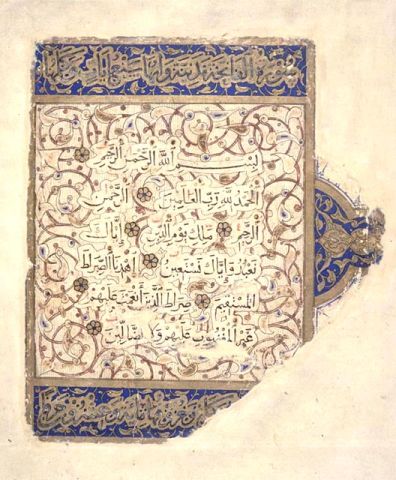
Image: 14th C. Qur'an, Mamluk origin, Library of Congress; Rights obtained.

A BREAKTHROUGH project which helps understand the Qur'an AS REVEALED -not just 'as explained.'

---------------------------------------------------------------------------

Tuesday, June 15, 2010

Day 135; Qur’an 15: 16-50, page 263 + 264

Welcome Friends:  Ahlan wa sahlan!
We know well that we must familiarize ourselves with our past in order to understand our present, and since we are interested in ‘Language,’ dear Readers, today we shall make a 'detour' together.
We’ll take a look at an important coin minted in Europe in the year 774 A.D. during the reign of King Offa, ruler of Mercia. 
As you can see, the coin is mostly inscribed in Arabic.  In the center (right) we read in Arabic:  ‘There is no god but God, and that Muhammad is His Messenger,’ while on the other side it says ‘Offa Rex.’  Note that there is no image of the king engraved here.  It also bears the date 157 A.H. of the Islamic Calendar, and around its edges (we can’t read it clearly but) it is said to be engraved with the 4 short verses of Chapter 112 of the Qur’an (Suratul Ikhlaas) as explained by Asad:

“SAY: "He is the One God:
"God the Eternal, the Uncaused Cause of All That Exists.
"He begets not, and neither is He begotten;
"and there is nothing that could be compared with Him.”
During the reign of King Offa, the Arab/Islamic culture in Spain was flourishing, and Arab Historians such as Hisham Ibn Al-Kalbi (737 AD - 819 AD) believe that he had accepted Islam by his own choice.  This offers one explanation for minting and circulating such a coin, and also perhaps for there not being any treaties between him and the Muslims, despite the obvious interaction.  But Western historians strongly dispute that conclusion.
To us, this is all beside the point; it is not King Offa’s faith which concerns us.  We are only interested in his Language, and ‘YES!’ dear Readers: 
We ARE talking about the English Language!  King Offa is the Anglo-Saxon King of Mercia, known today as the ‘English Midlands,’ along the valley of the River Trent.  (This coin is in the British Museum, which allows use of the photo for educational purposes, and it has not escaped us that they have called it an 'imitation of a dinar.') 
Which brings us back even more urgently today, to state that:
We cannot call ourselves 'educated' if we dismiss the possibility that many English words find their roots in Arabic:

From the Arab/Muslim Civilization in Spain, the rays of learning carried Arabic terminology into the rest of Europe, at a time when Europe was in its Dark Ages, and Arabic was the language of information, innovation, architecture, science, and art.  European languages, which were still in development, incorporated these Arabic words. 

Ignoring this influence is no less than a Linguistic and Historic travesty.


If you haven’t already read ‘Classical Arabic’ please do so before you continue, to see how the English language was still developing when Arabic was already mature and spreading worldwide. 
During those days a Gothic princess traveled to Damascus for audience with the Caliph, seeking his help to uphold her right to inherit according to Muslim Law.  (Compare that to someone today pleading such a case before the highest International Court.  In Damascus, Princess Sara married a Muslim gentleman of the Caliph’s court, and returned with him to Seville where she bore him two sons, and then, after his death, married another Muslim.)
Recently, westerners have begun to publicly acknowledge the influence of the Arab/Muslim Civilization on western progress, but scholars are still silent as to the influence of Arabic in their languages.  And only recently have Muslim scholars begun to be generous in offering the Qur’anic Text to others, after having held onto it as if it was theirs alone.  How can this eloquent Compilation speak to Mankind at large when no one is allowed to touch it?  And both sides still find it difficult to be self-critical. 
YET, in all urgency, everyone today is attempting to ‘bridge the cultural gap!’ 
I suggest that we search in the languages we speak AND the faith we profess for the cultural bridges that have always been there, connecting us all to each other, in spite of ourselves.

Yusuf Ali’s Translation of this Chapter.
Muhammad Asad’s Translation of this Chapter.
Their commentaries can only be read in verse by verse view.

COMMENTS:
PAGE 263 Arabic Qur’an.
 
1. Our Reading today begins with Verse 16, which mentions The Creator’s installation of towering celestial compositions, or ‘burooj’ (singular: ‘burj’ برج.- With diacritic marks: ‘burjun-برجٌ, which is the origin of several English words, such as the verb ‘burgeon,’ the nouns ‘berg’ and ‘burg’- but we already know that Etymology records will NOT reflect that linguistic fact, saying it is Germanic or of ‘uncertain origin’ [i]):

‘Early 14c., from O.Fr. borjoner "to bud, sprout," from borjon "a bud, shoot, pimple," of uncertain origin, perhaps from Germanic.’

2. The next verses discuss how these celestial compositions – stars/ constellations- were made beautiful so as to offer visual pleasure to onlookers.  They were also protected from every transgressor.  It is interesting to note that, although we are not able to physically ‘transgress’ to these planets, we can ‘eavesdrop,’ and listen to the sounds emanating from them EXACTLY like the verse states.  As for ‘being followed by discernible ‘shihaabs-شهاب ’ which are comet-like bodies or particles, we’ll leave that to scientists and cosmonauts.  (Do ionic particles flare-up, I wonder?) 
See Muhammad Asad’s explanation of these verses, and his notes 17- 18.  Yusuf Ali offers a more traditional explanation.

3. Then, Verses 19- 20- 21 discuss the earth and its bounties, which are released in due measure.
Verse 22 mentions other bounties, such as the fertilizing winds, and the rains for us to drink, while  Verse 23 is about Life and Death and God’s existence above and after all His Creation.

Verse 24 tells us that God knows the Former, and He knows the Latter, which could refer to precedence in good deeds, or simply in historic precedence.  At any rate, all shall be gathered to Him 25.

4. Then we arrive at the story of the Creation of the Cognizant Human.  See April 6th where we discussed it in detail.
For Asad’s explanation and notes see: 26- 27- 28- 29 -30- 31.
 
PAGE 264 Arabic Qur’an.

5.  In Verse 32 Iblees is asked why he did not honor Adam, to which he responds in Verse 33.  After that, Verses  34- 35- 36- 37- 38 recount an interesting exchange which took place between Iblees and his Lord (he addresses God as ‘My Lord-Rabbi’).  Here, we notice that Iblees asked for respite (postponement of facing the consequences of his actions) till the Day of ‘their,’ meaning our Human Resurrection.  We notice that Iblees did not ask for a second chance, which leads us to conclude that the Realm of the Unseen, with its positive versus negative forces, functions very differently from ours.  To try and understand the Unseen is futile, but we are nevertheless given a reassuring glimpse which should guide us towards fulfilling our better Selves, even as we rely on God to help us neutralize any negativity in our path.

6.  We see this quite clearly in Verses 39- 40- 41- 42. 
Well-explained by Asad, except that ‘Ibaad’ means ‘worshippers,’ not ‘servants.’

7.  Verses 43- 44 are fiery Dissuasion (ترهيب), while Verses 45- 46- 47- 48 are heavenly Persuasion (ترغيب) . 
Isn’t the Brotherhood in verse 47 heart-warming?  Why wait for Heaven to enjoy it- let’s be brothers and sisters now, and create a ‘heaven-on-earth!’

Our Reading today concludes with Verses 49-50; an announcement God asks His Messenger to deliver to His Worshippers:

‘Inform my Worshippers that I, I alone am The Forgiving, The Unceasingly Compassionate.  And that ‘my’ suffering (imposed upon any who deserve it) is indeed the painful suffering!  

Enough said!
 
Our next Reading is from HQ 15: 51-89.

Peace unto all!


[i] See German-English words and note that in Middle English, the word variation is BURCH, which suggests that the ‘g’ sound was a soft sound, more like ‘j.’

IMPORTANT NOTE: 
The timeline of what is called ‘Old English’ (450-1500) and ‘Middle English’ (1100-1500) coincide in larger part with the period of Arab/Muslim culture in Spain (711-1492), which was the CENTER of learning.


Monday, June 14, 2010

Day 134; Qur’an 14: 25- 52; 15: 1-15, page 261 + 262

Welcome Friends:  Ahlan wa sahlan!
Yusuf Ali’s Translation of our new Chapter.
Muhammad Asad’s Translation of our new Chapter.
Their commentaries can only be read in verse by verse view.

COMMENTS:
PAGE 261 Arabic Qur’an.
 
1. We begin our Reading today with Verse 42; a statement addressed to the Prophet, peace upon him, and to Those of Faith, telling them not to think that the wrong-doers will get away with their deeds.  The verse indicates that God knows exactly what they are doing, but has chosen to postpone their full dues till the time of Judgment, when theirs shall be the fearful image described in Verse 43.

It is interesting to note the description of their FOU’AAD being ‘hawaa’ –  هواءHawaa is well-explained by Asad as ‘abysmal void[i].’  For the definition of ‘fou’aad’ however, we go to our Reading of March 29, where we said that we might refer to ‘fou-aad’ as a ‘mental-response,’ and that al Asfahani had said that:
‘Fou-aad’ is the ‘heart/mind’
in a condition of being aflame/ignited.”

What a description:  Hearts/minds ‘Aflame… falling into an abyss…. yet empty at the same time.’

2.  Then, the Messenger is asked to warn People (in general) of Judgment (Verse 44), and we hear the argument expected from the wrongdoers in general, and its response, drawing attention to earlier communities who disobeyed their Messengers, and ‘whose homes they now occupied’…  (45) and whose fates should provide  a lesson.
(46) Of no avail were their cleverly contrived plots.

3.  The following four verses tell of the suffering of the Wrongdoers after this earth is changed into another (and the heavens 47), and all appear before God The Unique, The Almighty (48).
Asad:
“This is an allusion to the total, cataclysmic change, on the Last Day, of all natural phenomena, and thus of the universe as known to man –“

Verses 49- 50 describe their appearance, were we to see them.  Note Asad’s interesting comment on ‘chain reaction.’
Verse 51 states that every Self shall be rewarded according to its earnings, indeed God is swift in holding account.
Verse 52 brings this beautiful Chapter to an end.  See it in both explanations below:

“Here is a Message for mankind: Let them take warning therefrom, and let them know that He is (no other than) One God: let men of understanding take heed.” (Ali)

“THIS IS A MESSAGE unto all mankind. Hence, let them be warned thereby, and let them know that He is the One and Only God; and let those who are endowed with insight take this to heart!” (Asad)

What a powerful ending to this Chapter! Remember that its FIRST verse:

·  Addressed the Messenger Muhammad, peace upon him.
·  Mentioned the Compilation revealed to him.
·  Tied it to our Lord’s PURPOSE for Humanity and its guidance to His Path.

And now its LAST verse asserts that this (Qur’an) is A NOTIFICATION to Humanity.

·   By which we are all warned.
·   By which we all gain Knowledge
·   By which we KNOW that He is indeed: One God.
·   By which Those of Insight maintain Remembrance.
May we be among them!

This wonderful conclusion ties the first and last verses together in an embrace which includes highlights from History and from Faith, the fruits of the Tree of Human Life with its God-seeking branches of Words and Deeds, and Prophet Abraham’s beautiful supplication, peace upon him!
 
PAGE 262 Arabic Qur’an.
سورة الحِجر

Al Hijr
Yusuf Ali: 
“This is the last of the six Suras of the A.L.M. series.  Its place in chronology is the late Meccan period.”

Muhammad Asad:
“As in most surahs of this period, the main theme of Al-Hijr is the evidence of God's creative activity and of the guidance vouchsafed by Him to man through revelation - especially the revelation of the Qur'an, which, as verse 9 predicts, will for all times remain impervious to corruption.
“The title, derived from the mention in verse 80 of the Arabian region known as Al-Hijr, obviously suggested itself to the Prophet's Companions because of the many legends attached to that place-name since time immemorial. That it is a place-name and not a description … Consequently, I have left this title untranslated.”

4.  Verse 1 begins with ‘disjointed letters (A-L-R).  We had already discussed similar beginnings on April 6th, where we indicated that such letters usually introduce the ‘Compilation -كتاب’ – and we noted that they are in reality ‘sounds’ not letters. 
We find this verse, however, introducing both the Compilation AND the Qur’an, a clear indication that these two are distinct (meaning that the two nouns separated by the preposition ‘and’ cannot be one and the same thing).

For the benefit of our English Readers, who often miss the interesting intellectual discussions that go on in the Arab world:

Traditionally, Scholars have believed the two words (Kitab and Qur’an) to be synonymous; not indicative of any distinction.  To them, both words are alike, so whichever is used makes no difference. 
Recently however, Scholars have been paying attention to the distinction, mainly due to controversial books published on this subject, such as ‘The Kitaab and the Qur’an, a Contemporary Reading,’ by Dr. Muhammad Shahrour, the premise of which was the that the Qu’ran is NOT the entire Kitaab, but only the parts of it which ‘deal with prophecy.’  In his opinion therefore, Kitaab and Qur’an are not only distinct, but they are entirely separate entities, so that what we recite and consider ‘God’s Word’ is partially, but not all, ‘Qur’an.’ 

Now, the huge problem is that, although mainstream Muslim Scholars have rejected such an argument, no other convincing arguments have been put forward.
What have we been missing, for the past 1000 years and more?
 
We have lost the important distinction between ‘Kitaab’ and ‘Qur’an.’

Until now.  Our Qur’anic and linguistic research has uncovered a breakthrough regarding these two terms, which are neither synonymous nor alike:
 
·   The Kitaab, in general, includes All God’s Messages to mankind, the last of which is the Qur’an, May 19, which is why only ONE Kitaab/Compilation is mentioned in the Hereafter April 9.
 
·   However, when we find mention of ‘THIS’ Kitaab/Compilation specifically, it is referring to the Qur’anic Revelation in its compiled form.
 
·   The difference between the two terms is not in subject-matter, but is related to whether or not the static Kitaab/Compilation is approached by a Qaari’/Reader (see 6 components to IQRA).  
When so approached, the static becomes dynamic: ‘Kitaab’ becomes ‘Qur’an.’

Dear Reader: 
We shall be finding more evidence of this as we proceed, but I must tell you that the benefit you get from this project is totally dependent upon your level of interaction.  Your lives will change for the better if you employ the intellectual and spiritual tools offered here.

5. Perhaps we can better understand Verses 2-3 when we compare those who are in spiritual well-being to those who are in denial, as the verses seem to indicate that the Deniers might be today (and shall be in the Hereafter) wishing that they had been Purely Reverent to God!  Muhammad, peace upon him, is told to leave them to their false hopes, until the time comes for them to know.
Then verses 4-5 forewarn of the fate which inevitably befell past communities, each of which possessed a known compilation.
Similar to previously mentioned arguments made by the Deniers, in Verses 6- 7  we hear them challenging the Messenger and asking for angels, even calling him ‘a mad-man.’  The response is (Verse 8) that when angels do descend upon them, it will only be to bring about their end!

6.  Read Verse 9 in Asad’s explanation (also see Ali’s).  This is the FAMOUS verse which says that this Reminder or Remembrance (Thikr) is preserved, understood to mean that this Revelation will not be ‘contaminated,’ as was the case in previous Revelations which were translated and explained, so that much of the original does not exist anymore.

Now, the sad thing is that, despite the Compilation ITSELF being preserved, our UNDERSTANDING has been ‘contaminated’ because many original words and verses are understood differently, while others are abrogated and considered no longer applicable. Furthermore, we have not seen the distinction between ‘preservation’ and ‘maintaining a static state.’  By rendering the preserved Revelation’ static,’ we have neutralized its Qur’anic potential.  This is the 'Iqra' Challenge we are addressing here!

‘Thikr’ is explained as ‘Message’ and ‘Reminder’ by Ali and Asad, respectively.

7. The final verses in today’s Reading (Verses 10- 11- 12- 13- 14- 15) tell the Messenger Muhammad, peace upon him, that what is happening between him and his tribe is similar to the experiences of previous Messengers.
Asad:
“The confusing of revealed truths with illusory “enchantment” or “sorcery” is often pointed out in the Qur’ān as characteristic of the attitude of people who a priori refuse to accept the idea of revelation and, thus, of prophethood. The above two verses, implying that not even a direct insight into the wonders of heaven could convince “those who are bent on denying the truth,” are a prelude to the subsequent passage, which once again draws our attention to the wonders of nature as an evidence of God’s creative activity.”

Enough said!
 
Our next Reading is from HQ 15: 16-50.

Peace unto all!


[i] (هوي) يدلُّ على خُلُوٍّ وسقوط. أصله الهواء بين الأرض والسماء، سمِّي لخلوِّه. قالوا: وكلُّ خالٍ هواء. قال الله تعالى: {وأفْئِدَتُهُمْ هَوَاءٌ} [إبراهيم 43]، أي خاليةٌ لا تَعِي شيئاً

Let's TWEET this!

Tweet me!