CLICK IMAGE: Tanzil Website


OUR MISSION:
UNCOVERING the original message of the Arabic Qur'an by using Lexicons compiled more than 1,000 years ago.

ISOLATING Fact from Fiction.


RECOVERING Hope and regaining the perspective where Humanity is one, God's Message is one, and our Future CAN become one we all look forward to!


© 2010 IQRATHECHALLENGE: INTELLECTUAL PROPERTY PROTECTED BY D.M.C.A. ALL RIGHTS RESERVED.

© 2010 IQRATHECHALLENGE: INTELLECTUAL PROPERTY PROTECTED BY D.M.C.A. ALL RIGHTS RESERVED.
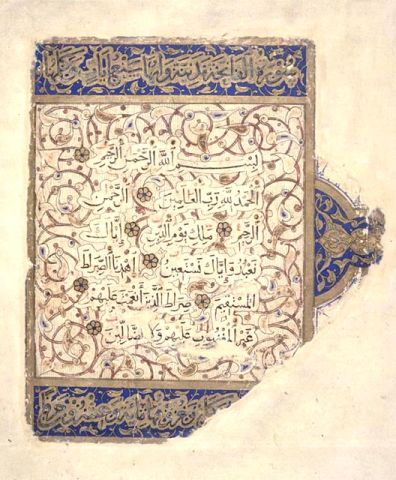
Image: 14th C. Qur'an, Mamluk origin, Library of Congress; Rights obtained.

A BREAKTHROUGH project which helps understand the Qur'an AS REVEALED -not just 'as explained.'

---------------------------------------------------------------------------

Friday, June 25, 2010

Day 142; Qur’an 16:88-102, page 277 + 278

Welcome Friends:  Ahlan wa sahlan!
Yusuf Ali’s Translation of this Chapter.
Muhammad Asad’s Translation of this Chapter.
Their commentaries can only be read in verse by verse view

COMMENTS:
PAGE 277 Arabic Qur’an.
 
1.  Our last Reading had illustrated the futility of offering excuses in the Hereafter.  Today, Verse 88 continues discussing the plight of Those who had Denied الذين كفروا- More suffering would be heaped upon them in the Hereafter, because of their impeding others from pursuing the Way to God, and the damage their corruptive deeds brought upon others in life; literally: ‘in that they were corrupting يفسدون
There are other verses which clearly state that ‘… God does not like the Corrupters.’ 5:64; 28:77.  (Also: ‘…God does not like Corruption.’ HQ 2: 205.)

2.  Verse 89 again mentions the Witness (‘shaheed,’ as in Verse 84, explained in our last Reading), but here, it tells the Messenger that HE WILL BE WITNESS over all the Witnesses, a concept mentioned 4 times in the Qur’an (HQ 2:143; 4:41; 16: 89; 22:78).  Before we ask ourselves about that, we continue reading the verse, and realize that the answer is in his being the bearer of the Compilation which clarifies all, and is Guidance and Mercy, and Glad Tidings to The Reverent.
(Remember the definition of Muslim -someone who purely reveres God).

3. Verses 90-91 are BEAUTIFUL VERSES that introduce under general headings the deeds God ‘commands/enjoins’ and forbids, and illustrate the importance of fulfilling our ‘covenant/ pledge’ with God (Ali/Asad).
(Verse 90 is oft-quoted today, at the end of sermons and supplications- see also explanation of Yusuf Ali .)

It is important to note that, chronologically, these Meccan Verses appeared before the detailed ‘Inviolables’ (HQ 6:151-153) which were revealed in Medina.

Notice the importance of caring for people ‘of Closeness’ to us ذي القربى – (which could be closeness of relation, occupation, or location).  Actually, each of us should be a source of positivity to all who come within any kind of contact with us.
Also note the three general headings God forbids:

· ‘Fahshaa’ فحشاء –Extra-marital sex (the last time we encountered this term was in the Chapter of Joseph, HQ 12:24).
· Munkar- منكر : Mutually Objectionable acts (which society disapproves of, and may or may not have laws against.)
·  Oppression.

After the general headings, we are given a few directions to take or to avoid. 
Verses  92- 93 are well-explained by Asad, but please make sure to read his notes. What an eloquent example:  
God knows what we do, specifically, and in detail!  In one moment of foolishness we could unravel years of effort. 
(Remember the difference between the general verb ya‘mal يعمل- and the specific verb yaf’al يفعل- mentioned on March 16th?) 

PAGE 278 Arabic Qur’an.

4. Verses 94- 95- 96 are quite straight-forward, continuing along the same lines with necessary directions.  Note the difference between what we have in our ‘possession’, and what God has in His, and that the reward of the Forbearing will be according to the BEST of what they were doing!
  
5. Verse 97 Is a Promise to every male and every female who worked good deeds WHILE FAITHFUL- they will indeed live a wholesome Life and receive their reward according to the Best of their deeds.

6. Verses 98-  99- 100 are important.  
Ali  sees the ‘refuge seeking words’ as a ‘formula,’ while Asad says:
‘The believer is now called upon to seek, whenever he reads or meditates on this divine writ, God’s spiritual aid against the whisperings of what the Qur’ān describes as “Satan, the accursed” – that is, all the evil forces, both within man’s own soul and within his social environment, which tend to undermine his moral convictions and to lead him away from God.’

These verses are indeed VERY important. 
Firstly, in that they show us the limit of the Deviant/ Sheytaan’s influence over humans: 

·  Over people who Have attained Faith AND are Dependent on God, his influence is NIL.  ZERO.

· The Deviant/ Sheytaan’s influence is only over those who take him as patron and make him partner (to the Divine- perhaps by following his insinuations, respecting, fearing him, or even giving him a presence in their thoughts).  

Secondly, this is one of several instances in the Qur’an where the Prophet is told to seek refuge in God (put استعذ  and قل أعوذ in Tanzil).  To understand the circumstances that necessitate him/us to seek refuge in God, we must look to context. 

Here, the context is:
Seeking refuge in God from possible Deviance in MISREADING, MISUNDERSTANDING, AND MISREPRESENTING the Qur’an!  This gives these verses even deeper meaning, and makes us take greater care in our Qur’anic Reading.

Read Posting of April 20th  where we explained that this is only time we are commanded to seek refuge in God, without it relating to the challenge of dealing with people's negativity. 

7. Verse 101 responds to those who question God’s Signs.  Well-explained by both Ali  and Asad.
The final verse in today’s Reading, Verse 102, mentions the Holy ‘Spirit/ Inspiration’ (Ali/Asad), usually understood to be Angel Gabriel.  The verse tells Muhammad, peace upon him, to state that it was The Holy Spirit who brought God’s Signs down to him from his Lord in Truth, to reinforce Those who Attained Faith, and Guidance and Glad Tidings to the Purely Reverent (to God).  
Enough said!
 
Our next Reading is from HQ 16: 103-117.

Peace unto all!

Thursday, June 24, 2010

Day 141; Qur’an 16:73-87, page 275 + 276

Welcome Friends:  Ahlan wa sahlan!
Yusuf Ali’s Translation of this Chapter.
Muhammad Asad’s Translation of this Chapter.
Their commentaries can only be read in verse by verse view

COMMENTS:
PAGE 275 Arabic Qur’an.
 
1.    After mentioning many of God’s beautiful bounties in our last Reading, Verses 73-74 deride those who worship, instead of God, things that DO NOT –and cannot- provide them with sustenance, neither from the Heavens nor the earth.  The similitudes such persons offer for revering others than God… are all refused.

2.     In Verses 75-76 God offers two similitudes: 

·     The first illustrates the importance of the God-given Bounties of Freedom and Wealth, extended to others by virtue of Generous Spending.

·     The second illustrates the importance of the God-given gift of Guidance (being on the Straight Path), extended to others by virtue of sound Judgment.

In fact, Freedom, Wealth, Guidance, and Sound Judgment are too valuable not to be shared with others.  When we do not employ them in the service of our society, they cease to be ‘Blessings’ or Bounties.  They transform into Burdens of Accountability for which we must answer soon enough, in what seems to be ‘the blink of an eye or even sooner!’ (Verse 77)

Note:
The (final) ‘Hour’ mentioned here, is called الساعة in Arabic.  When we copy + paste the word in Tanzil we find out more about:
·   Its ‘Timing’ (HQ 20:15, 33:64, 42:17).
·   ‘Knowledge of it’ (HQ 31:34, 41:47, 43:85).
·   Its ‘Suddenness’ (HQ 6:31, 12:107, 43:66, 47:18).
·   The ‘Awe’ it will inflict (HQ 22:1, 54:1). 

3.    After speaking of our gifts and responsibilities in adult life, Verse 78 takes us back to the point in time when we started this journey upon being delivered into this life by our mothers.  That was when we began, ‘knowing nothing,’ but thanks to the faculties which God had rendered for us, mainly: Hearing, Sight, and Cognitive Response “af’idah أفئدة-” we are given the capacity to be productive.  “…so that you may be productive لعلكم تشكرون (see definition of ‘shukr’).

(Regular Readers will note that I (may have finally) found an English term for the Arabic ‘fou’aad,’ discussed on March 29th.  Let me know what you think!)

4.   After having mentioned the power of perception, learning, and producing Verses 79- 80- 81 direct attention to the skies, asking whether they (Deniers) observe the birds which are upheld there by God’s natural laws, in which, indeed, are Signs for People who have Faith/believe.

PAGE 276 Arabic Qur’an.

5.    Next, Verses 80- 81 bring our sights down to our immediate lives:  Our homes as places of ‘tranquil settlement’ – and the lightweight ‘carry-on’ homes made of ‘animal-skin’ which accompany us in times of travel or residence (might our baggage fit into this description today?), the furnishings and other temporary benefits we derive from animal wool, fur, and hair.  And the protection we get beneath the shadow of what God has created, and in mountains, and in the clothing which protects us from heat, or provides armor against our aggression (of each other).  The verse ends by telling us that this is how God completes his favor upon us so that we might ‘have Pure Reverence’ (to Him).

Note:
‘Sakan’ سكن as seen in our 1,000 year-old Lexicon[i] denotes stillness/ tranquility.  When related to homes or spouses (see the Marriage Union) it denotes ‘tranquil settlement’ ‘snuggling’ or being comfortable with something or someone you love.

6.    Verse 82 speaks directly to the Messenger Muhammad, peace upon him (and to listeners in general) indicating the limit of his responsibility, which is the clear Delivery- or the Conveyance- of the Message. 
Verse 83 announces that although people might actually be familiar with God’s Favor, yet most of them are Deniers who end up (in time: thumma ثم) rejecting it.
 
(I like how Ali distinguished between ‘arafa-عرف and ‘alima -علم –which many people consider alike, and understand as ‘to know.’  Regular Readers will remember that we’ve already discussed ‘arafa’ On Jan 22nd  and April 8th.)
 
7.    Verses 84- 85- 86- 87 tells of the Hereafter when, out of each community, a Witness will be raised; these verses show the futility of offering any excuses for one’s shortcomings in life.  Well-explained by both Ali and Asad.

Here we note the word ‘shaheed’ which means ‘witness.’  This word in the Qur’an does NOT refer to ‘martyrs.’ 
When we copy + paste شهيد in Tanzil we’ll find out that (in more than 18 verses), the Witness is God, or sometimes a Messenger, or a person bearing LIVE witness.  Our Lexicon [ii]   tells us that the word ‘shaheed’ is only related to being in attendance (in an event), knowing of it, and conveying knowledge of it.
There actually is no single word in the Qur’an which refers to our concept of what a ‘martyr’ is.  The Qur’an calls anyone who is slain in God’s Cause - ‘sabeel’ (literally: in His Way), exactly that:  Someone slain in God’s Cause/Way.’  Put قتل في سبيل الله in Tanzil. 
The most beautiful verses discussing ‘martyrs’ and their being ‘alive and sustained’ by their Lord are in HQ3:169-17 (we passed through them without discussion on February 10th).
 
P.S. It is important for Readers to know that nowhere in the Qur’an is there mention of ‘Martyrdom and the 72 virgins’ which are rampant in western media today!  This narrative seems to have been introduced in a mistranslated report aired by CBS's 60 Minutes, two weeks before 9/11. 
If you’d like to read all about it, ask Google!
Enough said!
 
Our next Reading is from HQ 16: 88-102.
Peace unto all!


[i] (سكن) يدلُّ على خلاف الاضطراب والحركة. يقال سَكَن الشّيءُ يسكُن سكوناً فهو ساكن. والسَّكْن: الأهل الذين يسكُنون الدّار. والسَّكَن: كلُّ ما سكنتَ إليه من محبوب. والسِّكِّين معروف، قال بعضُ أهل اللغة: هو فِعِّيل لأنّه يسكّن حركةَ المذبوح به. ومن الباب السّكينة، وهو الوقار، وسُكان السفينة سمِّي لأنَّه يُسكّنها عن الاضطراب.

[ii] (شهد) يدلُّ على حضور وعلم وإعلام، لا يخرُج شيءٌ من فروعه عن الذي ذكرناه. من ذلك الشَّهادة، يجمع الأصولَ التي ذكرناها من الحضور، والعلم، والإعلام. يقال شَهد يشهد شهادةً. والمَشهد: محضر النّاس.

Let's TWEET this!

Tweet me!