CLICK IMAGE: Tanzil Website


OUR MISSION:
UNCOVERING the original message of the Arabic Qur'an by using Lexicons compiled more than 1,000 years ago.

ISOLATING Fact from Fiction.


RECOVERING Hope and regaining the perspective where Humanity is one, God's Message is one, and our Future CAN become one we all look forward to!


© 2010 IQRATHECHALLENGE: INTELLECTUAL PROPERTY PROTECTED BY D.M.C.A. ALL RIGHTS RESERVED.

© 2010 IQRATHECHALLENGE: INTELLECTUAL PROPERTY PROTECTED BY D.M.C.A. ALL RIGHTS RESERVED.
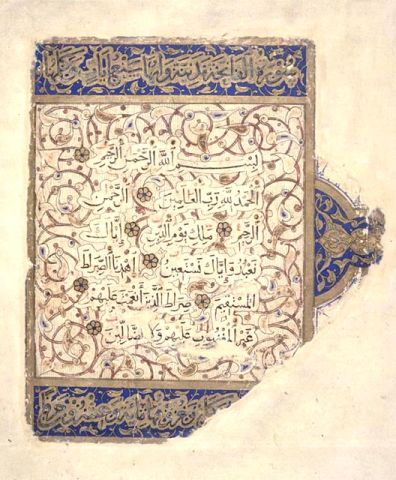
Image: 14th C. Qur'an, Mamluk origin, Library of Congress; Rights obtained.

A BREAKTHROUGH project which helps understand the Qur'an AS REVEALED -not just 'as explained.'

---------------------------------------------------------------------------

Monday, July 26, 2010

Day 161; Qur’an 20: 115-135, page 320 + 321

Welcome Friends:  Ahlan wa sahlan!     
Our last Reading ended with a beautiful prayer which we should repeat again and again:

“….  My Lord!  Increase me in Knowledge!”

Yusuf Ali’s Translation of this Chapter.
Muhammad Asad’s Translation of this Chapter.
Their commentaries can only be read in verse by verse view

COMMENTS:
PAGE 320 Arabic Qur’an.

1. Verse  115:  We begin the story of Adam’s Relapse (encouraged by his enemy, the Deviant/ Sheytaan) from another angle; well-explained by both Muhammad Asad and Yusuf Ali.  The following is from Yusuf Ali’s Commentary:

 “The spiritual fall of two individual souls, Pharaoh and the Samiri, having been referred to, the one through overweening arrogance, and the other through a spirit of mischief and false harking back to the past, our attention is now called to the prototype of Evil (satan) who tempted Adam, the original Man, and to the fact that though man was clearly warned that satan is his enemy and will only effect his ruin, he showed so little firmness that he succumbed to it at once at the first opportunity.”

What I would like to remind our Readers however, is that Adam’s story was a Lesson from which he EMERGED to start out afresh, strengthened by his experience.  Check Postings of January 4th and April 6th.
His was a natural human failing, and NOT something as final as a ‘spiritual fall.’  This is why I am calling it a Relapse.
Verses 116- 122 narrate the main points of this lesson:
 
· Iblees’ refusal to honor Adam (Verse 116).
· Introducing Adam to his enemy, his enemy’s plan, and the possible outcome (Verse 117).
· The characteristics of the Garden (Verses 118-119).
· The two major Temptations to which Humans succumb (Verse 120):
-Quest for eternal Life.
-Quest for eternal Dominion.
· Their Relapse, which resulted in:
- Recognizing their fallibility/vulnerability.
- Realizing the gravity of what they had done (Verse 121).
· After which Adam was, in time (thummaثم- ), Chosen, Forgiven, and Guided by his Lord (122).
· And told to descend physically (هبط) from the Garden to a place of discord, bearing in mind that God will be sending Guidance which will result in a positive state for those who follow it (Verse 123), and in a negative state for those who don’t, plus their blindness in the Hereafter (Verse 124) brought on as a result of their blindness to God’s Signs in Life (Verse 125-126).
We find the same verb (هبط) mentioned in the story of Moses (put it in Tanzil).

Adam and his spouse were unprepared as Iblees cheated them.  The Deviant/Sheytaan lied even as he vowed he was advising them of their best interests (HQ 7:21). 
Humans are not on earth as ‘punishment’ (there is no such thing as ‘punishment’ in the Qur’an.  There only is Outcome, or ‘Consequence.’)
There is no Original Sin to be carried from the first Humans to the last.  Each person is responsible for the deeds s/he commits.

PAGE 321 Arabic Qur’an.

2. Verse 127 concludes the narrative, warning of the severity and endlessness of suffering in the Hereafter.

Dear Reader:
No suffering burns deeper than the regret of Chances wasted and Time lost, NEVER to be regained.  Regretting what we failed to accomplish- when it was well within our reach- is what Hell is all about!

3. Verse 128 addresses Qureish / us all, to notice the many lessons we could learn as we look back at past generations.
                                              
4.  Verse 129 is well-explained by both Yusuf Ali and Muhammad Asad.

As indicated by context, it advises FORBEARANCE (to the Faithful, who were in the throes of suffering at the hands of Qureish).

5.  Just as this Chapter began with a direct call to the Messenger, peace upon him, telling him that this Qur’an was not conveyed to him to be a cause for his distress, the last part of the chapter (Verses 130- 131- 132) presents him with ‘The Balm to Distress:’
Note, dear Reader, that this is a balm for us too; one that could relieve us of our distress:

· Forbearance, especially in face of hostile talk.
· Active Worship/Remembrance of our Lord (by which we are fortified) before sunrise, before sunset, during the night and at the ‘margins’ of the day… so as to achieve Self- Contentment and Serenity.
· To maintain Focus on the bounty of Our Lord which is Everlasting, and not to be sidetracked by the fleeting pleasures of life, which He may have granted to certain groups as trials.
· To Command our family to Prayer /maintaining a strong connection to God and each other.
· To be Patient and Forbearing in the aforementioned (which indicates that maintaining this connection- together with family- is not easy!).
· To remember that God is the One who sustains, and that we are not asked for sustenance!
· And finally, to realize that what prevails in the end… is Awareness!

What a Balm, if we only made use of it!

6.  Verses 133- 134- 135 conclude this chapter with a warning to Qureish, presenting them with responses to their arguments and stating to them that they shall come to know who are those on the right Path, and who are the guided.

Enough said!
 
Our next Reading is from HQ 21: 1-35 A New Chapter!

Peace unto all!

Thursday, July 22, 2010

Day 160; Qur’an 20: 77-114, page 317 + 318 + 319

Welcome Friends:  Ahlan wa sahlan!     
Yusuf Ali’s Translation of this Chapter.
Muhammad Asad’s Translation of this Chapter.
Their commentaries can only be read in verse by verse view

COMMENTS:
PAGE 317 Arabic Qur’an.

1.   Our Reading today begins with (Verses 77- 78- 79) Moses receiving ‘wahi وحي-’ as God conveys to him to depart by night, WITH His Worshippers.  Notice how he is commanded to ‘hit/strike’ for them a firm passage through the sea, without fearing anything (and certainly without fear of Pharaoh catching-up with them). 
Pharaoh and his soldiers DO follow, and are overcome by the waters; Pharaoh is announced to have been someone who misguided his people; someone who, in fact, FAILED to guide his people, as should have been the duty of a true Leader!

(Remember HQ 11:96-99:  Just as Pharaoh led his people to Denial and Death in Life, so shall he lead them into the Fire on Resurrection Day!  Leadership is a HUGE responsibility.)

2.  In the following verses (80- 81- 82), God speaks to Bani Isra-eel directly, offering them His Bounty even as He warns them not to transgress, for anyone who transgresses will earn God’s Condemnation… and anyone who earns God’s Condemnation will plummet (towards their own destruction).

Notice the beauty of Verse 82: 
God is Oft-forgiving to someone who:

· Repents,
· and Attains Faith,
· and Works good Deeds,
· after which (thummaثم- ) s/he is Guided!

Here we have the 3 steps to Guidance, and the 4 steps that merit Oft-Forgiveness.  What we also understand from this, dear Reader, is that people who are ‘guided’ will still make mistakes.  Their mistakes however, are short-lived:  No sooner do they make them, than they realize what they have done, and they go through the cycle:

Repentance, Reaffirmation of Faith, Rectifying the wrongs committed, and Returning to the path of Guidance.
This is part of the Standard by which God holds us ALL accountable; well-detailed and explained by all God’s Messengers, peace upon them.     

3.  In Verses 83- 84- 85 we listen-in on an exchange between God and Moses, and we notice how Moses was asked why he had hastened away from his people.  Moses’ response was that he had hastened to his Lord, seeking His Acceptance.  This shows us how driven he must have felt towards his Lord, especially since he had an ‘audience’ with him unlike any other Messenger!
PAGE 318 Arabic Qur’an.

4.  In Verses 86- 91 we are told how the ‘calf-worship’ came about, as Moses’ people explain themselves to him.  We notice how they did not listen to Aaron who reminded them of their Lord, Al Rahmaan, The Creator.
Then in Verse 92- 94 we see Moses’ angry exchange with his brother, who explains that during Moses’ absence, his focus was on the command he had given him: To maintain the unity of Bani Isra-eel.

The next verses (95- 97) discuss the issue of the Saamiri السامري who was the instigator of the entire ‘calf-worship’ episode. 
The Saamiri may have been their ‘Story-Teller,’ from the root-verb ‘samaraسمر- ’- which means ‘to gather for friendly conversation after dark.’  The Saamiri seems to have understood all too well the Messenger (Moses’) teachings, and perhaps realized what a loss (to him) this new Faith would cause, and felt inclined to discard the most important part of the Messenger’s teachings:  The belief in the One, Unseen, God.

To us today, this is Gheyb and if we elaborate, we will have to speculate: 
Elaboration is Deviance, so we might as well stop here.  Anyway, read Asad’s comments on Verse 96.

Verse 98 reaffirms the Faith.

PAGE 319 Arabic Qur’an.

5.   In Verse 99 the Qur’an readdresses Prophet Muhammad, peace upon him, telling him that these are the narratives of the Past.
As Yusuf Ali indicates:  THIS is not second-hand information (as other narratives might be), but one delivered directly from God.

Then we notice in Verses 100- 101 that anyone who turns away from this Reminder shall bear the burden, the responsibility, of doing so… at the time of Resurrection.

6.  Verses 102- 107 describe Resurrection- when there is a ‘quickening نفخ-’ of Events… when Evil-earners are gathered together- confused as to the length of their earthly sojourn… when the mountains collapse.  Yusuf Ali calls this a ‘Rude Awakening.’

Verses 108- 109 show us how, on that Day, everyone will follow the Summons to final Judgment… when all voices are subdued before Al Rahmaan, The Creator… and none can intercede unless The Creator allows and accepts.

Verses 110- 111- 112 tell us that, at that time, there shall be only One Direction; all are directed towards Him:  The Living, The Self-Subsistent Fount of all being!

7.  Verses 113- 114 tell us that this Qur’an is Arabi.  It is Eloquently Self-Expressive, wherein God has forewarned in detail so that people could be Aware, and so that Remembrance –Thikr- could take place. 
Exalted is God, the Sovereign, the Truth…
Finally, the Messenger is told not to hasten in the Qur’an before it has been conveyed to him in full.  This offers us yet another indication as to the meaning of the word ‘Qur’an,’ and might indicate the need to proceed slowly through the 6 components of IQRA.

Reminder: 
The SIX components to the root verb ‘qara’a قرأ-’- (as found in our 1,000 year-old Arabic lexicon (summarized here):
1. Gathering the information.
2. Carrying it (retaining it).
3. Proceeding with purpose.
4. Bearing witness to it.
5. Being timely.
6. Being hospitable.

And if anyone needs further proof, please note that this beautiful verse, which begins by glorifying God the True Sovereign, goes on to mention the Qur'an and the need for the Messenger not to hasten through it, and then ends with the command to ask his Lord to increase his Knowledge...وقل ربِّ زدني علما.. Information processing- full circle!

(For detailed information on Kitaab versus Qur'an, put 'static' in 'Search this Site.'  For IQRA put 'components iqra.')

Enough said!
 
Our next Reading is from HQ 20: 115-135 End of Chapter.

Peace unto all!

Let's TWEET this!

Tweet me!