CLICK IMAGE: Tanzil Website


OUR MISSION:
UNCOVERING the original message of the Arabic Qur'an by using Lexicons compiled more than 1,000 years ago.

ISOLATING Fact from Fiction.


RECOVERING Hope and regaining the perspective where Humanity is one, God's Message is one, and our Future CAN become one we all look forward to!


© 2010 IQRATHECHALLENGE: INTELLECTUAL PROPERTY PROTECTED BY D.M.C.A. ALL RIGHTS RESERVED.

© 2010 IQRATHECHALLENGE: INTELLECTUAL PROPERTY PROTECTED BY D.M.C.A. ALL RIGHTS RESERVED.
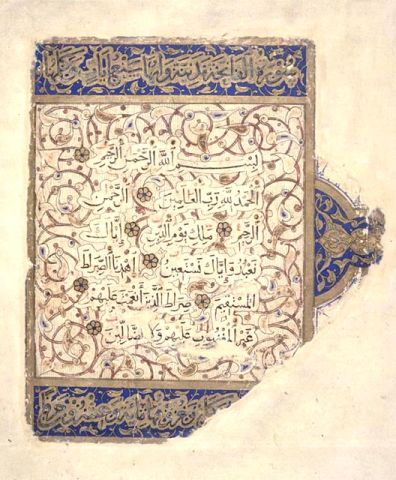
Image: 14th C. Qur'an, Mamluk origin, Library of Congress; Rights obtained.

A BREAKTHROUGH project which helps understand the Qur'an AS REVEALED -not just 'as explained.'

---------------------------------------------------------------------------

Saturday, December 18, 2010

Day 278; Qur’an 71: 1-28, pages 570-571


Welcome Friends:  Ahlan wa sahlan!

Yusuf Ali’s explanation of this Chapter.
Muhammad Asad’s explanation of this Chapter.
NEW: Laleh Bakhtiar’s explanation of this Chapter.

سورة  نوح
‘Noah’

From Introduction of Yusuf Ali:

This is an early Makkan Surah… The theme is that while Good must uphold the standard of Truth and Righteousness, a stage is reached when it must definitely part company with Evil, lest Evil should spread its corruption.
The story of Noah's agony is almost a Parable for the Holy Prophet's persecution in the Makkan period.”

From Introduction of Muhammad Asad:

“DEVOTED in its entirety to Noah's preaching to his erring fellow-men, this surah depicts symbolically every conscious believer's struggle against blind materialism and the resulting lack of all spiritual values.
The story of Noah as such is mentioned in several places in the Qur'an, and particularly in 11:25.”

COMMENTS:

Notable for its refrain and rhythm, this Chapter is almost a soliloquy, with most of the statements we hear being ‘voiced’ by Noah who seems to be giving his Lord his final assessment regarding his progress – or lack of it- with his people.
This narrative is retold for the benefit of its recipients, strengthening Prophet Muhammad as it persuades and dissuades listeners.  

We shan’t spend much time explaining these verses; Readers can see the full explanation by any of our three Commentators above.  We shall only highlight the important facts interspersed within.

PAGE 570 Arabic Qur’an

1. Verses 1-4 relate a part of Prophet Noah’s story with his people; we did encounter similar verses in HQ 11: 25.  It is interesting to note that God’s Messengers, peace upon them, bear the same message which asks people mainly to be aware of God, and obey the Messenger.  The promise is that, should people comply, they would earn forgiveness for part OF their wrongdoing (‘min’) and be granted respite.  But in the case of Noah, his people chose not to. 
2.  In Verses 5- 9 Noah shows his Lord his own dedication in calling his people to Him, day and night, loudly and softly, in public and in private; he laments that they would try to bar their senses from seeing or hearing him, and that his calls only made them flee further away, in stubborn arrogance.
PAGE 571 Arabic Qur’an

3.  In Verses 10- 12 Noah’s monologue gives us a few important facts (they ARE facts or else they would not have been mentioned).  One such fact is that Our Lord is ‘Ghaffaar/ Oft-Forgiving,’ and that when we ask His Forgiveness, we not only get it, but we ALSO get much bounty from Him.

4.   In Verses 13- 14 Noah asks his people, what the matter with them is, that they do not reflect highly on God/ realize His magnitude…. while it is He Who created them in stages?
It is important to remember this verse, which mentions our creation taking place in stages ‘aTwaar,’ and what it indicates, that this should lead us Cognizant Humans to recognize God’s ‘waqaar;’ the weighty, immense, significance of God being The CreatOR (‘waqaar’ literally means ‘weightiness’).  We’ve already encountered verses which speak, more generally, of people who do not hold God in rightful ‘esteem/ qadr.’

Dear Reader:
Can we ever truly realize God’s esteem?  I don’t think we can know it, but I think that we can feel it.  I think that, while we are always attempting to know more, all that is required of us is feeling it.
To know more about the Creator, look to His Creation.  Life.  He is The Source, The Origin, Al RaHmaan.
Look at the facts.  It is scientifically indisputable, that all Life, including human, is an evolution.  However, what IS now scientifically disputed, is the 150 years old Darwinian theory of natural selection!  In the 19th century, scientists were expecting that future studies on complex living organisms will only reveal the simplicity of their structure.  What has happened is the exact opposite:  The closer they were able to look at living organisms, the more detail they saw, and the greater complexity.  One highly complex organism is the bacterium, which contains the most efficient machine in the entire universe, the ‘Bacterial Flagellum’ (see pic below) with an RPM of 10,000! ([i])  No wonder some say that 'bacteria rule the world!'
Watch this 7 min. video ‘What Darwin Didn’t Know.’  How did this microscopic machine come about?  How did everything else come about?    
God. 
He is The Creator of Everything, and He is, over everything, Guardian and Disposer (HQ 39:62) 
Such information has spurred the ongoing debate between Evolutionism, Creationism, and Intelligent Design, behind which lurks the timeless question: Does ‘The Creator’ exist?
My answer to that, dear Reader, is: 
I am more certain of The Creator’s Existence than I am of my own.


5.   Then Verses 15-16 continue to speak directly to listeners (in the first person plural, showing them the magnitude of the Creator), asking them of the creation of the seven ‘mantled/ layered’ Exalted Expanses, in which the moon is a shining light, while the sun is a burning torch.  This description (more detailed than HQ 10:5) is considered a scientific ‘marvel,’ seeing that its accuracy is beyond what was ‘common knowledge’ at the time of Revelation.
Verses 17-18 continue, referring to the wonder which is their own beginning, and also referring to their end on this earth; how humans ‘sprouted out’ from this earth and propagated in a manner similar to all Life upon it, only to return back to the earth and be brought out of it ‘in an expelling’ ([ii]).

Dear Reader:
Do check out the following links; they are worth your while.
The Qur’an uses the word ‘nabaata’ ([iii]) which seems to refer to a process of ‘sprouting and propagating’ FROM earth-matter.  It is very interesting to see this taking place in the ongoing cycle which sustains all Life, called Mytosis
Seeing Mytosis in action is quite an experience (more detail here -6 min.). 
Meiosis, on the other hand, is a special type of cell-division necessary for reproduction.  Check this out too; it is just as remarkable.
Verses 19-20 continue, mentioning how God rendered the Earth a ‘spread’ for them to course through its passage-ways (gullies).

6.   Then, in Verses 21- 24, Prophet Noah turns to his Lord, telling Him how his people disobeyed him (with regard to worshipping God Alone and being Aware of Him) and followed someone whose wealth and offspring only took him deeper into loss/ruin, and they misconstrued an enormous ‘misconstruction/ makr,’ discouraging others from leaving their ‘deities’ (naming 5 specific ones).  He then states a fact as to the many people they have misguided, and asks God to increase them in nothing but Misguidance.

Then Verse 25 tells us that, because of their Wrongs, they were drowned and made to enter Fire, finding none to save them other than God.

7.  In Verses 26- 27 we find Prophet Noah asking God not to leave a single Denier on Earth, because they would mislead His worshippers and only breed blatant Deniers. 

We may wonder at this, and see it as ‘pessimistic and cold-hearted,’ but it may simply be an assessment of Noah’s, based on God’s telling him (HQ 11:36) that after his extensive efforts and dedication, he has reached a dead-end:  He shall not win another person over; no one else shall believe in him, other than those whom he had already won over.

The last verse in this Chapter has Noah asking God to forgive him and his parents and any who enters his house in faith, and to all Men and Women of Faith, and to only increase the Wrong-doers in ruination.
At the end of this chapter, let us pause for a moment and reflect on our Creator’s magnificence and magnitude.  I don’t know about you, dear Reader.... but today’s post made me desire, from the deeeeeeeepest recesses of my being… it made me desire and hope and wish and yearn and look forward to… meeting Him!
Let us hold that thought as we leave these pages.

Peace unto all!


[i]
The Rotation Per Minute of a car is around 6,000.  Only ‘Formula One’ cars can surpass this in speed- but NOTHING can surpass it in efficiency!

‘Expelling’ is Laleh Bakhtiar’s choice, which I like.

نبت:  يدلُّ على نماءٍ في مزروع، ثم يستعار. فالنَّبت معروفٌ، يقال نَبَت. وأنْبَتَتِ الأرض. ونَبَّتُّ الشَّجرَ: غَرستُه. ويقال: إنَّ في بني فلانٍ لنابِتَةَ شرّ. ونبَتَتْ لبني فلانٍ نابتةٌ، إذا نشَأ لهم نَشْءٌ صِغار من الوَلَد.

Friday, December 17, 2010

Day 277; Qur’an 70: 1-44, pages 568-570


Welcome Friends:  Ahlan wa sahlan!

Yusuf Ali’s explanation of this Chapter.
Muhammad Asad’s explanation of this Chapter.
NEW: Laleh Bakhtiar’s explanation of this Chapter.

سورة المعارج
‘The Ascensions/ The Paths of Ascent’

From Introduction of Yusuf Ali:
“This is another eschatological Surah closely connected in subject matter with the last one. Patience and the mystery of Time will show the ways that climb the Heaven. Sin and Goodness must each eventually come to its own.
Chronologically it belongs to the late early middle Makkan period, possibly soon after Surah 49.”

From Introduction of Muhammad Asad:

THUS CALLED after the word al-ma'arij appearing in verse 3, this surah belongs to the middle of the Mecca period. It is mainly devoted to the challenge which unbelief - or, rather, unwillingness to believe - offers to faith, both of them being conditioned by the restlessness inherent in human nature.”

COMMENTS:

The subject-matter of this Chapter is mostly in response to the first verse, a QUERY as to the inevitable suffering to befall the Deniers.  Presenting the answer with dire Dissuasion, we are then given a statement of fact about human nature, after which comes beautiful Persuasion, as the verses describe characteristics we should all aspire to fulfill. 

The title ‘The Ascensions/ The Paths of Ascent’ is derived from the third verse.


PAGE 568 Arabic Qur’an

1.    The first verse directly addresses an important issue, informing us that an ‘inquirer’ had inquired as to Impending Suffering.  Context helps us understand that this inquirer was a ‘skeptic’ who did NOT believe in what the Qur’an was warning of, which is that Suffering shall indeed befall. Actually, it seems that there were many skeptics who did not accept the concept of Final Justice being meted out to everyone, as we shall see when we arrive at Chapter 78 which begins with:

‘What are they inquiring about? About the tremendous News, regarding which they are in dispute.’

(Laleh Bakhtiar explains ‘athaab’ as ‘punishment,’ while most people think that ‘iqaab’ means ‘punishment’.  Please put ‘ugly connotation’ in ‘Search’ to see why the Qur’an does NOT use the word ‘punishment’ at all).  
Therefore, although these verses are timeless and speak to all skeptics, we understand that Qureish did in fact dispute the Messenger’s warning of resurrection for final judgment, and his assurances that it shall indeed befall. 
The next verses then tell us that it (the Suffering) shall be unstoppable as it befalls Deniers, its being from God ‘Of the Paths of Ascent,’ to Whom the Custodians/ Angels and the Spirit ascend within a projected period/ term of 50 thousand years (we already spoke of the word ‘alf’ earlier, which is about something ‘composed/ put together,’ here referring to large numbers).

2.    Verse 5 addresses the Messenger, telling him to show ‘Exemplary Forbearance.’  Here we think back to the story of Prophet Jacob, and his exemplary forbearance!  Knowing that his sons had done something to his young child, he became blind with grief, yet he was patient, pouring out his sorrow only to God (HQ 12:86). 
What a responsibility this must have been to Prophet Muhammad!  Imagine being told -by God Himself- to show the highest ever level of human forbearance in face of everything which Qureish was putting him through…  may God’s peace and blessings be upon all His Messengers!
Verses 6-7 show the difference between what the Deniers believed on one hand, and what was actually going to happen, as known by God.  They see what is indeed ‘Impending’ as a ‘far off’ event, unlikely to ever take place!
Verses 8- 18 describe the Suffering which was mentioned in the first verse; in 8-10 we see the transformation which takes place then, when the Exalted Expanse /sky becomes like molten metal, and the mountains like tufts of wool… and people who once were intimates, now do not even ‘inquire after/ ask of’ each other!

PAGE 569 Arabic Qur’an

3.    Verse 11 continues, beginning by saying: ‘They are made to see them…’ which appears in Arabic as one word: ‘yubaSSaroonahum,’ which helps us understand that nothing and no one is hidden from view that day.  After that, we are shown how alone the ‘Mujrim/ the evil-Earner/ one who had Extracted Himself from faith ([i])’ feels, and indeed is.  No one on earth matters to him anymore, and he is ready to ‘ransom’ himself, by exchanging his place with people who were dearest to him in life, beginning with his children, to his love-companion, his brother, his family (sheltering clan), and to EVERYONE else on earth, all put together… to save his own skin (put ‘Mujrim’ in ‘Search’).
When we read the next verses we realize why: 
What awaits him is WORSE than the worst nightmare!
Verses 15- 18 tell us about it… it’s the Blaze, which rips-out peoples’ scalps, beckoning to any who (in life), was giving his back (to God’s Message), turning away (from it), and amassing and stashing (his fortune).
Verses 19- 21 tell us WHY a person would do that:  It is inborn nature.
The Human (in his individual, base self) was created panicky -:([ii]-هلع)
He is naturally fearful when touched by misfortune, and tight-fisted when touched by good-fortune unless….. !  Unless ‘what?’  What is the exception?
The verses continue:… EXCEPT FOR ‘Those who Maintain CONSISTENT Relationship/ Prayer….!’
(Notice here how the singular reference to–insaan- became a plural reference to –muSalleen- so as to indicate the beautiful togetherness of this Relationship!)

Dear Reader: 
When parents fail to raise children to become better individuals, and when adults fail to rise through a relationship with God and with each other, people end up remaining at the level of their base selves, and earning eternal regret.
Let us look at that list of persons who were able to rise above their base nature and earn to be in the Gardens, having been granted eminence in bounty and forgiveness (put ‘karam’ in ‘Search’).  Verses 23- 35 tell us that:  
-They were persons who had maintained CONSISTENT ‘Relationship/ Prayer/ Salaat’ (remember that the past tense verb ‘salla’ is the opposite of ‘tawalla.’  Put words in ‘Search’).
-And they were persons who had handed a portion of ‘their’ wealth as a defined Right (which indeed ‘belonged’) to the soliciting person (who asks for it) and to the deprived person (who does not ask).
-And they were persons who had believed in the ‘Day/Time’ of Accountability.
-And they were persons who had been so wary of the Suffering which their Lord metes out, that they’d become tender, gentle, mellow (put ‘shafaq’ in ‘Search’), seeing that no one is immune from it.
-And they were persons who had been protecting their ‘vulnerable parts’ - except from their spouses OR WHAT ‘their rightful pledges hold/ is held in their tenure,’ for which they shall not be faulted (‘maloom’-[iii]).  But any exposure beyond that earns them the title of ‘Transgressors/ Aadoon.’
Their ‘vulnerability’ was explained earlier, where we found it NOT to be necessarily about the ‘sexual act.’ 
‘What is in their tenure’ was also explained earlier when we said that in Arabic, ‘maa’ما- -unlike ‘mannمن-’- is related to INcognizant Beings, so it is about ‘objects’ in our tenure (such as agreements/ contracts), and not about ‘persons.’ 
Although this verse may have been understood at one time to be a ‘ruling’ allowing men to have sexual relations with females in bondage to them/ ‘slaves’, it doesn’t seem to be about that (remember, bondage is odious and everyone is encouraged to eradicate it one way or the other).  Rather, it does seem to be about the agreement itself (which could have been one of bondage at the time).  This agreement binds people to take care of each other –males AND females- intimately enough that they become privy to each other’s ‘privates.’   This would include our relationships with all caretakers such as nurses, doctors, therapists, instructors, family members, etc.  Neither society nor God would fault us for that kind of vital care and self-exposure.
Such an understanding also makes perfect sense when we reflect on the verse which tells women that they can ‘display their adornment to those in their tenure’ (HQ 24:31)- a ‘troublesome’ verse which has traditionally been explained by literally beating around the bush and then saying that this must refer to women’s FEMALE slaves/ servants!
The list of persons who were able to rise above their base nature and earn to be in the Gardens, being granted eminence in bounty and forgiveness continues:
-And they were persons who had Tended to their Trusts and their Commitment.
-And they were persons who were Upright in their Testimony.
-And they were persons who had SAFEGUARDED their ‘Relationship/ Prayer/ Salaat’ (Verse 23 spoke of the ‘when’ for ‘Salaat,’ while Verse 34 speaks of the ‘how.’  See ‘Hafithoon,’ for other instances of this word.  Notice Chapter 23: 1-9.) 
Verse 35 concludes, by mentioning their eminent abode in the Gardens.

4. Verses 36- 38 ask Prophet Muhammad:
‘Then, what is the matter with Those who have Denied, that they rush to and fro in front of you (defiantly), banding-up to your right and to your left?
Does each one of them hope to enter the Garden of Bliss?
5. The answer to that question appears in Verses 39- 44, beginning with a resounding: ‘No!..’ Then going on to state: ‘Indeed We have created them from what ‘they know…’ only to show in the next verses, that He Who created them in the first place, can easily replace them with others far better than they!

PAGE 570 Arabic Qur’an
6.     In Verses 40- 41 God vows ‘By the Lord of all positions/ phases of Rising and Setting,’ that He is capable of replacing the Deniers with others better than they, and that none can thwart Him.
Oath= ‘qassam;’ see all.
The final three verses, 42- 44 begin by telling Prophet Muhammad to ‘leave them/ let them be,’ a command given to him eight times in the Qur’an (chronologically, this may be one of the earliest times he was so told, but for us, it is the last time we encounter it.)  Here it is the same as HQ 43:83, leaving Those Who Deny to frolic their lives away, until they meet the day they’ve been promised of. 
This awe-inspiring Chapter, which began by addressing the subject of the inevitable Suffering, now ends with two verses which should cause Deniers to shudder and quake as they listen to their own description on that inevitable ‘day/ time!’ 
On that day, they shall all emerge from their graves, rushing as if towards a goal, with eyes downcast, overwhelmed by humiliation, THAT IS THE DAY WHICH THEY HAVE BEEN PROMISED!
May our Deeds and God’s Mercy save us from that day!
Peace unto all!


[i]
Interestingly, this is the only time that the word ‘Mujrim’ (in a LONE singular), appears in the Qur’an.  See it here and here in plural.


هلع: يدلُّ على سُرعةٍ وحِدَّة. وناقة هِلْوَاعٌ: حديدة سريعة. ونعامةٌ هالِعٌ كذلك. ومنه الهَلَعُ في الإنسان: شِبْه الحِرْص. ورجلٌ هَلِعٌ وهَلُوع.

[ii]
لوم:  كلمتانِ تدلُّ إحداهما على العَتْب والعَذْل، والأخرى على الإبطاء.
فالأوَّل اللَّوْم، وهو العَذْل. تقول: لُمْتُه لَوْماً، والرّجلُ مَلوم. والمُلِيم: الذي يستحقُّ اللَّوْم. واللَّوْماء: الملامة، ورجل لُوَمة: يلُوم الناس. ولُومة يُلام.
والكلمة الأخرى التلوُّم، وهو التمكُّث. ويقال: إنَّ اللاَّمَةَ: الأمرُ يُلاَم عليه الإنسان.

Let's TWEET this!

Tweet me!